
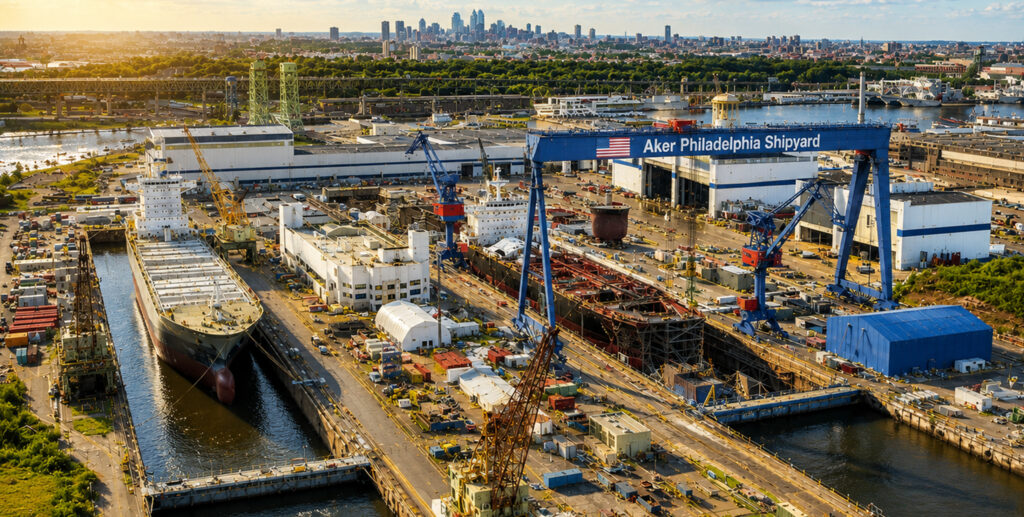
U.S. shipyards are experiencing something they haven’t seen in decades: real momentum. Orders are rising, foreign investment is flowing in, and long-dormant facilities are roaring back to life. But even as the industry shows signs of revival, a bigger question looms: Will Congress act fast enough to support the growth, or will America miss a once-in-a-generation chance to rebuild its maritime industrial base?
The clearest example of this resurgence is happening in Philadelphia. After South Korean shipbuilding giant Hanwha acquired the historic Philly Shipyard, the company pledged to invest billions of dollars into expanding the facility and dramatically scaling up its workforce. The shipyard is now so busy that it has more work than physical space to handle it, a problem U.S. shipbuilders haven’t had in decades. Recent reporting shows the yard is juggling government contracts alongside an order for a dozen tankers and LNG vessels, the largest commercial order in years. It’s a flashing neon sign that the economic potential of American shipbuilding is real and growing.
But the industry’s revival isn’t just about one shipyard. It’s about the enormous supply chain behind every vessel: steel, aluminum, engines, electrical cable, coatings, cranes, dry docks, and thousands of specialized components. If the U.S. can rebuild this ecosystem domestically, shipbuilding becomes a powerful engine for manufacturing growth. As the Alliance for American Manufacturing notes, the sector already supports major naval production, but a revitalized commercial shipbuilding industry would multiply demand, strengthen supply chains, and reduce the chronic delays and cost overruns that have plagued naval programs.
The challenge is that America is starting from far behind. Decades of offshoring and foreign subsidies have hollowed out the U.S. shipbuilding base. In the 1970s, American shipyards employed 180,000 workers and produced more than 70 oceangoing ships per year. Today, the country builds only a handful of commercial vessels annually, less than 1% of global output, and more than 20,500 domestic shipbuilding suppliers have disappeared. Meanwhile, China now dominates the global industry, producing hundreds of ships each year and controlling roughly two-thirds of future worldwide orders. The U.S. Navy estimates China’s shipbuilding capacity is 232 times greater than America’s.
That’s why advocates say Congress must act quickly. The bipartisan SHIPS for America Act aims to rebuild U.S. shipbuilding by directing fees collected from Chinese-built vessels into American shipyards, workforce development, and maritime infrastructure. The bill would also expand the U.S.-flag fleet, strengthen domestic supply chains, and incentivize commercial shipbuilding alongside naval production. Supporters argue it’s the only way to counter China’s unfair trade practices and restore America’s ability to build the ships it needs for both economic and national security.
Momentum is building. The SHIPS for America Act already has 94 cosponsors in the House, and labor unions, manufacturers, and national security experts are urging Congress to move it forward. But legislation moves slowly, and the shipbuilding opportunity is moving fast. If Congress delays, the U.S. risks losing the window created by rising demand, foreign investment, and renewed interest in domestic maritime production.
The stakes couldn’t be higher. A strong shipbuilding sector doesn’t just create jobs; it strengthens national security, reduces dependence on foreign shipyards, and ensures the U.S. can scale production in times of conflict. As the Alliance for American Manufacturing warns, failing to act now would have “catastrophic consequences for the security of our nation, the strength of our industrial base, and the livelihood of America’s workers.”
America’s shipyards are growing again. The question is whether Congress will seize the moment or miss the boat.
 Spotify
 Apple Podcasts
 Podbean
 YouTube
 Spotify
 Apple Podcasts
 Podbean
 YouTube