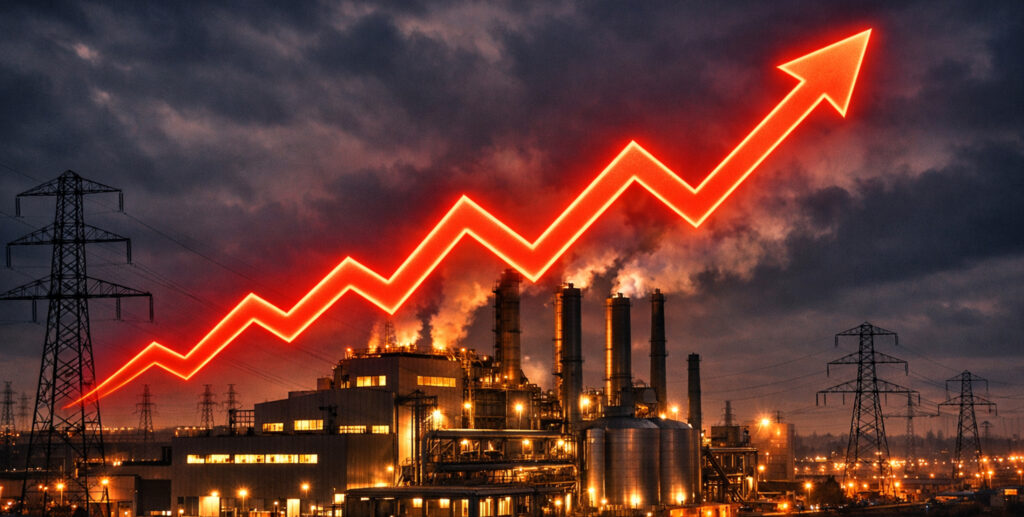
Manufacturers across the United States are waking up to a reality that’s no longer theoretical: the energy crisis isn’t coming, it’s already here. Electricity prices are rising, grid reliability is slipping, and demand from data centers, electrified transportation, and AI infrastructure is exploding faster than utilities can keep up. For manufacturers, this isn’t just a budgeting headache. It’s a strategic threat.
The warning signs have been building for months. The U.S. Energy Information Administration reports that industrial electricity prices have climbed nearly 20% since 2021, and several regions, especially the Midwest, Texas, and the Southeast, are facing projected capacity shortfalls as early as 2027. The North American Electric Reliability Corporation (NERC) has repeatedly cautioned that two-thirds of the country is at elevated risk of blackouts during peak demand. And with AI data centers expected to consume up to 9% of U.S. electricity by 2030, the strain is only intensifying.
That’s the backdrop behind the Manufacturing Dive analysis, which argues that manufacturers can’t afford to wait for the grid to stabilize. They need a plan now to manage rising costs, avoid downtime, and protect their operations from an increasingly unpredictable energy landscape.
The biggest challenge is volatility. Manufacturers are seeing wider swings in electricity pricing, especially those on variable-rate contracts. Natural gas markets remain sensitive to geopolitical shocks, including the ongoing instability in the Middle East and disruptions in the Strait of Hormuz. Meanwhile, utilities are struggling to build new generation fast enough to meet demand from hyperscale data centers, EV charging networks, and electrified industrial processes.
As one energy analyst put it, “Manufacturers are competing with AI for electricity, and AI is winning.”
But the crisis isn’t just about cost. It’s about reliability. Even brief outages can cripple production lines, damage equipment, and cost millions in lost output. The Department of Energy estimates that U.S. businesses lose $150 billion annually due to power interruptions. For manufacturers running continuous operations, a single hour of downtime can be catastrophic.
That’s why more companies are turning to on-site energy solutions. Solar installations, battery storage, microgrids, and combined heat-and-power systems are becoming essential tools for managing risk. According to Deloitte’s 2026 industrial energy survey, 62% of manufacturers plan to increase investment in on-site generation within the next two years. Many are also renegotiating utility contracts, adopting demand-response programs, and deploying energy-management software to monitor usage in real time.
The shift isn’t just defensive, it’s strategic. Companies that control their energy supply gain a competitive edge. They can stabilize costs, reduce emissions, and ensure production continues even when the grid falters. Some are even selling excess power back to utilities or using stored energy to offset peak pricing.
And the urgency is growing. The International Energy Agency warns that global electricity demand from data centers alone could double by 2026, driven largely by AI workloads. In the U.S., states like Virginia, Georgia, and Ohio are already experiencing delays in connecting new industrial facilities to the grid because utilities simply don’t have the capacity.
Manufacturers that wait for the grid to catch up may find themselves stuck, unable to expand, unable to control costs, and unable to guarantee uptime.
The message from energy experts is clear: the crisis is here, and the companies that act now will be the ones that stay competitive. As one industry leader told Manufacturing Dive, “Energy is no longer a utility bill. It’s a strategic asset.”
Manufacturers who treat it that way with planning, investment, and urgency will be the ones who thrive in the next decade of industrial growth.
 Spotify
 Apple Podcasts
 Podbean
 YouTube
 Spotify
 Apple Podcasts
 Podbean
 YouTube