TRANSCRIPT
Lewis A. Weiss (00:01.47)
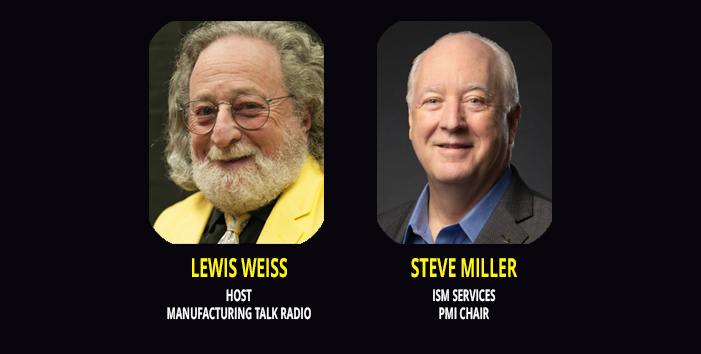
Good day everyone. This is Lew Weiss, which you knew already from Manufacturing Talk Radio. I’m here today with Steve Miller, who’s the committee chair for the ISM business services re committee and report. How’s that? It’s a good thing you don’t have to wear that across your t-shirt. everyone, I just wanted to let you know that if you like the show, please give us a like.
Steve Miller (00:19.854)
True.
Lewis A. Weiss (00:30.488)
And I just wanted to mention also that we’ve hit a milestone. we’re just about two and a half million views. not not bad for not being sixty minutes or Bloomberg. So we’re very pleased with that. So let’s keep those numbers moving up. Steve Miller, I’d like if you could, because I received a couple of emails within the last week or two.
Steve Miller (00:39.15)
Wow, that’s great.
Lewis A. Weiss (00:59.678)
from aud audience members who asked how does the ISM process the survey or how do you arrive at the numbers and statistics that fills up a nine page report. So if you could give us a a minute or two of that and then we can get to the report.
Steve Miller (01:18.382)
Sure, happy to. So the ISM organization has had the manufacturing report and the services report for quite some time. The services is still the baby. we started gathering data in ’97, so what, just about thirty years old now.
or just past thirty years old, actually. So what yes, yes, in terms of reporting, you know, the sub indexes we’ve done that. but in s in terms of the consolidated index, that was that just started at the beginning of ninety eight. So two more years for the for the everybody to, you know, light candles and celebrate.
Lewis A. Weiss (01:43.4)
Happy anniversary.
Steve Miller (02:03.148)
Celebrate 30. the what what they do is they go out to several hundred individuals that are all in supply management roles. So that’s one of the things that’s distinctive about the our survey is that we’re looking at actual business activity rather than forecasts of business activity. And we ask some very simple questions that allow people to disclose without violating confidential information. So they say this month versus last month.
across ten different indexes.
Is activity higher, the same, or lower than it was? are supplier deliveries faster, the same, or slower than they were last month? So we can do a month-over-month comparison of what’s happening in terms of the health of the services industry and the health of the manufacturing industry. in terms of survey respondents, so that we can see which ones are growing, which ones are shrinking for.
Each of the indexes. That information is all put together and provided to me on a monthly basis. I review the data, develop my conclusions based on that information, review that with several people in ISM to see if they see it differently or the same. We finalize the report and then we release that on a monthly basis at 10. Was it 10 a.m. Eastern Time on the third business day of each month?
Lewis A. Weiss (03:32.51)
Right. One of the things that I really like about both this report and the manufacturing report is the comments from responders. I find that that’s very insightful. it goes beyond the numbers, it it sort of gets involved with the emotionality of the individual who’s giving the information. So I find those comments really quite helpful. that said, let’s take it to the video.
as they used to say. good report. Let’s talk about it.
Steve Miller (04:04.047)
Okay.
Steve Miller (04:08.108)
Yeah, so the fifth month in a row that we’ve seen the twelve month average increase. so we’re at fifty-four point five this month. and so we’re we’re continuing to see a solid growth in the services industry or services sector. And we’re seeing that that growth rate increase over time. So after three years of seeing it drop year after year in terms of a twelve month average, we’re actually seeing
that increase. So very positive in terms of strength. We saw growth in new orders, we saw growth in business activity.
we saw continued expansion, which means slower supplier deliveries, but not at the same level as we saw last month. So a little bit of a surprise. We expected to see some of the petroleum related commodity limitations or shortages potentially impacting overall deliveries. We’re not.
Lewis A. Weiss (04:56.082)
Mm-hmm.
Steve Miller (05:10.768)
we’re not seeing that in that that index increase. And then employment was the big kind of disappointment. When you look at increased business activity and increased new orders, you’d hope that that would flow through to employment, like it did to inventory, where we saw a huge, a significant increase, the highest level we’ve been in the history of the of the industry. Sure.
Lewis A. Weiss (05:32.776)
Let’s talk about that just for a moment, about the inventories. I mean it was like a almost a nine and a half percent increase. Is that a good indicator of what’s coming down the road in terms of production and sales and so on?
Steve Miller (05:48.175)
So so short answer is yes, in that it’s we’re seeing or there’s confidence that demand will continue. are you seeing some glitching going on on my side with the video? Okay, good. I’m just gonna
Lewis A. Weiss (06:01.107)
Right.
Lewis A. Weiss (06:05.807)
yes, but it stopped.
Lewis A. Weiss (06:10.694)
It it’s back now it’s it’s good again. No, we lost your virtual background.
Steve Miller (06:17.692)
Okay.
Lewis A. Weiss (06:17.822)
Sorry, we could do without it if it’s a problem.
Steve Miller (06:23.419)
Okay. Let me just avoid the mess in the back.
Steve Miller (06:32.061)
Get up here and we’ll go from that and just hopefully that’s not too boring in the back for you.
Lewis A. Weiss (06:35.486)
But now you look like the proverbial talking head.
Steve Miller (06:40.083)
Very good. so so certainly the the inventory number shows two things. One is it shows we’ve got confidence that demand is going to continue. And I think looking back on the last twelve months, certainly a good a good sense for that. the other thing that that probably points to employment together with inventory is that we saw a lot of commentary that demand
for many industries is seasonality related. and so that that may give you reluctance to get more permanent resources like employees while still investing in inventory to be able to meet demand and work overtime and be able to do that. And Lew, I’d say the third piece is that we saw commentary last month that people were buying ahead to avoid price increases related to transportation.
Lewis A. Weiss (07:20.5)
Right.
Steve Miller (07:38.681)
And petroleum-related product price increases. And so we’re probably seeing those new orders come into inventory.
Lewis A. Weiss (07:40.585)
Right.
Lewis A. Weiss (07:44.827)
right, right.
The let’s talk about it the the tariff issue. Is that presenting much of an issue? I’m I’m reading some of your respondent comments and that seems to be of a of an ongoing concern.
Steve Miller (08:03.601)
Yeah, it is, but certainly not at the level now that’ll change that’ll change in June’s report after the ten percent, you know, announcement of the ten percent in tariffs across sixty countries that happened. It was either last night or this morning. but but much lower than it was and nothing close to what we’re seeing in terms of petroleum, gasoline, diesel transportation kind of cost increases.
And it wasn’t much of a you know, when you saw from April of last year through twenty twenty five, we really didn’t see a significant impact from tariffs, other than we saw the prices paid index go into the sixties and stay in the sixties all year.
Lewis A. Weiss (08:51.06)
Is that an indicator perhaps that the actual manufacturers or or service providers absorbed some of that tariff cost themselves?
Steve Miller (09:00.336)
Yes. Absolutely. And we saw that in our in our semi annual report. Is that that’s what many services companies were intending to do either over a six month period or permanently absorbing those?
Lewis A. Weiss (09:13.766)
Mm. Mm hmm by the way, I just wanna mention for our audience, J June twenty second, we’re having a a special show with you. You wanna tell us a little bit about that?
Steve Miller (09:25.478)
Yes. Yes. So twice a year we come out with a semi-annual supply chain forecast for manufacturing and for services. It releases on the seventeenth of June. And then on the twenty-second of June, we’ll be having some some social media activity to be able to talk about what we think the implications are going forward for the next twelve or the next six months, as well as looking back at the last six months, how did we actually
perform versus what we had forecast six months ago.
Lewis A. Weiss (09:59.252)
So everybody put that on your calendars, the seventeenth of June and the twenty second of June. And we’ll we’ll sure remind you about it also, ’cause th I found that those two events have been quite meaningful. Not only that, but your forecasting and prognosti prognosticating was pretty much on, except for a couple of surprises thrown out by Washington, DC. But
Steve Miller (10:24.595)
You know, it’s we find over and over again that supply management people really do have a good insight into what’s h happening in the in the activity within the business.
Lewis A. Weiss (10:31.198)
Yeah, yeah. It’s almost like you’re manipulating the system.
Steve Miller (10:37.811)
Well we listen well. I’ll say we listen well.
Lewis A. Weiss (10:41.556)
So to continue, Steve, I’m sorry.
Lewis A. Weiss (10:47.262)
So re regarding the imports, you know, there was a rather significant drop there.
Steve Miller (10:55.645)
Yeah, so still an expansion. I think four months in a row where we’ve seen export orders as well as import activity at a fifty or above. so still seeing good activity there, but significant drop. And Lew, I would I would attribute that to the or the same order ahead behavior that we heard about last month, is that we probably eased off on that a bit.
Lewis A. Weiss (10:58.898)
Mm-hmm.
Lewis A. Weiss (11:22.48)
Mm-hmm. Mm-hmm. So the pricing seems to be fairly consistent at the higher level month over month.
Steve Miller (11:31.675)
Unfortunately. Yes. Yes, unfortunately. And we saw the petroleum related products costs. they were talked about last month as we’re not seeing those come into the supply chain yet. And they hit the commodities up in price this month. So definitely seeing those flow through in addition to transportation and diesel and gasoline and fuel and energy.
Lewis A. Weiss (11:48.402)
Yeah.
Lewis A. Weiss (11:56.562)
In in view of what’s going on and all of that’s going on, what’s in short supply?
Steve Miller (12:03.811)
so it looks like a lot of data center related products. Data center related products. So we’re seeing memory components, we’re seeing computers and computer related, we’re seeing breakers. and then in in addition to seeing some of the tariff impacts for like high voltage switches and that type of thing, we’ve been seeing that over the last six months. but there was one concern raised that I thought was
Lewis A. Weiss (12:06.868)
Slotter what? Mm-hmm.
Steve Miller (12:33.651)
was important to add in in the commentary is that a wholesale industry respondent was saying they’re starting to see constraints on piping for for data center construction activity. So you know we’re we’re already hearing in the news utility related and more local politics related concerns around water impacts and
and energy usage and energy cost impacts related to data centers and AI, now we’re actually starting to see supply component shortages for that activity. So we’ll wait and see how significant that becomes. But what we don’t, you know, from from an economic standpoint, what we don’t need to see is is any type of depression of that activity, because it seems to be it seems to be the wind under the wings of the economy at the moment.
Lewis A. Weiss (13:31.262)
I think the water issue, which no one’s really talking much about, at least not in the mainstream news, but I think water is going to become a significant issue coming, you know, down the road.
Steve Miller (13:48.881)
Yeah, it’s it’s a you know it’s very complicated s situation on the the local data center activity. It doesn’t seem like they’ve worked out all of the impacts and how to manage that. You go to a company like Intel, Intel’s impact in local communities is they actually improve and increase clean water availability because they make that a core part of their strategy is where they go. They’re gonna clean dirty water and then they’re gonna release clean water into the local community.
so hopefully we’ll see more of that type of environmental and social responsibility or or economic responsibility. Yeah.
Lewis A. Weiss (14:21.748)
Yeah.
Lewis A. Weiss (14:25.854)
Yeah. I hope that works out. We find out sometimes after the fact that oops, it didn’t quite work out the way we thought. But one can only hope. Steve, I I I know you’ve got a hard stop, so we’re gonna give you a moment to give us some last few comments, a conclusion, and if you wish to prognosticate a little bit, be my guest.
Steve Miller (14:35.741)
Yes.
Steve Miller (14:52.421)
Okay. Okay. That’s great. So so I think the services economy’s been very resilient and we’re seeing you know, we’re we recovered more than fifty percent of the drop last month in new orders, stayed in expansion territory all of the months, but but we’re back halfway to the 60 point six that we were two months ago. Very good sign from a new order perspective, in that that’s what really drives our activity.
Lewis A. Weiss (15:14.323)
Mm-hmm.
Steve Miller (15:21.293)
but what we’re also seeing is a drop in the number for the backlog of orders at the same time as we’re seeing weakness in employment. so keep your eyes open to maybe more commentary around AI and AI impact and whether that’s starting to creep into the employment numbers. because something is creating that productivity that’s having us okay not backfilling positions.
Okay, putting hiring freezes out there while we’re seeing increase in business activity and new orders. So overall message strong. I think we you and I joked about it before in the old the old quote of you know a recession is when your neighbor loses his job, a depression is when you lose yours. so fingers crossed that you know this is this what people are talking about is seasonality.
actually is is robust demand that we’ll see in Q three and then we’ll see those employment numbers follow. That would be good news.
Lewis A. Weiss (16:23.676)
Yeah, I’m glad that you refreshed and brought back that old joke about losing jobs because the young people who are listening never heard that joke before. So you’re like the new comedian. All right, Steve, thank you very much. And perhaps next month we can touch on a little bit more about AI. we’re gonna be doing a whole series of AI episodes. So perhaps
Steve Miller (16:27.808)
That’s
Steve Miller (16:32.859)
Yeah, yeah, yeah. That’s true. Hey, you know, it’s I’ve got a I got a million of I got a million of
Lewis A. Weiss (16:52.51)
From your perspective we can talk about AI.
Steve Miller (16:56.286)
happy to. Yeah, I’d love to talk with you.
Lewis A. Weiss (16:58.032)
Okay. Thank you all. And don’t forget hit that like button. And if you don’t like the show, let us know and we’ll fix it. Or we’ll have you on to tell us why you don’t like the show. But we know you like the show. You love us. Thanks all. Till next time.
 Spotify
 Apple Podcasts
 Podbean
 YouTube