
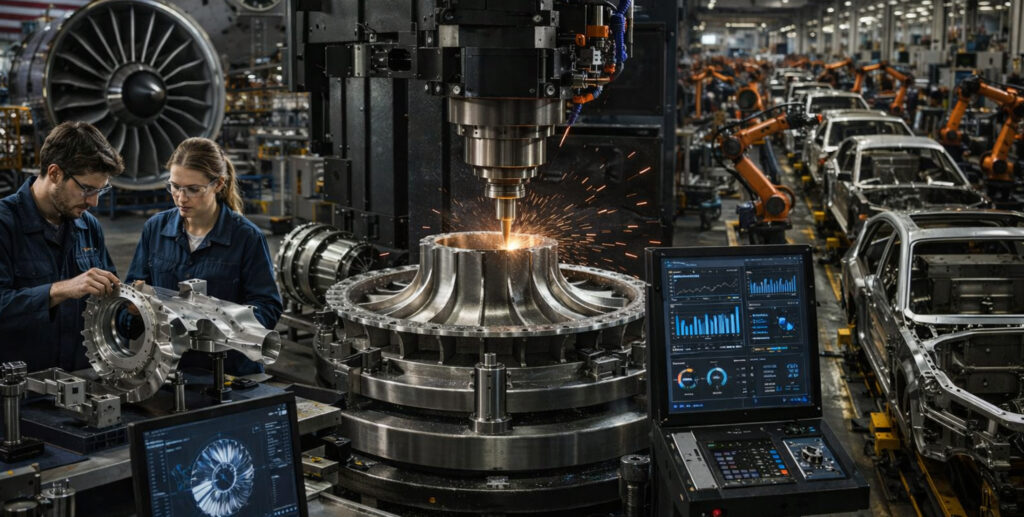
April 2026 U.S. machine tool orders rose again, continuing a multi-month growth trend driven by aerospace, automotive, and reshoring-related investment. The latest USMTO report shows manufacturers increasing capital spending despite economic uncertainty, signaling sustained demand for precision machining capacity across the industrial base.
Why Machine Tool Demand Is Rising
The U.S. Machine Tool Orders (USMTO) report shows a clear pattern: manufacturers are still investing heavily in production equipment. Aerospace suppliers are expanding capacity to meet the rising demand for commercial aircraft and defense programs. Automotive manufacturers, especially EV and hybrid producers, continue retooling plants. And reshoring efforts are pushing more companies to bring machining work back to the U.S.
Even with interest rates elevated, companies are prioritizing productivity, automation, and precision machining to stay competitive. Machine tools remain the backbone of that investment.
Key Data from the April 2026 USMTO Report
According to the American Machinist summary of the USMTO data:
- April 2026 machine tool orders increased compared to the previous month.
- The growth continues a multi-month upward trend in capital equipment spending.
- Demand is strongest in aerospace, automotive, medical devices, and energy.
- Regions with the largest gains include the Midwest, Southeast, and West Coast, reflecting strong manufacturing activity clusters.
- High-precision turning, milling, and multi-axis machining centers remain the most in-demand categories.
The report also notes that order activity is being supported by long-term backlogs, supply chain stabilization, and increased confidence among OEMs and Tier-1 suppliers.
Economic Factors Driving the Trend
Several macro-forces are sustaining machine tool demand:
- Aerospace Production Surge
Boeing, Airbus suppliers, and defense contractors continue expanding machining capacity to meet multi-year order backlogs.
- Automotive Electrification
EV, hybrid, and battery-related machining needs are driving new investments in flexible, high-precision equipment.
- Reshoring & Supply Chain Localization
Manufacturers are bringing machining work back to the U.S. to reduce risk and shorten lead times.
- Workforce Shortages Accelerating Automation
With skilled machinists in short supply, companies are investing in CNC automation, robotics, and advanced machine tools to maintain output.
- Capital Spending Momentum
Despite economic uncertainty, manufacturers are prioritizing equipment upgrades to improve throughput, quality, and efficiency.
What This Means for U.S. Manufacturing
Rising machine tool orders are a leading indicator of industrial health. When manufacturers buy equipment, it signals:
- Confidence in future demand
- Expansion of domestic production capacity
- Increased competitiveness of U.S. machining
- Strengthening supply chains
- Long-term investment in advanced manufacturing
If the trend continues, 2026 could become one of the strongest years for machine tool demand since before the pandemic.
Key Takeaways
- April 2026 USMTO data shows continued growth in machine tool orders.
- Aerospace, automotive, and reshoring are driving demand.
- Precision machining centers and multi-axis equipment remain top purchases.
- Manufacturers are investing despite economic uncertainty.
- Machine tool demand is a strong indicator of U.S. industrial expansion.
FAQ
What is the USMTO report?
The U.S. Manufacturing Technology Orders (USMTO) report tracks monthly machine tool orders and is a key indicator of manufacturing investment.
Why are machine tool orders rising in 2026?
Aerospace growth, EV retooling, reshoring, and automation needs are driving capital spending.
Which industries are buying the most machine tools?
Aerospace, automotive, medical devices, energy, and precision component manufacturers.
What does rising machine tool demand mean for the economy?
It signals strong industrial activity, increased production capacity, and long-term confidence in U.S. manufacturing.
 Spotify
 Apple Podcasts
 Podbean
 YouTube
 Spotify
 Apple Podcasts
 Podbean
 YouTube