TRANSCRIPT
Speaker 1 (00:00):
Welcome to Manufacturing Talk Radio, your everything manufacturing podcast with host and veteran
manufacturing industry expert Lewis Weiss and co-host Amy Nicklaus. Make sure to check out our
catalog of 800 previous shows on YouTube, Spotify, or wherever you’re listening. Now, let’s get into the
episode.
Speaker 2 (00:34):
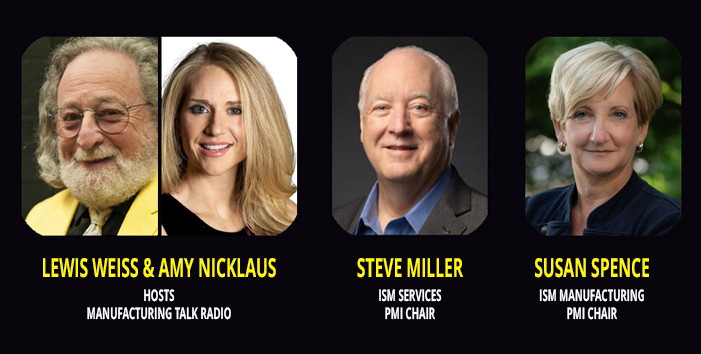
Welcome everyone today for the Manufacturing Talk radio with Lew Weiss, myself and Amy Nicklaus.
And we have the two chairs of the Institute for Supply Management, Susan Spence, who’s the
manufacturing chair, and Steve Miller who’s the services chair. And we’re going to be doing the, it used to
be called the semi-annual report. It’s now called the Supply Chain Planning Forecast. So just to give you a
clue on how the report is going to come across this report, okay, so that we don’t go over any trademark
infringements. Great report, great report. Susan. Let’s start with manufacturing or we’ll have a mix and
match with supply chain and manufacturing services go.
Speaker 3 (01:55):
Sure. So yeah, indeed, let the good times roll. The optimism that we started to see in December has been
surpassed with even more of the same from manufacturing. So as you could see in the report, the percent
increase our panelists expect to see with regards to things like revenue almost doubled. We’re up to
expecting an 8.5% jump in revenue versus four point a half. The production capacity that we thought that
this panelist told us would be up about 5.2 for the year. It’s looking more like 9.7, the operating rate,
likewise up to about 87 capital expenditure, not as big of an increase, but from a three to almost a five.
Unfortunately prices from December to June, the prediction was 5.4, they went up actually 11.9 and are
expected to be a total of 14.1 for the year. So it looks like most of the price increases that have been seen
are already here.
(03:07):
And maybe another couple points, the employment on manufacturing, it got better, but it’s still only a 1.4
up from a 0.4% predicted increase. So while we have maybe fewer industries in these increasing modes,
for instance, the percent of, I’m sorry, the number of industries reporting a percent of revenue increase in
December, it was 16, it’s down to 14. They’re about the same or slightly lower, but the percentage jumps
are bigger and a number of the top six are there. So indeed it’s a good report reflecting even more
optimism and certainly connected to the first five months of this year’s monthly report. The orders are
flowing, the backlogs growing on manufacturing as of last month, everything except employment was
back into expansion mode pretty much. So it’s all good.
Speaker 2 (04:04):
It is all good and we’re glad to hear that. By the way, for our listeners, if you enjoy the show and enjoy the
content, kindly hit the like button. It always looks good right
Speaker 4 (04:17):
Below,
Speaker 2 (04:19):
Below, right below, which is right next to my Let the good time roll button give us a thumbs up on that.
That being said, we also, we’d like to hear from Steve about services and near the end of our show we are
going to go over the six or seven or eight special questions, which they always do in this report. And
This transcript was exported on Jun 23, 2026 – view latest version here.
riverside_magic_episode 02_mtr_podcast (Completed 06/23/26)
Transcript by Rev.com
Page 2 of 14
some of that is some of the best information in the report, hearing it from the responders. So Steve, give
us a little bit on what’s going on with services.
Speaker 5 (05:01):
Sure, thank you. Thank you Lew. Also, good news services revenues are expected to increase 8.6%. That’s
almost double what we were saying in December. Operating rate is at 91.3% of normal capacity, which is
pretty hot. In fact, it’s the hottest it’s been at least going back to 2020. Not a whole lot of capacity
available for big orders coming through. In addition to what we’re currently handling, production capacity
is expected to increase 7.1% in 2026 and capital expenditures are expected to increase 6.4%. So sounds
like a lot of confidence in what we’ve got going on in the services industry. Prices paid similar to Susan’s
situation, prices paid are up 7.7% year to date through June with an overall expectation of hitting 8.9% for
all of 2026. So if there’s a little good news hidden in that as we’re only expecting additional price
increases for inbound materials, purchase goods and services to go up another 1.2% for the rest of the
year. And services employment similar to manufacturing is not huge, but is expected to increase and in
our case, less than 1% 0.9%, which is the average of what we’ve actually seen over the last three years. So
from a historical perspective, not a bad number, but people will probably be disappointed to see the 0.9%
versus something more than kin to four to five.
Speaker 2 (06:46):
So it seems as though with all of the not so great news that we hear in the news all the time, it doesn’t
seem as though that it’s had a major effect on economic aspects.
Speaker 3 (07:03):
Well, we were talking at the last interview about how resilient the consumer needs to be and Steve has
some good data on that that supports it. My concern though is the inflation and it is real and it’s tough
right now and it was tough before the Middle East conflict. It continues to be, although it’s calmed down a
little bit of late in manufacturing, but you know what? The economy is growing the employment number
and Steve’s and ours manufacturing is similar. It’s stubbornly flat and we think that businesses are still
being cautious not knowing what the next economic policy might mean for them. Although things are
more certain now, especially with the legal rulings that have happened of late, but it’s encouraging, but I
feel like some of that is pent up demand that if we can take care of the factors that are preventing people
and having them hold back, then we really could have something wonderful and not just hovering around
a 50 anyway for manufacturing.
Speaker 2 (08:21):
Why do you think that employment is flat? Because in manufacturing we’ve got something like 12 million
people in manufacturing and the number that I keep hearing is that what we really need is somewhere is
around 15 million and the economy is strong and everything is going up. Why is unemployment flat by
Speaker 3 (08:46):
The
Speaker 2 (08:47):
Manufacturing?
Speaker 3 (08:47):
This transcript was exported on Jun 23, 2026 – view latest version here.
riverside_magic_episode 02_mtr_podcast (Completed 06/23/26)
Transcript by Rev.com
Page 3 of 14
From my point of view and what the panelists have said, which is informing my point of view, last year it
was because there was such uncertainty in what was going to happen with tariffs and companies did not
know what was going to happen to the price of their cost of goods sold. And so in the face of uncertainty
that they might be faced with a 15, 20, 30, 40, whatever percent tariff, they basically stopped buying
capital and stopped hiring. And the uncertainty I think was worse than once. You know what a one-time
passthrough is going to be, you deal with it, but because it changed so many times from March all the
way up until it changed a lot between I think March and September and until we had the Supreme Court
ruling, folks were just loath to higher people and spend money because they’re sitting there waiting to
know if their raw material inputs were going to go up 20, 30, 40%.
Speaker 2 (09:59):
But later on in the report, and I’m sure we’re going to get to that, but later on in the report you talk about
the fact that manufacturers have not really raised their prices to their customers, that they’ve been
absorbing a lot of the tariff increases and they’re talking about not raising their prices going six months or
a year down the road. So if they’re so concerned, why aren’t they raising their prices?
Speaker 3 (10:29):
And we could get into the numbers of that later. Some of them are, a lot of them are not, and I think the
ones that are not, I can only speculate because I don’t have survey comments supporting this is if they feel
they can’t, right? It’s not the case with everybody, but in any that
Speaker 2 (10:51):
Companies don’t have a problem,
Speaker 3 (10:53):
I know seems to be anyway, and then as soon as terrorists settled down, we had the Middle East conflict
come up within a month of that and in some cases for some sex there’s just too much for them.
Speaker 4 (11:11):
Susan, you mentioned, we’ve talked about tariffs a few times here, but with the trade policy and tariffs, I
mean obviously they’re still looming, they’re still hanging over our head. We’re are manufacturers finding
workarounds for that? Are they still like a big wild card for what’s coming up? What is that?
Speaker 3 (11:29):
I think so, and what they’ve told us in the monthly surveys is up until January, February timeframe, they
just weren’t getting a lot of new orders. I remember one transportation equipment panelists saying
normally by now our customers would be replenishing the fleet. Now they’re doing only one or two
vehicles or whatever they can get away with to keep it to a minimum because they’re worried that they’re
going to order something and then tariffs go into effect. Or maybe there’s another new tariff policy that
they hadn’t anticipated and now they have to cancel orders. That was just one example. So there’s still
uncertainty around that. There’s less than there was, but as we’ve been saying today, the 150 day tariffs
that started within the same couple weeks of the Supreme Court ruling, I think we’re about to run out. I
think it’s July. And so there are investigations that are going on in order to I guess support these other
tariffs by now, I forget the section, I think it was 2 32 section tariffs, and so at least it feels like these
companies are saying at least it’s not 50, 60, 70%. It doesn’t seem to be. So maybe there’s more rules
around the type of tariffs that they could have because there is actually a section of the code that
addresses it and the Middle East effect certainly complicated, made it even worse. But as you could see
with the oil shock questions relatively short-lived in the meantime on manufacturing. And I want to give
This transcript was exported on Jun 23, 2026 – view latest version here.
riverside_magic_episode 02_mtr_podcast (Completed 06/23/26)
Transcript by Rev.com
Page 4 of 14
Steve some time to talk. There’s still, as of last month, 43 commodities as you guys know that we’re up in
price and a whole lot of shortages. So
Speaker 2 (13:22):
The US dollar, they’re predicting that the dollar is going to continue to strengthen. What kind of effect is
that going to have in terms of imports and exports and pricing in general?
Speaker 5 (13:43):
So one of the positive things in the services industry is that we’ve got a lot of the work around AI is going
on within the services industry. I think there isn’t really much of an option unless you’re going with China
produced open source models other than the US in terms of getting that type of capability.
(14:09):
So I think on a portion of the services world, it won’t be a problem from an export standpoint, from an
import standpoint, of course that works in our favor as the dollars get stronger and as our ability to pay for
them with oil prices dropping improves. That’s certainly some tailwinds for the overall services industry.
And going to one of the special questions that we’d be talking more about later, we saw some very
significant cost impacts. 55% of respondents said they see a small negative impact or effect from question
number five in rising oil prices and 25% were saying a large negative effect. So not only will we have
more cash as a result of those prices coming down, which we already see oil below $80 a barrel, but with
a strengthening US dollar, that certainly will work well for us from an import standpoint.
Speaker 2 (15:16):
It’s kind of interesting. This past weekend I was up in Connecticut with my family and the gas station
pricing, it was about a dollar a gallon cheaper in Connecticut, which is in itself amazing because
Connecticut tends to be more expensive, sort of like California, but it was a dollar a gallon less. I was
amazed. I was amazed.
Speaker 5 (15:42):
Yeah, it’s happening, happening fast. I’m not sure why because supply chains don’t work that fast, but it
was nice to free income down.
Speaker 3 (15:50):
I think traditionally, and this might be off, but from my days buying jet fuel at FedEx, it was about maybe
about six weeks after a published crude pricing before we saw a change in. Likewise, I went off to Europe
for vacation where I paid $8 a gallon, but I’m not complaining. I drove a hybrid and I didn’t have to fill up
much and then by the time I came back and within a week, it was just very different. And that’s perhaps
why, likewise Steve said 55% for services, 46% of the survey takers said small negative impact for
manufacturing as well. It’s relatively quick for that one to drop back. So that can impact transportation
costs certainly. And then there’s the other derivative costs, but aside from that, we still had, I don’t know,
25, 30 commodities that were up in price even before the Middle East conflict. So the inflation thing is
still a thing.
Speaker 2 (16:55):
Well, and some of it is what I’ve heard called opportunistic pricing, which is another word for gouging
Speaker 4 (17:04):
Price
This transcript was exported on Jun 23, 2026 – view latest version here.
riverside_magic_episode 02_mtr_podcast (Completed 06/23/26)
Transcript by Rev.com
Page 5 of 14
Speaker 2 (17:04):
Gouging. So that does exist, and I’ve actually been in a gas station recently where while I’m there, they’re
changing the prices. So I asked, do I get to pay the lower price or the higher price? He says, it depends on
how long it takes me to fill your car.
Speaker 5 (17:26):
Well, you’ll be happy to see that. Also in the survey, the pricing response to oil shock, the question was
our cost will not be affected or one of the answers was our cost will not be affected by the oil price shock,
but we plan to use it as an opportunity to raise prices. Correct. I saw 0% of manufacturers said yes to that
and 1% of services said yes to that. So it’s a good sign. I did
Speaker 2 (17:54):
See that.
Speaker 5 (17:55):
Whether they’re telling the truth or not, we don’t know, but
Speaker 2 (17:57):
Right. Very interesting. We
Speaker 4 (17:59):
Give, so let me ask you this. So one of the things Susan, we talked about was 82% of manufacturers
expect revenue growth, but 17% are still expecting declines, averaging that 12%. Can you give us a little
more insight into who those companies are and what separates the winners from the ones who are kind of
lagging behind?
Speaker 3 (18:21):
So we’re never going to tell you who the companies are because anonymous, but I can tell you who the
sectors are, right? And that’s in the report as well. So if you know who the 18 manufacturing sectors are,
14 of ’em expected increase in revenue, that means four did not, the four that did not expect an increase in
revenue. The four sectors, textile mills, apparel and leather products, wood products, all of that makes
sense. Petroleum is also in there and that’s one of the big six. So when I think of apparel, leather, wood
products, textile, it’s not all discretionary, but apparel might be if prices are going through the roof for
your basic household expenses, what’s the thing that you can maybe wait on, maybe apparel, that sort of
thing. But the good news is that 14 of ’em did expect to increase in revenue and that’s good. You could
argue maybe Petroleums had their increase in revenue, but it’s pretty short lived, right?
Speaker 2 (19:32):
I’d like to touch base about profit margins because kind of interesting, the profit margins, seemingly the
bulk of the people, the bulk of the manufacturer, the bulk of the services, they say that it’s going to be the
same or better. That’s about 70% of the marketplace. Meanwhile, costs have gone up. They’re not raising
prices because of things like oil and tariffs and so on, and yet they’re still looking at the coming this
second half of the year as increased profit margins.
Speaker 3 (20:09):
Why that makes sense to me. Look at employment, the employment is flat. So if you’re managing a
budget, so I’ve been retired for a few years, but my single biggest line item in my budget was people and
This transcript was exported on Jun 23, 2026 – view latest version here.
riverside_magic_episode 02_mtr_podcast (Completed 06/23/26)
Transcript by Rev.com
Page 6 of 14
sg a and benefits. So if I can do without backfilling and preserve that part of my budget, then my
contribution of the company is going to be not to cost more, right? So that’s a generic response, but it’s the
first thing I think about is where else can I save? Well, if I can do the work or if I have AI tools that can
do the work, we’re not there yet in manufacturing, then there’s a way to preserve the margin that way. You
agree, Steve?
Speaker 5 (20:58):
Totally,
Speaker 4 (20:59):
Totally.
Speaker 5 (21:00):
Because seeing 8% over 8% growth projections for revenue, we’re seeing a similar number, just slight
8.9% in prices paid, but that’s a very small percentage compared to labor in terms of our total cost of
operation. So if a labor is flat and we’re projecting 8.9% revenue growth or 8.6% revenue growth for
services, we will have a bunch of that in our profit margin. I think that profit margin, those dollars, the
free cash flow will be put back into capacity increases based on the way we’re seeing the numbers come
through in the reporting. Now whether that capital investment is for AI systems and compute power to be
able to run those or whether it’s something different buildings, retail outlets, things like that remains to be
seen, but I think I know where many are betting based on the special questions around ai.
Speaker 4 (22:02):
Yeah, it sounds like companies are kind of deciding to work a little bit smarter, not harder when they’re
seeing those lines show up in their reporting.
Speaker 5 (22:13):
Those capacity utilization numbers are continuing to go up, and so there’s not a lot of fluff left in that
number, so we either need to get productivity really, or we’re going to end up needing to hire people,
which wouldn’t be a bad answer.
Speaker 2 (22:29):
We have a lot more to go over in regards to this report. So the point is stick around and give us a like and
you’ll get to hear the seven or eight responses to the special questions, which are always very informative.
That said, Steve, I don’t want to get into specific numbers, but I can’t help but notice the prices in
restaurants. The prices in restaurants have gone up significantly. Not even to mention the fact that it
seems like everybody and their mother is now charging 3% and 4% and 5% if you use a credit card, that
certainly does help their profit margin.
Speaker 5 (23:14):
Yes, yes. In fact, a place that I ate at last week had a 3% cost of operations tax added on,
Speaker 2 (23:23):
So what happened before, why
Speaker 3 (23:25):
This transcript was exported on Jun 23, 2026 – view latest version here.
riverside_magic_episode 02_mtr_podcast (Completed 06/23/26)
Transcript by Rev.com
Page 7 of 14
They were eating the merchant fee, now they can’t anymore or opportunistically it. Remember when bag
fees became a thing that was supposed to be a temporary thing, and then I think airlines were like, well,
folks are used to it. Why would we get rid of this great revenue stream? And that was just a way of life. I
don’t know. That’s my guess.
Speaker 2 (23:48):
I managed to tell every restaurant manager how much I resent the three to 5% for credit card charges
considering of my 50 years of eating in restaurants. I never had that. Why now all of a sudden is that a
critical thing that they were all doing it and
Speaker 4 (24:07):
I’ve been there when he’s complained about it, I’ve been there if that’s pleasant. Love that. By the way,
Speaker 5 (24:15):
About six years ago, software started hitting the market where you could embed that into your bill as an
additional charge at restaurants. And so I think that helped drive it because before you couldn’t really add
it automatically and show it as a separate charge. The fuel surcharges certainly have had an impact on
now food in general delivered food higher and significant amount of inflation there. The fuel surcharges
that you would typically have from a fuel distributor coming into restaurants, that’s all going into your
menu pricing and be careful about going to those restaurants that have electronic tablets where they can
just raise it by changing the number in the panel. You’re going to see that come really fast.
Speaker 2 (25:05):
15, 20, 25, 30% or custom.
Speaker 5 (25:09):
That’s
Speaker 2 (25:10):
The new one.
Speaker 5 (25:10):
Yes.
Speaker 2 (25:14):
Going forward, the second half of 2026 looks even better than the first six months of this year. Any
thoughts on that?
Speaker 5 (25:26):
If we see the number that I mentioned just a little bit earlier, if we’re seeing 80% of services companies
seeing increased costs due to fuel search or fuel prices, that’s certainly some good tailwinds for the
industry going forward. I was surprised though, Lew, at just how positive the numbers were. The numbers
are so much better looking, so much better than what we were estimating as a discipline, a supply
management discipline back in December. It was a little bit surprising at how big the revenue increase
number was projected for 2026
This transcript was exported on Jun 23, 2026 – view latest version here.
riverside_magic_episode 02_mtr_podcast (Completed 06/23/26)
Transcript by Rev.com
Page 8 of 14
Speaker 2 (26:06):
Considering no one’s supposedly raising their prices. And this is your 95th year of producing these
reports. I think you started in 1931, accurate, so we got another five more years. Are we going to do
something special at a hundred years if we’re all around
Speaker 3 (26:31):
Retire
Speaker 5 (26:33):
Again?
Speaker 3 (26:33):
Again,
Speaker 5 (26:38):
Lew, back to one of the questions you’re talking about just in terms of the economy overall, and it was a
comment that Sue made earlier just in terms of some interesting data across the different areas, retail,
trade, construction, arts, entertainment and recreation, A combination of food services are all coming up
repeatedly as very positive on the list from top to bottom, the highest growth industries for increased
revenue. Well, so mining is there at the top in which is not a surprise,
(27:15):
But retail trade is number two for increased revenue, increased capacity, increased capital investment
above 91.3% of normal capacity but not, or sorry, but number one rather than number two in employment
growth. So very positive on that side of it. Arts, entertainment and recreation is in the top four for
increased capacity, increased capital investment and employment and wholesale trade is in the top 10 for
increased revenue, rank capacity, capital investment and employment. So we’re seeing, and the last one
was construction is number three in increased capacity, increased capital investment and increased
employment number two, so not on the list until or not on the list at all actually for increased revenue. So
they’re looking at driving additional business by building capacity and probably being more efficient in
how they produce, but all very directly impacting the general consumer in terms of income and behavior
in the market, which seems to be very positive and a little different than what we saw in December.
Speaker 2 (28:35):
So going further forward and letting the good times roll. Let’s talk about the special questions. The first
one being regarding ai, so which is high on the hit parade in terms of technology that we’re experiencing
in this country. So what did your question was? My supply chain organization use as the following
applications and that’s basically a yes or a no or a maybe or soon, and I was sort of surprised at some of
those numbers. Let’s talk about that.
Speaker 5 (29:16):
Yeah, so that one for services, 18% of respondents said they don’t use AI in their business. If you’ll
remember, not a year ago, less than a year ago, there was a lot of discussion around do you need a
governance system? You need to make sure you have appropriate terms and conditions, controls over
data, making sure you’re not violating IP or giving away trade secrets or things like that through your
tools to now 82% are using some form of AI within their business. That’s a really positive message for
people in the AI field as well as hopefully a positive message for the kind of impact that we may be able
to see in terms of productivity and profitability in business.
This transcript was exported on Jun 23, 2026 – view latest version here.
riverside_magic_episode 02_mtr_podcast (Completed 06/23/26)
Transcript by Rev.com
Page 9 of 14
Speaker 2 (30:04):
Well, what I find interesting is that those who are using it or about to use it, the numbers are really small.
Susan manufacturing,
Speaker 3 (30:17):
I don’t, numbers aren’t
Speaker 2 (30:18):
Great.
Speaker 3 (30:20):
They’re a lot better than they were. So if we’re talking about, let me make sure we’re on the same
question. I’m on question number eight. I think that’s the one you’re talking about. Back in December
manufacturing, 32% of our survey panelists we’re not using anything that’s down to 18. So over half now
are using some kind of AI chat bot agents. That’s a pretty big leap. A number of folks were talking about
it and they were studying it and in the pipeline and now some have been rolled out. What we don’t know
is that back office type of work that the chat bots and agents are using or hard manufacturing. I imagine
it’s the former
Speaker 5 (31:09):
Or just extra emails which are now longer because they were generated by chat. Exactly.
Speaker 3 (31:15):
It’s true because someone could say, okay, I’m taking the suggestion of a summary email. I mean I’ve
started to do that too. It’s like this just says it all. It’s pretty good. Hopefully remember back in college or
high school, the cliff notes and you try to get away with not reading the book.
Speaker 2 (31:32):
Yeah,
Speaker 3 (31:34):
So you just want to be able to get the content anyway on manufacturing is not as far as long as services,
although the numbers are pretty similar, but relative to December, so smartly companies are studying it,
maybe they’re going a little slower with the rollout and hopefully being careful, make sure it works before
they deploy. We’ve all heard the nightmares
Speaker 2 (31:59):
Question number three regarding the change in quality of work in regards to ai and the question was how
is the quality of work or lack of errors, vera’s change with AI use? And some of those numbers are rather
surprising. There’s some that are the same, 32% in manufacturing, 27% in services and the NA is like 50,
40% and 50%. So it is almost like it’s not yet fully being utilized. Any comment on that Susan?
Speaker 3 (32:43):
I want to make sure we’re on the right question. We have a different question number three. So make sure
we’re on the June, 2026 report, not the December. I’ve got both in front of me, so I’ll take it.
This transcript was exported on Jun 23, 2026 – view latest version here.
riverside_magic_episode 02_mtr_podcast (Completed 06/23/26)
Transcript by Rev.com
Page 10 of 14
Speaker 2 (32:56):
The question is how has the quality of work or errors changed with ai? So irrespective of what number
that is.
Speaker 3 (33:08):
Yeah, so Lew, you’re looking at the December forecast right
Speaker 5 (33:16):
From the December? Yeah,
Speaker 3 (33:17):
That’s the question number three is from the December forecast. So the one in June, the AI questions just
real quick, the questions on AI this time were which of the following AI tools are you using? And that
was the choices were we don’t use it at all. We use AI agents, we use AI chatbots. And then there was a
question before that, what has been the overall effect of AI on your employment?
Speaker 2 (33:52):
Right,
Speaker 3 (33:53):
So last time we put AI questions out for the first time, that was great and now they’re different questions.
So the ones Steve and I are talking to are the AI chat bots and agents. You’re right though, in December,
manufacturing wasn’t doing a ton and now over 50% of them are doing something. So that’s pretty
impressive in my opinion. But you’re right, it was 32% in December was doing nothing. That’s down to
18. Right?
Speaker 2 (34:21):
I agree. I agree. There is a significant change, the timing of tariffs in order to raise prices. That was a
number six question I believe. Is that correct?
Speaker 3 (34:38):
That was response to oil price shock,
Speaker 2 (34:40):
Right?
Speaker 3 (34:41):
Yeah. Not tariffs but the oil price shock. Are you changing your selling prices in response to that? And
that was an interesting response on the manufacturing side. 60% of our survey panelists said we’re going
to pass all or some, it took a little while, it’s like no, we’re not, we’re we’re going to try to eat it. But this
one was like, it’s almost like it’s too much on top of everything else.
Speaker 2 (35:10):
There seems to be a fair amount of reluctance about raising prices as a result of tariffs and considering
there’s a strong reluctance and the fact that revenue has increased and profitability has increased, where
the numbers coming from, I guess it has a lot to do with flat employment.
This transcript was exported on Jun 23, 2026 – view latest version here.
riverside_magic_episode 02_mtr_podcast (Completed 06/23/26)
Transcript by Rev.com
Page 11 of 14
Speaker 3 (35:35):
Yeah, well so if you look, and Steve needs to answer this for himself, of course that question which is
question number two back in May and that was what we were in month two or three of tariff chaos and
people couldn’t believe what they were seeing. It was a total of 87% said we’re going to pass on summer
all it’s still like 72% are saying they’re going to, but a lot’s happened in a year, right?
Speaker 5 (36:13):
We’re seeing inflation creep up just a little bit. And many companies aren’t raising prices because of
tariffs. They’re raising prices because they want to raise prices, they want to generate more income,
Speaker 3 (36:25):
They have to. Yeah. So
Speaker 5 (36:28):
Tars for services companies are a small percentage of a small percentage. Really it’s
Speaker 2 (36:37):
A credit card charge that annoys
Speaker 5 (36:40):
You. Got it. Why? Because can,
Speaker 2 (36:43):
By the way, I want to mention that at the end here, for anyone who wants to be able to see the report or
print out the report, you can click on it and you can come to download the report if you wish. And like I
said, you can print on both sides that way it’s only 10 pages instead of 21. That’s right. Okay, so moving
on, pick your own poison with regards to the questions because mine are not in sync with yours.
Speaker 5 (37:20):
So one that I thought was interesting, just looking at the monthly ISM services report compared to the
supply chain forecast, it was looking at inventory stocking strategies. Only 10% of services companies
said we’re requiring higher levels of inventory as a result of global tariff uncertainty. But when you look
at our monthly report, we’re at the highest inventories number, survey number in the history of the survey.
So somebody’s putting in higher inventories for some reason. Maybe it’s not tariffs, maybe it’s oil price
protection to get ahead of any flow through of transportation costs or petroleum related products. But that
one for me was very interesting and the special questions looking at that versus what’s really happening
around inventories and the sentiment saying, you know what, a 62.5 isn’t a bad number because we
ordered all this stuff to make sure we’d have it and price
Speaker 3 (38:26):
And likewise manufacturing, if you look at that same question, which is topic number one, the flip was in
May, which was again month two or three of the tariff saga lower levels of inventory, not many 17%.
Well now it’s 49% we’re just not stocking those high price goods and they couldn’t afford to. But now that
they’re seeing order flow, our inventory number likewise is up, but they’re seeing order flow. And so
perhaps these companies are pricing their finished product hire to absorb that if that’s in fact what their
policy is. Yeah.
This transcript was exported on Jun 23, 2026 – view latest version here.
riverside_magic_episode 02_mtr_podcast (Completed 06/23/26)
Transcript by Rev.com
Page 12 of 14
Speaker 2 (39:08):
The question regarding reshoring I found to be rather interesting in the numbers of people who are not
necessarily looking at changing their vendors, they are looking to change perhaps countries that they’re
buying from, but actually that whole could be filled by instituting tariffs on everybody.
Speaker 5 (39:33):
Yes.
Speaker 2 (39:34):
The point is that it seems as though between 60 and 80% of companies are not looking to change their
vendors
Speaker 3 (39:42):
And the manufacturing panelists have been telling us for sure last May and June, you have to look at it. It
would be irresponsible not to. But by the fall largely it’s like it doesn’t make sense. We’re not coming back
to the us, it’s still cheaper to go overseas even though it’s not as cheap as it used to be. And so the message
was the economic policies have not resulted in this big reassuring effort. And that’s not just because our
survey respondents say, so there’s lots of articles. I know I’ve read, you guys probably have too to say it
hasn’t resulted in it. And these survey back in May of 2025, yes, we’re actively looking and reshoring was
27% looking, but only 15% are looking at it now. So they’ve looked, they’ve studied, it’s like it makes no
sense
Speaker 2 (40:40):
And no one’s really talking much about it, but I’ve been kind of tuned into it about the import logistics.
The cost of shipping goods by Ocean has gone up significantly and they’re still not looking necessarily to
Reshore.
Speaker 3 (41:01):
So when COVID happened and you couldn’t get a shipping container, oh my gosh, I remember just
looking at a shipping container company that was going to try to start up in Memphis, Tennessee, and a
shipping container’s not a very complex product, it’s welded metal, they couldn’t make it work. They
couldn’t hit the price point of China. Even with the doubling a shipping container price and how long you
had to wait, they still couldn’t touch them. Not surprised about that.
Speaker 2 (41:35):
Well, all in all, we’re letting the good times roll and I want to thank Shirley and Lee for that song. And
then Ray Charles of course made it famous at the end of the fifties, and I’m not, Amy, I’m not going to
play it again. I don’t want to break any trademark rules and regulations.
Speaker 4 (41:55):
Thank
Speaker 2 (41:56):
You. Do we have any final comments, Steve?
Speaker 5 (42:03):
This transcript was exported on Jun 23, 2026 – view latest version here.
riverside_magic_episode 02_mtr_podcast (Completed 06/23/26)
Transcript by Rev.com
Page 13 of 14
I’d say that we talked about chatbots and using AI for anybody who’s good at chatbots, get all the emails
and phone numbers of the suppliers who came to you and gave you fuel surcharge, price increases and be
ready to run that bot to send it all back to ’em saying, give me my new rate card because oil’s back under
$80 a barrel.
Speaker 2 (42:26):
Right? Right. Yeah. Susan,
Speaker 3 (42:31):
I like the report. It makes me feel better about the month to month optimism we’re seeing and hopefully
we’re going to accelerate the expansion with reasonable economic policy. C folks just have to listen to the
people on the frontline, these purchasing managers, they know what’s going on because they’re living
every day. So please pay attention and believe folks when they tell you this is what’s driving them or not
expect
Speaker 4 (43:03):
Based on one last question for you. Just from the consumer standpoint, for the everyday person, maybe
someone who’s not working within manufacturing, what does this report, I mean it’s great hearing all of
this positive feedback, but as a consumer, what do you think we should be expecting or looking for based
on what you guys are talking about and how that’s going to affect manufacturing?
Speaker 5 (43:30):
Yeah, two things for services anyway, two things that I’d expect. One, you’re going to see gas prices come
down to a more normal level where they were probably the end of last year. And the second piece is don’t
expect to see prices for goods and services to go up in the second half of the year the way they might have
in the first half of the year if they do go to a different service provider or seller. Because the survey
information that we have is one to 2% between now and the end of the year,
Speaker 3 (44:03):
But not going back down either except for oil, which that one goes up the quickest and did back down the
quickest, thankfully, because it’s very shocking, those numbers. But the price increases are, we’re still at
82% for a subindex. So buckle up
Speaker 2 (44:24):
To Amy’s point about the everyday consumer, all of this news that we’re putting out there is all positive,
positive, positive, but yet the housewife going shopping, she’s spending more, the gas is costing more.
Even though the gallon, the barrel priced now down to $80 instead of 115, they still have to deal with this
issue.
Speaker 4 (44:52):
Well, it’s a part-time housewife myself, I like Steve’s answer the best. So we’re going to go with that
where we’re leveling out not to expect too much more and gas prices should go down, so I’ll take that.
Speaker 2 (45:06):
Okay. And again, folks, if you like the show, you can print out the report yourself, just hit the button and
you can get to the report and print it out. And thank everybody for being here. Great report. Let’s keep the
This transcript was exported on Jun 23, 2026 – view latest version here.
riverside_magic_episode 02_mtr_podcast (Completed 06/23/26)
Transcript by Rev.com
Page 14 of 14
good times rolling. A good time to roll. I may wind up listening to that in the car going on tonight. I love
it.
Speaker 3 (45:33):
Thank you so much, folks. Appreciate the attention. Thank you.
Speaker 2 (45:36):
Thank
Speaker 4 (45:36):
You.
Speaker 2 (45:37):
Thank you all. Take care. Bye bye.
Speaker 1 (45:54):
Thanks again for joining us on another episode of Manufacturing Talk Radio with hosts Lewis Weiss and
Amy Nicklaus. Before you head out, make sure to subscribe and leave us a review. For more information
about the show and the manufacturing industry, head over to mfg talk radio.com. That’s M-F-G-T-A-L-KR-
A-D-I o.com.
 Spotify
 Apple Podcasts
 Podbean
 YouTube
 Spotify
 Apple Podcasts
 Podbean
 YouTube