
Summary
CEOs report that U.S. supply chains in 2026 are more stable than during the pandemic era, but still strained by labor shortages, geopolitical uncertainty, rising costs, and persistent bottlenecks in transportation and materials. Companies are accelerating reshoring, diversifying suppliers, and investing heavily in technology to build long-term resilience.
Why Supply Chain Stability Still Feels Fragile in 2026
Chief Executive’s analysis shows that while the chaos of 2020–2022 has eased, executives remain cautious. The biggest drivers of instability include:
- Ongoing labor shortages in logistics, trucking, and manufacturing
- Geopolitical tensions affecting global sourcing
- Higher transportation and materials costs
- Unpredictable demand cycles
- Pressure to shorten lead times and improve reliability
CEOs say the supply chain is “better, but not back,” and that volatility is now a permanent operating condition.
Reshoring and Nearshoring Continue to Accelerate
Executives report a major shift toward regionalized supply chains, driven by:
- Rising overseas labor and shipping costs
- Tariff exposure and trade uncertainty
- The need for faster delivery cycles
- Federal incentives for domestic manufacturing
- Customer expectations for U.S.-made products
Companies are expanding operations in the U.S., Mexico, and Canada to reduce risk and improve responsiveness.
Technology Is Becoming the Backbone of Supply Chain Resilience
CEOs highlight rapid adoption of:
- AI-powered forecasting
- Real-time visibility platforms
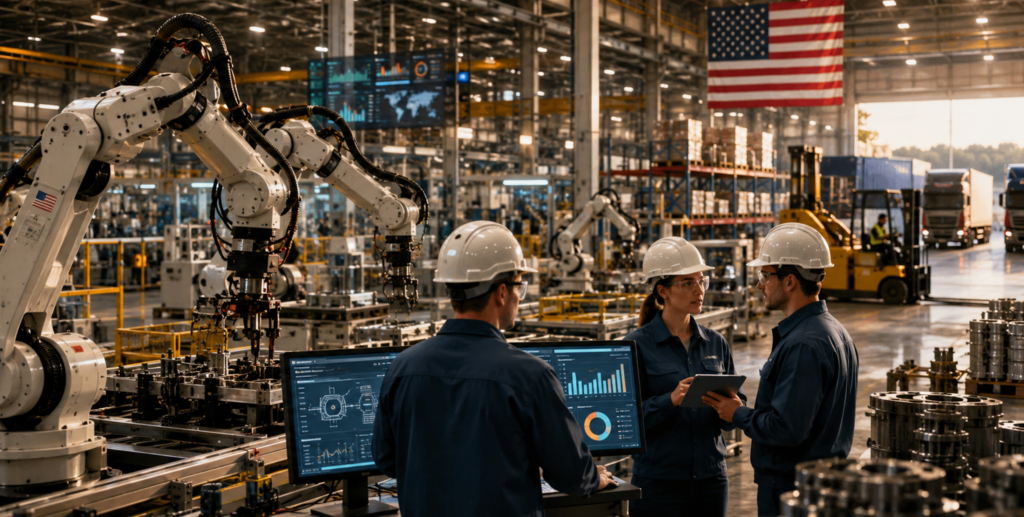
- Automation in warehousing and manufacturing
- Digital twins for scenario planning
- Advanced analytics for supplier risk scoring
These tools help companies anticipate disruptions, optimize inventory, and make faster decisions.
Labor Shortages Remain a Critical Constraint
Despite cooling down in some sectors, CEOs say labor shortages continue to limit capacity:
- Truck drivers
- Skilled trades
- Maintenance technicians
- Warehouse operators
- Manufacturing specialists
Companies are increasing wages, expanding training programs, and investing in automation to offset workforce gaps.
Geopolitical Risk Is Reshaping Sourcing Strategies
Executives cite rising concerns around:
- China-U.S. trade tensions
- Conflicts affecting shipping routes
- Semiconductor and critical-minerals dependency
- Cybersecurity threats targeting supply chains
Many companies are diversifying suppliers and building multi-country sourcing strategies to reduce exposure.
Transportation Costs and Delays Are Still Elevated
CEOs report that:
- Freight costs remain above pre-pandemic levels
- Port congestion has improved but not normalized
- Trucking capacity is inconsistent
- Lead times for specialty materials remain long
Companies are renegotiating contracts, shifting modes, and building more inventory to buffer delays.
What CEOs Are Prioritizing for 2026 and Beyond
- Regional Manufacturing Footprints
More production in the U.S., Mexico, and Canada.
- Supplier Diversification
No more single-country dependency.
- Technology-Driven Visibility
Real-time data is becoming mandatory.
- Workforce Development
Training, automation, and retention programs.
- Risk-Adjusted Inventory Strategies
More strategic stockpiling and safety-stock planning.
Key Takeaways
- Supply chains are more stable than during the pandemic, but still fragile.
- CEOs are accelerating reshoring and supplier diversification.
- Technology is now central to supply-chain resilience.
- Labor shortages continue to constrain capacity.
- Geopolitical risk and elevated transportation costs remain major concerns.
- Companies are building regional, tech-enabled, multi-supplier networks for long-term stability.
FAQ
Are supply chains fully recovered?
No — they are improved but still strained by labor shortages, costs, and geopolitical risk.
Why are companies reshoring?
To reduce risk, shorten lead times, and strengthen domestic production.
What technologies matter most?
AI forecasting, automation, digital twins, and real-time visibility platforms.
What is the biggest ongoing challenge?
Labor shortages across logistics and manufacturing.
 Spotify
 Apple Podcasts
 Podbean
 YouTube
 Spotify
 Apple Podcasts
 Podbean
 YouTube