TRANSCRIPT
Lewis A. Weiss (00:02.07)
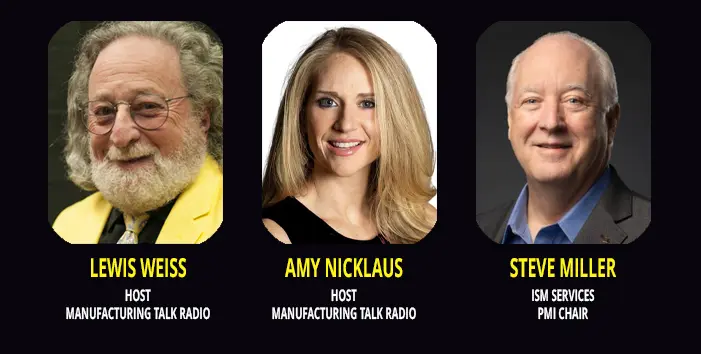
Morning, everyone. This is Lew Weiss with Manufacturing Talk Radio with Amy Nicklaus, my co-host, and Steve Miller, the committee chair for the ISM services sector report. I’ll get the name of that report correct one of these days. probably, probably. So welcome aboard, Steve. and w great report. You’re doing a great job. Doing a great job.
Steve Miller (00:19.723)
Then we’ll change it.
Lewis A. Weiss (00:32.248)
Let’s talk.
Steve Miller (00:33.393)
Okay. Yeah. So so one couple of concerning numbers, but in an overall, you know, overall painted picture of some really solid numbers. You look at business activity new orders, really, really healthy, good multi-year highs, good good numbers. you look at the trend of the ISM services PMI, we’ve on been on a consistent upward trend since the beginning of the year. The twelve month trailing average has increased.
from January through through August. it continues to trend upward, which is a really positive sign. what’s not keeping up is employment. and my best window or or magnifying glass into that is that prices paid continued to be elevated. And when you’re running a services business and your cost of operations are up, you know services rely a lot on people. And
And what we’re seeing in the commentary is that companies are delaying hiring for backfills. We’re not seeing significant employment reductions. we’re seeing delays in hiring. So, so some companies are seeing lower employment this month versus last month because they’ve had some attrition and now they need to backfill. And you know what? We’re trying to manage our operating income. And the way we do that is slow down rehiring by a little bit.
That makes up the gap that we have in our prices paid. and then everybody everybody smiles. the little thing out out in the wings though, in the window, is backlog of orders. And backlog of orders has been significantly higher this year than it was last year. and we saw a jump this month while we’re seeing strong orders. So really good report, good overall PMI number, healthy businesses overall.
but you see construction, you see agriculture, not at all strong.
Lewis A. Weiss (02:36.133)
unlike manufacturing, the month of August tends to be a little bit on the slower side because of the summer vacations and so on. and I I’ve seen over the over the decades that September, October, November seem to be the a significant boost in business, particularly manufacturing. Does that work the same in the surfaces area?
Steve Miller (03:04.545)
Yeah, well when you see a combination in food services and and arts and entertainment, those are ones that in in the services sector get a boost during the summertime. Construction as well. So you saw construction and expansion where I think people were betting on the cum of having lower lower mortgage rates. the building, because summertime is a good time to build, that’s when people move, you know, to go into new houses, new schools, things like that.
Lewis A. Weiss (03:29.262)
Mm-hmm.
Steve Miller (03:32.89)
but we didn’t see the sales activity this summer. So construction typically strong summer, education typically weak because that’s when people are generally not in school, particularly university level, as well as you know, across the board for anybody that’s that’s not got year-round schooling. so we’re seeing some seasonal improvements or in in some areas that was called out for August, and then we’re seeing some seasonal trends.
to improvement in September as well with education. And then you’ve got the backdrop of data centers and utilities, which are continuing to be very strong, keeping that, keeping that minimum level up and then building on top.
Lewis A. Weiss (04:18.361)
Whatever it is, it’s working.
Steve Miller (04:20.211)
It is. It is. Fingers crossed, right?
Lewis A. Weiss (04:24.647)
I noticed in the respondent comments there’s not too much in way there are some, but not too much in the way of tariff and war conflicts and so on. is that not a major factor?
Steve Miller (04:41.899)
So it isn’t as pronounced as it as it was when you know back months ago where it was the talk of the town, even though there’s still activity going on in Terrace. It was, however, the conflict of the Middle East and Terrace were the two most frequently commented on areas in the comments coming from the respondents. So I it isn’t that it’s not an issue. I think that it’s it’s just
You know, we get less comments when things are going well and things in the services sector are going well.
Lewis A. Weiss (05:14.733)
Yeah, yeah. does the Canadian tariff trade war thing have a significant impact on the services?
Steve Miller (05:27.385)
in in accommodation and food services where we’re seeing that impact on on food costs as well as the construction side and then also wholesale where construction materials, particularly wood, and then the third area we see is agriculture where we’re seeing that be a significant impact. so
those those food ingredients that go into food products that are being purchased where you see a fifty percent tariff increase in some areas, certainly impacting impacting companies. You know the other one is the is the three one tariffs coupled also with the forced labor tariffs additively being a a strong a strong impact on importers.
Lewis A. Weiss (06:19.161)
I think the Canadian tariffs which goes into effect in a couple of days from now, September eighth, those that effect is not in these numbers yet. but they could wind up being there in your September numbers.
Steve Miller (06:37.225)
Yeah, it’ll you know, and and the c the time to contract also has you know has an impact. Are people getting ahead of it and doing preemptive price increases? or are we saying, okay, now our contract doesn’t expire until December, so sorry, your problem, you know, from a from a tariff impact standpoint. those that are in a a hot market, like in steel, areas where we’re already seeing shortages.
they say, Okay, well then we just won’t sell to you anymore. but in areas where there’s a lot of competition and supply, it’ll be a you know, it’ll be a discussion again. I think September we’ll see a little bit of flow through and depending on how long it lasts, we’ll see it go later in the year. We’ll start seeing that that come through. With certainty, petroleum related products is gonna be a a a continued pressure on prices paid at least into Q one.
Lewis A. Weiss (07:37.082)
I think one of the major impacts is going to be not in the services but in the manufacturing side, where we sell to Canada sixty thousand cars. And China has now taken a lead to potentially to take advantage of that. They now have five major vehicles, E V vehicles, which are now selling to Canada. so we may we may wind up losing that market altogether.
Steve Miller (08:07.355)
what’s the old saying? it’s all fun and games until somebody loses an eye. you know, if there’s somebody out there, that happens all the time in business, right? There’s somebody out there that can take advantage of another negative situation, they go for it. And boy production’s there, styling is great, reliability and ability to service and support, not so much there yet, but it it certainly
Lewis A. Weiss (08:12.077)
Right. Right.
Steve Miller (08:36.403)
something that is gonna negatively impact car manufacturers, either a little bit or a lot, you know, remains to be seen. But yeah, that that would be and and you know and then warehouse or sorry, wholesale trade, retail trade, and transportation and warehousing are all in the services sector. So if it impacts the automotive industry, it’ll impact services sector as well.
Lewis A. Weiss (09:01.177)
Sure, sure. So let’s talk about some of the respondent comments.
Lewis A. Weiss (09:12.001)
You got any favorites there, Steve?
Steve Miller (09:14.803)
you know, I tried to just I tried to just highlight that we’re seeing continued strength in business. We’re seeing some concern over tariffs and and the conflict in the Middle East and oil prices. and then from an employment standpoint, we’re seeing some reluctance to hire. so that overall was the the commentary I tried to put through, give a little bit of flavor for data center and and utilities, because those are kind of the predominant
the flow of comments across all the different areas where we ask we ask the question.
Lewis A. Weiss (09:48.886)
I I noticed there are some comments about near shoring and reshoring. it’s not as strong as it was, but it it’s still
Steve Miller (09:59.126)
Yeah, I I think y you and Sue have made the point previously that, you know, it’s it’s fine to want to have local production. but a lot of the goods and and products that we buy that go into either our services, like building utility capacity, or automotive, it isn’t like you just go down the street and say, Okay, well we’ll just buy we’ll just buy this high grade steel.
from from someone else. Well, you know, it took us maybe years to qualify a supplier to get exactly what we need. And that was what the comment said is that, you know, we’re we’re trying to continue to look for secondary suppliers to help mitigate the impact of the tariffs. However, we’ve got quality and availability issues in finding those suppliers.
Lewis A. Weiss (10:53.869)
That’s
Amy Nicklaus (10:54.188)
like a good opportunity for for those it’s it would take a long time for them to come, but it sounds like a good opportunity for those sli suppliers to really start to generate and pop up locally though. Yeah.
Steve Miller (11:08.447)
Yeah, and and we’re seeing that. We’re s I mean from a from a capacity and a capital investment standpoint, gangbusters in the services industry. I believe the numbers from JP Morgan Chase or JP Morgan was eight percent, eight point nine percent across the services industry, and at least triple that within data center and utilities. So sign really good flow of capital investment.
Amy Nicklaus (11:17.346)
Yeah.
Steve Miller (11:37.703)
to support the services industry. and then we’re seeing some of those signals on the manufacturing side as well.
Amy Nicklaus (11:39.854)
Yeah.
Amy Nicklaus (11:43.758)
Well that’s good. I mean I feel like those things though naturally would take time if we haven’t had the capacity here in in the States, you know, for us to build it. It that it seems like timeline wise it that would make sense even though it is disrupting what we where we are currently. Is that am I on the Yeah.
Steve Miller (11:53.824)
Yeah and
Steve Miller (12:00.541)
I I completely agree. Yeah, I completely agree. And you look at you look at changes in administrations over the last twenty years, even longer than that, you see policy preferences come through. And it’s very difficult if it takes you eight years to build a facility, qualify it, have it producing at at scale. or you think about oil refining and what’s happened in terms of refining capacity in the US.
Amy Nicklaus (12:08.706)
Yeah.
Steve Miller (12:28.733)
It’s difficult to make those multi billion dollar commitments with uncertainty of four years from now what may it look like and may be very different.
Amy Nicklaus (12:37.166)
Right. That makes sense. That makes sense.
Lewis A. Weiss (12:43.033)
Steve, with the coming up on the last quarter of the year, you care to make a stab at a prediction or a forecast for services?
Steve Miller (12:57.291)
Yeah, so so please color this in a b you know a bit as Steve is an optimist, generally speaking. I still look for every flaw everywhere, but but generally an optimist. with back or with backlog of orders increasing, order strength, new order strength, and business activity strong, I gotta believe that we’re gonna see a breakout of employment to back above fifty. and if that happens,
There’s there’s nothing in the environment today that says supplier deliveries are gonna get faster. so I think supplier deliveries number stays elevated above fifty, as it has for quite some time. employment gets closer to fifty or above fifty for the remainder of the year, and we continue to see strong orders and and business activity. So I think we’re we’ll continue in the mid to high fifties, for the rest of the year, unless we see some
significant shift in AI, which all the numbers that are coming in right now seem very positive.
Lewis A. Weiss (14:05.495)
seems to be a significant portion of manufacturing companies in the United States that are looking to employ AI within their operation. but it seems as though that the organizations themselves are not ready or the people aren’t ready. But the the will is strong.
Steve Miller (14:31.859)
Yeah, I I I don’t think so it would I I would not question the productivity improvement that’s being driven by AI in software development. It seems unquestionable at this point that the ability to to develop code using AI is is a very powerful application area. I don’t think it’s
Not talking about about you know, vote go to the ballot box politics, but but office politics. I don’t think the office politics support people saying AI isn’t working or we’re spending a lot more labor trying to implement AI than we are reducing labor from the benefits of AI. It’s just not politically correct to be able to say that. it’s it is definitely the flavor of the year.
And and you never know. there there are areas in administrative improvement, ability to dig through data without requiring lots and lots of people to vet through that, to match up documents, to cross across systems that are gonna be significantly impacted and are being significantly impacted with AI.
what does that mean to overall business? Does it help us grow our business because we respond faster and focus people in the right areas? Gosh, I wish I knew that one ’cause I could invest my money more wisely into the areas that are gonna win in the future. it it seems like t a tough it’s definitely a tough environment to bet against right now.
Lewis A. Weiss (16:16.951)
It seems as though that AI and automation and getting involved with the d data center issue that is arising here in this country in the unpopular view of those data centers. And I mentioned the other day on the manufacturing report that there is now technology that is being explored and actually one
data center has already been created in the North Sea where they’re putting these data centers in the ocean in sealed containers. It requires le and they use wave technology to generate electricity to generate the the data centers power requirements and it’s it’s really seems like a
a a good answer to a problem that is gonna be facing us.
Steve Miller (17:20.393)
Yeah, I I i if if we have kind of widespread resistance around locating data centers in the US, we just lose. That people are going to and and and countries are going to invest in data center capacity. If we choose not to, boy it’s it’s gonna be back to the comment earlier around car sales in Canada. it’s just not it’s just gonna be a bad
it will be a drain in our ability to participate in the hottest growth area in industry today.
Lewis A. Weiss (18:01.465)
So and actually the wave technology was created also in the North Sea by Sweden. So Sweden is really taking a lead on this top
Steve Miller (18:11.371)
So I can I I’m I’m mechanical engineering by education and early employment. and we were talking about, you know, wave generated power back then and probably many, many years before. it’d be great if it was cracked. not because there are alternatives like like
Lewis A. Weiss (18:28.537)
Mm-hmm.
Steve Miller (18:37.641)
nuclear energy that was disposed of and taken out of operation, but really because there’s an economic opportunity when you look at more efficient and less costly from a capacity or or capital investment standpoint. So I love I mean I would love for that to be a solution. I’m a skeptic on that as well as wind power as being a significant contributor. but
Lewis A. Weiss (18:56.825)
Yeah.
Steve Miller (19:05.193)
Like when you have the put the natural gas getting burned off in in the outskirts of Texas. if you can use that and use it to generate power and locate a dent data center nearby so you don’t have to invest in the infrastructure to get the power over, seems like a great solution for for putting and putting them in areas where people are not worried about.
Lewis A. Weiss (19:25.569)
Yeah, yeah.
Lewis A. Weiss (19:31.893)
If if interested, just go to Google and Google wave technology. There’s tons of information. And there is a manuf there is a wave technology plant right now generating I don’t know, ten, twelve percent of the population on their northern shore with wave technology power.
Steve Miller (19:53.644)
More power to I hope I hope that ends up being a a viable long term solution because it’s it’s free. You know, at least the the the the input is free waves.
Lewis A. Weiss (19:58.554)
Yeah, yeah.
Lewis A. Weiss (20:03.821)
Yeah, absolutely. It’s absolutely. Okay. any parting words, Steve?
Steve Miller (20:11.557)
you know, the the one for me is I there isn’t anything in this report that says don’t raise rates, you know, with the the consistent and elevated pricing pressure. and I hate the idea of pr of of rates going up, but we’re we’re definitely seeing an uptick in prices paid.
and we’re seeing employment not being, hey, our businesses aren’t able to survive. It’s we want to protect the profit margin, so we’re gonna delay hiring. cutting interest rates isn’t going to or isn’t gonna accelerate employment, I don’t think. And so if you’re looking at a lever to pull and what is it going to impact, and we see inflation being sticky and difficult and potentially increasing.
with the numbers that we’re seeing in manufacturing as well as services on prices paid, it certainly points towards a rate increase from my perspective.
Lewis A. Weiss (21:15.651)
according to the Federal Reserve Chair at his last meeting, he’s sort of leaving the door open that there’s gonna be a price increase next month, a interest increase next month. So that can throw a monkey wrench into everything. Yeah. But th they don’t typically go more than a quarter, sometimes a half, a point.
Steve Miller (21:35.051)
Okay.
Lewis A. Weiss (21:42.975)
increase. But it it could be already factored in that it’s gonna feta complete. So we’ll keep we’ll keep that under our hats for now and we’ll wait have just have to wait to see. Amy, any parting words?
Steve Miller (21:52.959)
fingers crossed.
Amy Nicklaus (21:57.896)
I mean, I love that, you know, the services industry is continuing the the numbers are continuing to be good. And and and similar to you, Steve, I think I’m I’m very optimistic in what that means. You know, it’s like turning a very large ship. It happens slowly, but it’s nice to kind of see those those things happening.
Steve Miller (22:16.873)
Yes.
Lewis A. Weiss (22:18.873)
Well, you’d be happy to know that the USS Lincoln has landed in Thailand and the sailors managed to get off of some shore activities. So so much for coming home, but they at least they got their feet on the ground.
Steve Miller (22:36.042)
Absolutely.
Lewis A. Weiss (22:38.026)
All right, folks. Thank you. And everyone, thank you for listening to us. And if you like the show, hit that thumbs up or give us a review or write to us or email us. we’ll be happy to have discussions with you on any topic you’d like. Steve, till next month. Thank you. All righty. Bye-bye.
Steve Miller (23:00.81)
Thank you.
 Spotify
 Apple Podcasts
 Podbean
 YouTube