TRANSCRIPT
Lewis A Weiss (00:01.422)
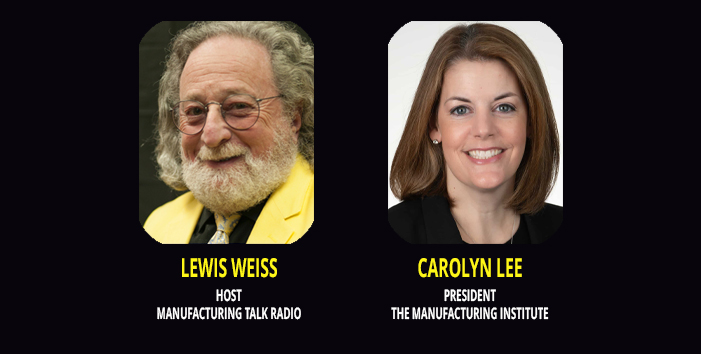
Good day everybody. This is Lew Weiss with Manufacturing Talk Radio. And I’m pleased to have today Carolyn Lee from Manufacturing Institute, who she now has gotten a new title, amongst many others, is that she’s now a regular on Manufacturing Talk Radio. This is now her third her third visit in the last thirteen years or thereabouts. Good morning, and how are you?
Carolyn Lee (00:28.793)
Good morning. It’s great to be here. Nice to see you again, Lew.
Lewis A Weiss (00:32.248)
Thank you, thank you. I think the last time we saw one another was at a trade show. So yeah. So Carolyn, what are you doing nowadays?
Carolyn Lee (00:37.092)
I think so.
Carolyn Lee (00:43.535)
You know, every day is is busy. We have a lot going on. of course, you know, everyone knows they open open the the news or the phone and see every day a new announcement about a plant investment and manufacturing investment and growth here in the US, which is fantastic. Every time I see one of those I think, Where are the people gonna come from? And so that very question is the thing that keeps us busy at the Manufacturing Institute each and every day.
Lewis A Weiss (01:11.818)
seems as though there’s a lot of foreign companies coming to the United States, including one last week was a South Korean company opening up in North or South Carolina, but I’m not sure that deal’s gonna go through. But let’s wait and see as the saying goes.
Carolyn Lee (01:30.66)
Yeah, that’s right. That’s right. I think you know, in the since the COVID era, we’ve seen a lot of reshoring, onshoring, nearshoring conversation, recognition that we, you know, and that’s even before the the trade conversations, since President Trump came back into office. So, you know, there’s been a lot of focus. But here’s like go back to even before COVID. Lew, we’ve talked about this is that
Lewis A Weiss (01:46.051)
Right.
Carolyn Lee (01:56.036)
Manufacturing has long faced a structural talent shortage. We have had about four between four and five hundred thousand open jobs every year since I started in this role in 2017. With the exception of COVID, we’re coming right out of COVID. We were near a million open jobs the summer of 2022, I think it was. So we’ve had this problem for a long time. Now, what is driving and the biggest parts of that challenge has evolved a little bit along the way.
But we have long had to make sure that we were building and strengthening the manufacturing workforce for today and tomorrow. That’s what the MI’s mission is. And we we we keep going because the work has to get done.
Lewis A Weiss (02:36.47)
It’s gotta get done and I’m not sure that technology can pick up the slack.
Carolyn Lee (02:41.943)
It is not an either or, right? The I I it’s funny, for many years I’ve said the robots are not taking over. and and yet every factory I go to, I see a lot of robots. I was actually talking about this this morning with somebody out in my community. And, you know, there is certainly room for automation and more automation, and that continues to advance in manufacturing, which is fantastic. Every single worker I have ever talked to.
And said, what do you think of the automation has told me they love it. It does the thing that was boring or that hurt them or you know they didn’t enjoy doing. So that is certainly there. And we know that automation and technology always makes us more productive. but we still need the people to to ideate and to create and to bot build and to solve and to fix, fix all these robots. So the people are still very much front and center in modern manufacturing.
Lewis A Weiss (03:23.382)
Yeah.
Lewis A Weiss (03:35.842)
Japan it’s gotten such such part of the everyday life that people for seventy five hundred dollars can buy a home assistant, a c a robot in your house that will do get me this, get me that, do this, do that and the other thing. And it’s it’s not a big deal there, yeah.
Carolyn Lee (03:46.861)
You’re
Carolyn Lee (03:56.164)
Right, right. I it that is actually it’s I was again just talking about this today. It’s fascinating to me. I mean, myself, I don’t want a lot of home automation. I have I have three teenagers. So when I say, Okay, I open my c my office door and say, guys, you know, they’re home for summer still, hey, I need this, and and I set them on their way. So you look it is fascinating, but Roomba’s been along for around for a really long time. Not all of this is new. I think the depth of the engagement
I know I’ve read in Japan it’s definitely the the home assistant has really come into especially for caregiving because there are there they have a population shortage and and crisis. And so look, I think just as we’ve seen, you know, autonomous vehicles moving supplies around manufacturing floors for a long time now, that could be deployed in hospitals, you know, that that they’re bringing around the water and the ice and the
the supplies that every room needs so that the people, the caregivers, can continue to give care. And so I think this wave of automation that we’re seeing and this ubiquitous kind of infusion of technology into our world, a lot of people are talking about, you know, the end of jobs. I don’t believe that. I think it’s the shit continual shift of tasks and roles, just as we’ve always had ever since the first steam engine. And that will continue. It’s happening faster. So it’s a little bumpier. We and and hopefully we’ll talk about this in a bit.
Lewis A Weiss (05:18.126)
That’s right.
Carolyn Lee (05:22.233)
We gotta make sure that people are ready with the skills they need to engage in this world. That’s that’s something we’re really passionate about at the MI. But this evolution will just continue and we’ve gotta make sure that our our people, our most valuable resource, are at the center of that.
Lewis A Weiss (05:38.56)
a as you pointed out, we’ve been doing that for a hundred years. Ever since the Industrial Revolution. You know, no, I don’t want to give up my horse. so th so then they invented the street swimmer to clean up the horse dupe. Okay. All right. Well we’re we’re certainly in a like minded attitude about this. I I really
Carolyn Lee (05:43.269)
That’s right.
That’s right.
Carolyn Lee (05:49.517)
Right. That’s right. That’s right.
Carolyn Lee (05:57.604)
Right.
Lewis A Weiss (06:08.61)
I love robots. I think they’re great. And I love the one that was on Star Trek. I forgot his name. Yeah, he was the best. okay, so give us a little background on your view of the state of manufacturing. You you already gave us a clue that we’re already short and that people are retiring and people are dying and people don’t want to go into manufacturing and we have zero birth birth rate in this country or
Carolyn Lee (06:16.741)
That’s right.
Carolyn Lee (06:25.263)
Yeah.
Lewis A Weiss (06:37.034)
Almost zero birth rate. So
Carolyn Lee (06:37.754)
Right.
Carolyn Lee (06:41.369)
Where we? We are look, manufacturing has a really bright future in the US and and I’ll leave it to my my colleagues that are affiliate, the National Association of Manufacturers, to talk about the investment environment and all the things that make, you know, for making sure that people and companies are able to invest in a competitive environment here in the US. and and the NAM team does a great job talking about that. For for the MI, we talk about the people.
Lewis A Weiss (06:42.072)
That is
Carolyn Lee (07:09.965)
Right, as I started at the top of the show, there’s all these investment announcements. I think last year it was literally, you know, it was fast and furious. Every single day there were multiple announcements. And it’s fantastic, but at the center of those announcements are the jobs, right? And and I started my career on Capitol Hill working for members of the House and the Senate. So I know how important it is that that for policymakers to see the jobs that are attached. I like to talk about the skills that those jobs need.
Right. And that’s where we really focus in. You know, I grew up in a manufacturing family and my dad would have said we’d hang a sign and people would come. And my grandfather who left high school and and went into manufacturing and ended up becoming a machinist and learning the trade, you know, there was a lot more skills that they were coming out of high school with at that time and they were fixing cars, right? They were fixing equipment at home and then they went in and it was a transferable skill. Today a car is a computer with wheels.
Right. So it’s it now you can fix it and and people people engage in those things, but it’s different. Our our culture is different. So there’s a bigger gap of awareness and manufacturing, and that’s something that that we’re constantly tackling. So, you know, the future is very bright. The the creation, the bill you know, I tell my kids all the time, everything we have, unless we pick it, you know, the fruit off the tree or the vegetable from the ground, everything else is manufacturing.
And so when you talk to students about that, they get excited. We just have to bring it to life for them because most people don’t know someone in manufacturing. And so they don’t know what it means. And so but when they see it, it comes to life and they see the opportunity. So that’s a big part of our mission, a big part of the work. And then it’s about getting them the skills they need to fill the jobs that they hope for.
Lewis A Weiss (08:58.382)
Without a doubt. Can I tell my other story we spoke about before the show? Okay, so for Manufacturing Day, we’re going to have Carolyn Lee back on the show. We’re gonna have three or four students that were on our show in twenty sixteen when they were in high school. And we’re gonna be talking about their evolution and where they are and you know what what manufacturing jobs are in and what kind of money are they making.
Carolyn Lee (09:01.623)
Yes, please.
Lewis A Weiss (09:26.892)
And they’re they’re all incredible success stories and they’re only in their late twenties. So that’s gonna be that’s gonna be exciting.
Carolyn Lee (09:31.193)
Yeah, absolutely. I can’t wait. I can’t wait. Cause that’s the best thing, right? It’s the the journey. I think that whenever I talk to students, I tell them don’t just ask someone what they do, but the journey that got them there. You know, everybody has a long and windy path and and that could light the spark of interest and the opportunity and know that and have people understand that something’s accessible that they might not have known before.
And so it’s it’s truly remarkable. So I can’t wait to have that conversation and l and hear about these students and how that can help others.
Lewis A Weiss (10:04.63)
I told one of the students way back when I said, Do you like swimming? Yeah, I I like swimming. I go to the pool all the time and I said, Well, if you become an underwater welder you can make a hundred and fifty thousand a year
Carolyn Lee (10:14.796)
Right. That’s right. That’s right. When I was toiling away on Capitol Hill in my early career, and I will say Capitol Hill staff doesn’t really get paid very well. And I had my student loans and my, you know, apartment, my dad would always tell me, if you had been a CNC machinist, you’d be making, you know
Lewis A Weiss (10:21.251)
Yeah.
Lewis A Weiss (10:31.692)
Yeah.
Carolyn Lee (10:31.81)
s seven figure, six figures by now. And I was like, that that wasn’t really in my cards. But you know, that’s true. They that’s it’s good money. I see this all the time with our fame Earn and Learn program that that’s rapidly expanding across the country. I talk to these these, you know, young people, I can’t say kids, these young people who are a couple of years out of high school and they’re buying a house and they have a car and they’re helping out their family and they are launching, you know, into this career with these high demand skills.
that, you know, in the sky’s the limit, they can keep doing that, they can keep, you know, and run the maintenance shop. Or I know some that have gone on into plant leadership, into operations leadership and, you know, and and it’s upward mobility from there. So it’s it’s a fantastic future here in modern manufacturing.
Lewis A Weiss (11:18.71)
I spoke to a couple of years ago I spoke to a oil rig worker and he goes out on the rig for thirty days, then he’s off for thirty days and he earns a hundred and fifty thousand dollars a year and he only works six months. It’s
Carolyn Lee (11:34.724)
I know. I had a conversation like that once on an airplane and I thought, God, where did I go wrong?
Lewis A Weiss (11:40.846)
I don’t know, you don’t look like an oil rig gal.
Carolyn Lee (11:45.069)
Probably not, probably not. I I would say I probably found the right career path for me. I’m not quite you know, I’ve done all of those simul welding simulations and people always say that, you know, women are better at welding w because of fine motor skill. I’m not that person, really. I I’m just not. So I think I’ve done all right.
Lewis A Weiss (11:55.703)
Yeah, yeah, yeah.
Lewis A Weiss (12:06.296)
Got it, got it. So let’s talk about misconceptions aside from the fact that manufacturing isn’t dirty, d dark, dirty and dangerous as it was, but give us some clues into some of the other mis mis thinking.
Carolyn Lee (12:21.88)
You know, it’s funny, I I will I will answer and then I will have a a counter to it. People most people think they ’cause you know, we’ve we’ve done a lot of kind of poll testing, message testing, all that stuff on on manufacturing over the years. And when and and whenever you go out to the public and you say manufacturing, people draw smokestacks and they they they describe an assembly line. And I think that everyone thinks that the entirety of the sector is automotive assembly because that’s about the only thing they can
reference in their head. If you’re old enough, you remember Laverne and Shirley and the bottling line, right? And if you’re ol really old enough or you were a kid in the 80s and watched I love Lucy reruns, as I did, the chocolate con you know, conveyor belt. So when we talk about everyone thinks that they they do not conceive all the rest of the parts. When we talk about the job shortage of manufacturing, our we we include all of the roles, whether it’s finance or HR or creative and comms
Lewis A Weiss (13:02.83)
Right.
Carolyn Lee (13:19.256)
to production and engineering and all of the things, because all of those pieces and parts are what makes the manufacturing stre sector, you know, s possible and and successful. So when we look at all of that, people don’t aren’t able to conceive of what a what modern manufacturing looks like today. I go into these facilities, I’m sure you’ve had the same experience. I mean you could eat off the floor.
It is it is clean, it is bright, it is air conditioned in in most industries, right? Depends on what you’re making. And it is is fascinating, right? I was in a steel mill and they were they were pouring the the I forget what it’s called. They were pouring it, right? And then it explodes and it and melts and it’s amazing. I could have stood there all day watching. Or my one of my favorites are the pickers, you know, the little spider hand pickers. And I was in a detergent factory and they were I was in Tennessee and they were picking up the pods of detergent and dropping them in the buckets. I mean
Lewis A Weiss (14:05.57)
Yeah, yeah, yeah.
Carolyn Lee (14:13.954)
all day long. So for me it’s not just what we make, which is what people focus on, it’s how we make it. The machines that run that build perfectly every time, right? So when we talk to students, it’s about that. It’s about who designed that machine, who’s fixing that machine, who’s programming that machine, right? Who’s engaging with it together? So so I said at the start I’d I’d talk about some of the the the misconceptions. But I actually think we’re in this interesting time that
It’s not that people that young students today have a misconception of manufacturing. They don’t have any fathom of what manufacturing is, right? So it’s not that we’re having to prove it’s not dirty, dark, and dangerous. We’re actually having to explain what the potential are of these jobs. Now at the same time, since COVID and and this shift in the the zeitgeist about you know cost of college, which is is very high in most places.
Lewis A Weiss (14:52.536)
Right.
Carolyn Lee (15:10.902)
And what education and whether or not you’re getting your value out. Do you have a job that’s commensurate with your degree if you went to a four-year degree? I am not a person who says it’s one or the other. We need all. We need people with eight years degrees and 16, right? We need PhDs. We also need people with six weeks or 16 weeks of training in a skill who can come in and begin. So we need all of the things. What I always say is we need.
People to identify what are the skills they need for the jobs they want and then how do we help them get on that? So for manufacturing today, I think our biggest challenge, this is a really long answer, our biggest challenge is to help people understand what’s possible and then what the people are who make that possible, what their roles are, rather than combat this idea that it’s dirty, dark, and dangerous. I think today’s k students, they don’t even know that.
Lewis A Weiss (16:03.436)
It’s it’s funny when I first started manufacturing talk radio in twenty thirteen, going into about the fourth or fifth year, people were saying, Why do you why are you doing a a a podcast about manufacturing? It’s such a narrow niche. I said, You’re wrong. Everything is manufactured. Everything. And at one time you never heard manufacturing in the news. Never.
Carolyn Lee (16:21.304)
Right. Everything
Carolyn Lee (16:31.192)
Yep. Never.
Lewis A Weiss (16:33.19)
I think we may have been one of the first to talk about manufacturing to a wide audience. And it’s it’s amazing because now every time you turn on the news it’s something about manufacturing. If it’s not Trump, it’s manufacturing, you know.
Carolyn Lee (16:43.724)
That’s right. That’s right. You know, and I will say actually we we did a lot, as I said, we did a lot of poll testing in this, and a lot of sentiment testing about manufacturing over the years. After COVID, because of you know, the great toilet paper shortage, which wasn’t, it was just a mismatch, right? Supply chains and then all the things plus all of the medical supplies, right? If it was nitrile gloves or everything that went into making sure that that the vaccines came out.
All of COVID experience greatly improved the public’s perception of manufacturing because all of a sudden they had to pay attention. Right? Why wasn’t the thing you wanted on the store shelf when you could get to the store? Well, supply chains. So all of a sudden that perception changed dramatically, and people thought, okay, this is important. I don’t know that I want my kid to do it because I don’t understand what the jobs entail and the and the future prospects of those jobs, but
They recognize so it’s been a little it’s been ticking along and and improving and then all of this attention on it in these last couple of years has helped that. So for us in the sector, it’s important that we seize this opportunity to talk about and and for the institute, our philosophy around workforce development is really centered on employers need to lead because workforce development is a you something that you have to do in a forty to sixty mile, you know, radius of your facility.
There is no national switch you can throw. I I worked in federal policy for a long time. There is no singular federal policy that can make this all better. There’s a lot of things that could help, but there’s no single solution you can turn on. So what we have to do is work locally. We have to engage those high school students you were talking about. We have to help them see where they can get those skills that they need. And then we work on this so the employers leading can really help us address this challenge.
And where we’re seeing employers do that, we’re having great outcomes.
Lewis A Weiss (18:41.218)
We you know, it’s it’s funny that the opportunity now is changing with regards to education because parents now are beginning to freak out when they see a six figure bill for college. And you know, you want to go to school and become a school teacher and make forty thousand dollars or fifty thousand dollars? we need school teachers, yes, but maybe you need to rethink your career path.
And that’s happening.
Carolyn Lee (19:12.824)
Yeah, I mean I every day, I think I just saw one this morning, you know, I won’t say every day. Every week I see an article from a major news outlet that says, more students are thinking about the trades. I hate that we only talk about it in nature of the trades versus skilled work. that’s another hobby horse of mine because there’s a wide array in addition to the trades that we need. But you know, there’s a lot of conversation. I have teenagers. We talk about this. I’m in the schools and we hear it.
there’s a lot of opportunities that are now suddenly bubbling to the top because of the pressure. And and you know, look, there’s other economic headwinds that are making people pay attention in a way that maybe in the in the early two thousands we weren’t. I would argue that if you look I think the pendulum swung too far that it was the only way to succeed is college, a four year degree. And but yet the majority of Americans receive most of their education from two year
you know, institutions, whether it be a a community college or technical school, or you go for a short course. We need to make all of these things accessible. the in the the I think it was the big beautiful bill included the Pell Grant expansion so that shorter courses of learning could receive federal financial aid, which is fantastic. It has to meet certain criteria and I know the Department of Education is still working on that. But we’ve got to help make learning and skills accessible.
And again, I’ve said it already, I think, twice on this call today. We got to make sure people are getting the skills they need for the jobs they want. It’s not a one size fits all. It’s it’s not the only reach to success is a four year degree. And it’s not that the only you know, that you you don’t need one. You you need what you need for the job that you’re looking for.
Lewis A Weiss (20:48.75)
True. True.
Lewis A Weiss (20:58.498)
Right. We’re gonna be doing a on site interview at the community college of Morris County, here in New Jersey, where they have a actual manufacturing facility where they teach kids kids, you know, young adults to be able to manufacture, make things and they take in they take in commercial jobs from local businesses and they do
Carolyn Lee (21:16.099)
Yeah.
Lewis A Weiss (21:28.194)
real work and they get real money and they share in the profits and so he’s gonna be on our show and we’re gonna go we’re gonna go there and see what’s all what it’s all about. That’ll be a lot
Carolyn Lee (21:30.082)
Yeah. Right.
I love it.
Carolyn Lee (21:39.097)
I love it. I you know, I see so many great educational institutions, high schools with amazing Steam Labs and you know, and and and I think h you know, if if project based learning, let’s just talk about that for a second. If any of these things had existed when I was a student, maybe science would have made more sense to me, right? Or maybe I wouldn’t have ended up with p political science. maybe it would have made more sense, but it is awesome. There’s amazing facilities all over this country that are are close to people.
And you know, there’s so much opportunity to go in at any point in your career journey and learn new things to give you a different trajectory. And so popularizing that is really important.
Lewis A Weiss (22:15.96)
Sure, sure.
So if if you’re a manufacturer and you’re you’re bringing in automation, you’re bringing in AI and so on, y you got another you have a new problem now. are you gonna retrain existing employees? Are you gonna go out on a recruiting bench and hire people who are right out of school who or or have had two years of trade training? what do you do? Or do you do a little of everything?
Carolyn Lee (22:47.148)
All of it. You gotta do all of it. Because look, it’s not you know, I’ve been in facilities that that have, you know, lathes from nineteen fifty. You know, so it’s not like your it’s not like your your iPhone or your computer where you’re like, I’m gonna upgrade and you just put it to the side and you plug in a new one and off to the races. You know, the investment that manufacturers have to make are so enormous and what has to go into transitioning and bringing in new equipment.
Is so substantial that that’s a multi-year process, right? So you need to train up the people you have. You also need to identify what skills you need to augment and bring in those people or build those. Ideally, in our view, you build those pipelines so that you’re constantly training the say the maintenance technicians you need to be able to fill those roles and maintain that equipment. So it needs to be both, but here’s the hidden secret. I was just talking about this with my team yesterday.
The training is not just for the skill to do the job. The training in and of itself is an indicator to your employees that you care about them, you value them, and you you they have a future with you, which helps you attract and retain the workforce that you need. So all of this is a cycle and it it it it’s perpetual motion machine, right? It continues to feed and that that competitiveness culture that you need and upgrading the skills of the team. So there’s so many benefits to training. you know, it is rare that I find a company
a a medium or large company who doesn’t have training very front and center. For smaller companies, it’s a harder, harder thing. My dad’s company when I was little, it was like, you know, four people and my mom was doing the books on the side. That’s harder to stop production and train there. You know, some of the tools that the MI is building is to help companies of all sizes, but particularly for the small and medium, particularly in the AI space, we’ll be rolling out AI fundamental skills training this fall.
That will be free and available for f everyone thanks to support that we receive from Google.org that will allow people to be able to engage in short course learning to be able to get those fundamental skills and AI so they can continue their journey. And we hope that through work like this and and other activities that are going on around the country, all manufacturers will be able to have the time and work to build in the time to invest in the training for their employees because that’s the way they’re going to succeed.
Lewis A Weiss (25:09.08)
What has the immigration issue that’s evolved over the last year or year and a half? How has that negatively or positively impacted manufacturing employment?
Carolyn Lee (25:20.768)
Yeah, so I know my call my my colleagues at the National Association of Manufacturers work on immigration and have some policy proposals. You know, what I always say when it comes to immigration is we need more people. We need an all of the above solution to bring and attract the best and the brightest from around the world to the American economy. We know that our birth rate is not increasing and tra historically the way that the US economy has always grown.
in the number of people has been in immigration. So we need a legal immigration system that allows people to come in. that that’s what the and for us, how do we make sure that we are bringing more people in to do these jobs? As I said, we have about 450,000 open jobs nearly every month. And so for us it’s not only how do we bring in the best and brightest from around the world, but also who’s on the sideline? You know, who’s looking for upskilling in their career.
You know, veterans returning from their time in the service. We have a great program, Heroes Make America, that helped build that connection from the military to the manufacturing community. How do we bring people and support people who are coming from other bears? Maybe they were home caretaking for somebody before. How do you bring them in? How do you track them? People coming out of our criminal justice system. We’ve done work in a for a long time helping companies support those coming out of the criminal justice system or have had involvement in the criminal justice system.
with second chance hiring so that we can attract everybody. We have some activities coming up this fall focused on how do you bring in people with varying abilities and making sure that that they have a place too in manufacturing because we need all the people we can get to build this economy that we have and keep it going strong.
Lewis A Weiss (27:05.783)
Do do you have success stories when some of the manufacturing companies that you’ve worked with who have made the conversion?
Carolyn Lee (27:14.104)
Absolutely. so we actually have an and I have it so from from veterans to second chance hiring to folks coming in from the care economy, we have stories. we have a whole bunch of stories on the website that we’ve told over the years, but it is like NEMA manufacturing, they’re in the Midwest and they have probably the gold standard of of supports for second chance hiring.
One of the stories that I always talk about is actually, and this is kind of this is kind of a grab bag, the the the San Antonio Fame chapter, I think it’s Almo chapter in San Antonio, Texas, they’ve been really successful building out FAME, which is the Earn the Learn for Maintenance Technicians. Well, after that community came together and worked on FAME and started all the employers work together over the years because it’s it’s a collective training program.
to build best in class, global best maintenance technicians. hugely successful program that Toyota founded that the MI now operates and expands all over the country. They started working on second chance hiring. Hey, there’s this other, you know, we have this cooperative, we have these companies that have been working together and know how to to to collaborate to develop talent pools. What if we work together to help support some folks who are coming in from the from
other opportunities or from other other challenges in their life, how do we support them? So it’s really a col local collective action to solve and develop that channel pool. And that’s where it shifts from looking manufacturing and and you know this, Lew, we’re not it’s it’s not a zero-sum game. You need your suppliers and your customers to have the people they need too. Otherwise they’re not gonna be doing they’re not gonna give you the parts you need or or you’re gonna be able to sell them the product. So we have to be in this together and develop talent pools.
not just who am I hiring and only look at it as a zero sum game. So when communities can come together and build durable talent pools, all of the sector will will benefit from that.
Lewis A Weiss (29:17.966)
Just for the sake of our audience, give us a bit of a definition of second chance hiring.
Carolyn Lee (29:23.044)
Sure. Sir. So there’s a couple different names and and so what we what we call it is for those who have been justice involved, and I think it’s one in about one in three, one in four Americans have had some exposure to the criminal justice system over their lives that might make it hard for them to get a a a job when they come out. And so for those individuals, what we did, and this was back I think in in twenty twenty one, what we did was working with some companies and some
nonprofit partners who are looking to hire individuals who are coming out of the criminal justice system, what are the supports that those individuals need in order to be successful in that in these careers? For some, they might not have had a full-time job before. They might not know what to do when you’re sick. You know, do you just not show up? Do you call in? How do you behave? They might need more time off to go deal with parole officers or go
ta you know, deal with the the court system and the legal system to make sure that they are complying with their, you know, their their requirements. And so how can manufacturers support them in that and make sure that these individuals can be successful? And what we’ve seen is that those companies that do that, they actually end up with really high retention rates. And there’s a lot of loyalty that comes from the individuals who suddenly have, you know, some all the support and these opportunities.
they stay and they they continue to grow in these companies. And so there’s some tremendous stories that we’ve cataloged over over our time working on this. And it’s a really great talent pool. And it’s a talent pool that’s available in every community across the country.
Lewis A Weiss (31:03.16)
There’s a couple of years ago we were gonna ha we were going to have a an inmate on our show to talk about training that goes on or doesn’t go on in the prison system. And more times than not, they’re not. And y you know, there’s a a a potential work pool if we did if we instituted the proper systems within prisons.
Carolyn Lee (31:16.002)
Yeah, depends on what you are. Mm-hmm.
Carolyn Lee (31:32.249)
And I’ve seen some great training programs. I’ve toured some in Kansas and Indiana, for instance. I know that there’s great training opportunities that go on and instances where that is happening. It’s also what happens when they when they leave. How do you make sure that you have the supports and there’s great community partners who are able to support those individuals? Look, it is better for all the communities for people to have good family supporting jobs, right? That
Lewis A Weiss (31:32.942)
Yeah.
Carolyn Lee (32:00.721)
regardless of what the demographic of the population may be. And so helping people get sustainable employment and then supporting them in that employment brings great benefits. And so that is definitely part of the talent equation. But also again, people with with varying abilities, whether it might be mobility or intellectual abilities challenges, how can we help and how can manufacturers who are pillars of their communities, who make big investments to to put plants in the ground, right, and bring in all this equipment
How can they tap into these talent pools? And that’s something that the MI works to help them to do.
Lewis A Weiss (32:37.538)
Sounds like a worthy cause to me. Carolyn, thank you very much. You have any final words you’d like to submit?
Carolyn Lee (32:39.075)
Very much so.
Carolyn Lee (32:45.312)
I would say, you know, there’s a lot happening in the world and there’s a lot of great workforce development resources available all across the country. At the MI, we work nationally to help make sure that manufacturers can build and strengthen that talent pool they need. And whether it’s maintenance technicians through fame or it’s returning veterans through heroes, things like Manufacturing Day that happens in every community across the country, or the upskill up upcoming AI skills, you know, we’re here to help serve.
the manufacturing sector because that’s what makes our country strong. So I appreciate your time and attention and dedication to manufacturing. We all benefit from it. And it’s good to see you, Lew. I appreciate being here.
Lewis A Weiss (33:26.006)
Thank you. And you will be back here on October two when we broadcast our show with three or four students from the past, with you, me, and Amy, who’s my co host, who’s under the weather today and couldn’t be here. again, thank you very much. A pleasure seeing you again, Carolyn.
Carolyn Lee (33:46.83)
Pleasure to see you. I look forward to October then.
Lewis A Weiss (33:50.574)
And if you all like the show, hit the like button or you can request information about advertising and marketing. we take all all comers, nobody’s turned down. so thanks much everybody for listening and Carolyn, thank you.
Carolyn Lee (34:06.853)
Thank you. Thank you.
 Spotify
 Apple Podcasts
 Podbean
 YouTube