
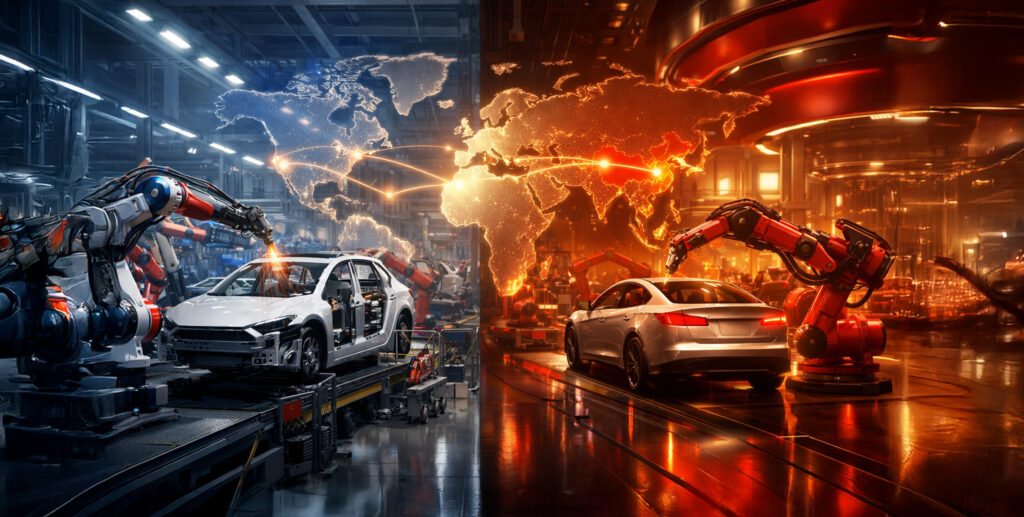
A new flashpoint is emerging in the auto industry as several senators call on the current administration to prevent Chinese automakers from building vehicles inside the United States. Their concern is not just about competition. It is about the speed and scale at which Chinese electric vehicle companies have expanded globally and the possibility that they could undercut American manufacturers if they gain a foothold in the domestic market.
According to Reuters, lawmakers argue that Chinese automakers could use factories in the United States, Mexico, or Canada to bypass existing trade barriers. They warn that this could create what they describe as an uneven playing field that would be difficult for American companies to overcome. Their message is simple. If Chinese automakers enter the United States with ultra-low-cost electric vehicles, the economic impact could be significant.
The backdrop to this debate is a massive shift in global auto economics. China has become the world’s largest vehicle exporter, shipping more than 5 million cars in 2023. Analysts expect that number to climb toward 6 million by 2026, driven largely by electric vehicles that cost far less to produce than their American or European counterparts. Some Chinese electric vehicles sell for the equivalent of $12,000 to $20,000, a price point that no American manufacturer can match today.
Meanwhile, the United States is experiencing one of the largest manufacturing investment waves in modern history. Federal economic data shows that spending on manufacturing construction surged more than 30 percent in 2025, reaching record highs. Private companies have announced more than $200 billion in new battery plants, semiconductor facilities, and electric vehicle supply chain projects since early 2025. When you include long-term commitments and multi-year capital plans, economists estimate that the broader clean energy and transportation sector is now tied to more than $3 trillion in planned or active investment.
This surge is not happening in a vacuum. It is a direct response to global competition and the desire to reduce reliance on foreign supply chains. The current administration has already taken steps to limit the entry of Chinese connected vehicles, citing concerns about data security and the potential for foreign access to sensitive information. Regulations introduced in 2025 effectively blocked Chinese passenger vehicles from entering the United States market, and industry groups have strongly supported these measures.
Automakers and economists say the renewed scrutiny of Chinese companies could accelerate the reshoring trend that is already underway. States like Michigan, Tennessee, Georgia, and Kentucky are reporting thousands of new advanced manufacturing jobs tied to electric vehicle production. Battery plants alone are expected to create more than 50,000 direct jobs and many more indirect jobs across logistics, construction, and engineering.
There is also a broader financial story. Investors have poured billions into American electric vehicle startups, battery technology companies, and charging infrastructure providers. Venture capital funding for climate and mobility technology reached more than $70 billion globally in 2025, with a significant share flowing into United States-based companies. Institutional investors see long-term opportunity in domestic production, especially as global supply chains become more unpredictable.
While the debate over Chinese automakers is heating up, there is a positive outcome emerging. The pressure of global competition is pushing the United States to innovate faster. Universities and research labs are expanding programs in battery chemistry, artificial intelligence for manufacturing, and lightweight materials. States are investing in workforce training programs that prepare workers for high-skilled, high-wage jobs in advanced manufacturing. Communities that once relied on traditional auto plants are now seeing new opportunities tied to electric vehicles and clean energy.
In short, the tension surrounding Chinese automakers is not just a challenge. It is also a catalyst. It is driving a new era of American industrial investment, strengthening supply chains, and positioning the United States to compete more aggressively in the next generation of transportation technology.
 Spotify
 Apple Podcasts
 Podbean
 YouTube
 Spotify
 Apple Podcasts
 Podbean
 YouTube