
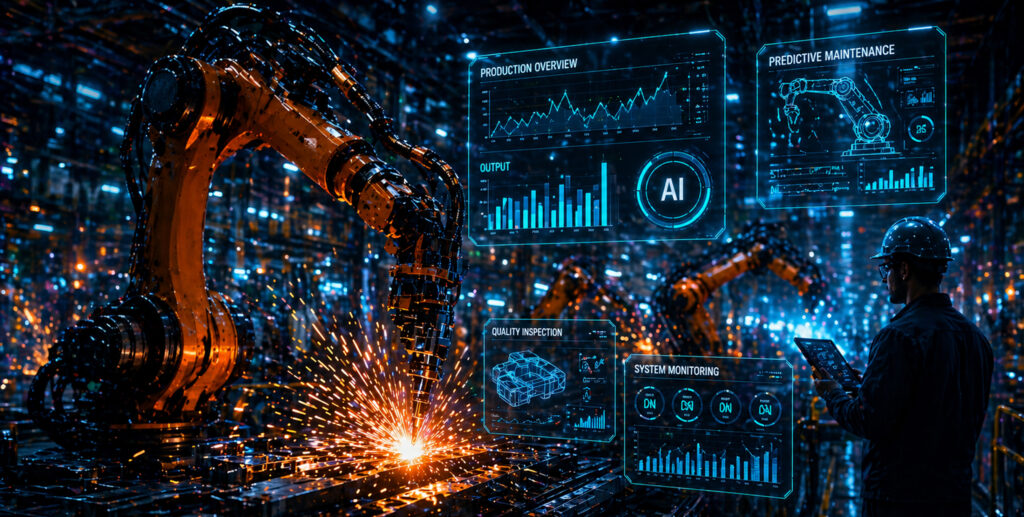
Walk onto a modern factory floor in 2026, and the first thing you notice is not fewer workers. It is workers surrounded by intelligent systems that anticipate problems, adjust production flows, and handle repetitive tasks that once slowed everything down. At a Texas-based semiconductor plant, for example, agentic AI systems now coordinate equipment scheduling, quality checks, and material movement in real time. The result is a production line that runs faster, wastes less, and gives engineers more time to solve higher-value problems.
Across the industry, this shift is accelerating. Deloitte and IDC both identify agentic AI as the top manufacturing trend of 2026, with companies moving beyond simple analytics toward autonomous systems that act on data instead of just reporting it. Early adopters are already seeing major gains. Generative design tools are cutting engineering cycles by more than 50 percent as AI rapidly iterates thousands of design options. Predictive maintenance powered by IoT sensors and machine learning is reducing unplanned downtime by 30 to 40 percent, a massive savings in sectors where every idle minute costs real money.
These productivity gains are arriving at the exact moment manufacturers need them. The United States has faced persistent labor shortages in advanced manufacturing, and companies have responded with record capital investment. According to the National Association of Manufacturers, the value-added output of U.S. manufacturing reached roughly 2.90 trillion dollars in early 2025, representing nearly 10 percent of GDP and driving 35 percent of national productivity growth. Every 1 dollar spent in manufacturing adds about 2.64 dollars to the broader economy, making efficiency improvements especially powerful.
Agentic AI is multiplying the impact of this investment. Instead of replacing workers, it is making each worker more valuable. Engineers spend less time on tedious modeling and more time on innovation. Technicians rely on AI-guided diagnostics that shorten repair times. Production teams can run smaller, more customized batches without sacrificing speed or quality, something overseas competitors struggle to match. This is one reason reshoring continues to accelerate: automation and AI are making domestic production cost-competitive without pushing wages down.
The return on investment is straightforward. A mid-sized plant that reduces downtime by even 20 percent can save millions annually. Add in energy optimization, scrap reduction, and faster design cycles, and the payback period for AI-enabled upgrades often falls well under two years. For manufacturers that have already invested heavily in new facilities, these gains compound quickly.
There is also a positive long-term outcome that rarely gets attention. As AI takes over the most repetitive tasks, the demand for higher-skilled roles grows. IDC notes that engineering and technical occupations are projected to expand faster than average through 2034, driven in part by the need to manage, verify, and collaborate with AI systems. This means more stable, better-paying jobs rather than fewer jobs overall.
The only real risk is slowing this momentum with overly rigid rules that treat AI as a threat rather than a tool. Manufacturers are already building strong human-in-the-loop systems, verification frameworks, and governance models to ensure safety and reliability. What they need now is room to keep innovating.
If the current administration continues supporting investment in advanced manufacturing, the United States could enter a new era where productivity rises, reshoring accelerates, and workers benefit from more meaningful, higher-skilled roles. Far from being a job killer, agentic AI is shaping up to be one of the most powerful job creators the sector has seen in decades.
 Spotify
 Apple Podcasts
 Podbean
 YouTube
 Spotify
 Apple Podcasts
 Podbean
 YouTube