
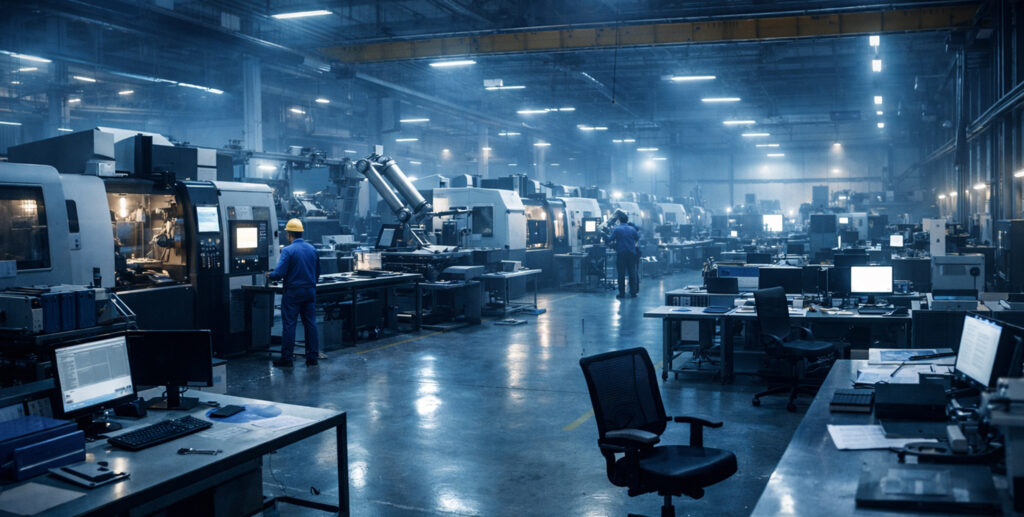
America’s manufacturing workforce is entering 2026 with a mix of momentum and mounting pressure. The sector employs roughly 12.7 million people nationwide, yet manufacturers continue to report persistent difficulty filling open roles. According to federal labor data, the average manufacturer had about 4.2 percent of positions unfilled in late 2025, and nearly one in four companies faced vacancy rates above 5 percent.
Even with employment hovering near historic highs, the trendline is softening. Manufacturing employment slipped from 12.71 million in September to 12.69 million by December 2025, and early 2026 brought a loss of 12,000 jobs in February alone. That is a fivefold increase in losses compared to the same month a year earlier. At the same time, compensation continues to rise. Average hourly earnings reached $36.07 by the end of 2025, with production workers earning $29.51. Benefits now account for about one-third of total compensation, pushing labor costs up 3 to 4 percent annually.
The challenge is no longer just headcount. It is skills. Modern factories rely on robotics, digital systems, and increasingly artificial intelligence. Nearly 98 percent of manufacturers are exploring AI driven automation, but only 20 percent feel prepared to use it at scale. By 2027, more than 40 percent of companies with production scheduling systems are expected to upgrade them with AI capabilities. Yet the workforce pipeline is not keeping pace. The country may need 3.8 million new manufacturing workers by 2033, and researchers warn that 1.9 million of those jobs could remain unfilled without major improvements in training and recruitment.
Economic signals reflect the strain. The manufacturing purchasing managers index stayed below 50 for much of 2025, indicating contraction, while construction spending on new manufacturing facilities declined as companies reassessed capital plans amid shifting trade conditions. Even so, investment announcements continue to rise as companies pursue reshoring and modernization strategies. These commitments represent billions in long-term capital aimed at strengthening domestic production capacity.
Despite the pressure, there is a bright spot. Productivity is improving. Output per hour rose 2.4 percent year over year in late 2025, the strongest gain in more than a decade. That means companies are beginning to see returns on technology investments, even as they work to close the talent gap.
A positive outcome emerging from this moment is the renewed focus on workforce development. Manufacturers are partnering with community colleges, vocational programs, and training providers to build a stronger pipeline. Many are reframing manufacturing as a technology-forward career path rather than a traditional industrial job. This shift not only attracts younger workers but also positions the sector for long-term competitiveness.
If the industry continues to pair investment with intentional talent development, the current workforce crunch could ultimately spark a more resilient, more innovative era for American manufacturing.
 Spotify
 Apple Podcasts
 Podbean
 YouTube
 Spotify
 Apple Podcasts
 Podbean
 YouTube