
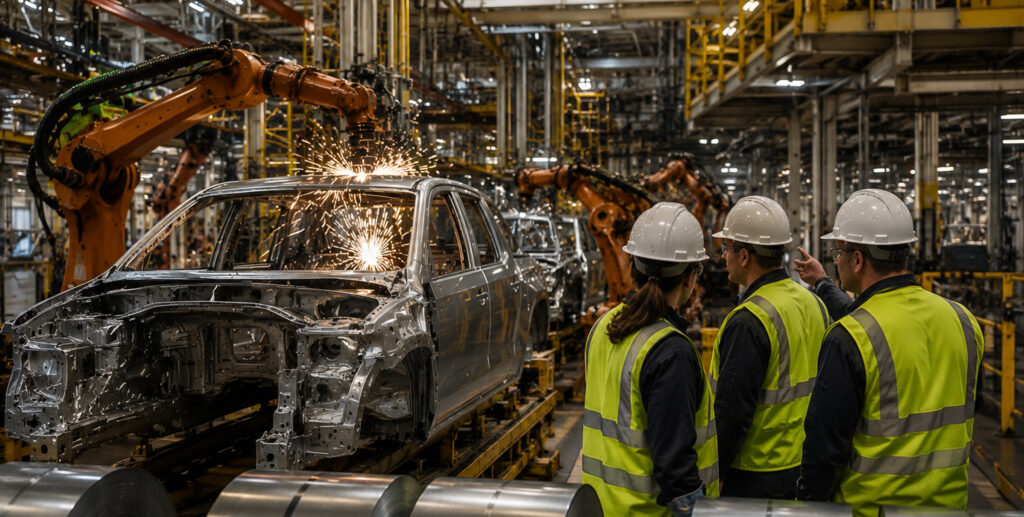
General Motors may be preparing to collect a $500 million tariff refund, but the company made it clear on its latest earnings call: the refund is a small win in a much larger and more expensive battle. GM still expects to absorb between $2.5 billion and $3.5 billion in tariff costs in 2026, driven largely by Section 232 duties on steel and aluminum, the metals that form the backbone of every vehicle the company builds. Even in the first quarter alone, GM incurred a $200 million tariff bill, and that figure already assumes the refund will eventually arrive.
The refund stems from the Supreme Court’s decision to invalidate certain IEEPA-based tariffs, which GM had paid under the previous administration. CFO Paul Jacobson told analysts the company will book the refund as a receivable but will not adjust free-cash-flow guidance until the timing becomes clearer. In other words, the money is coming, but GM has no idea when.
Still, the refund is not meaningless. It gives GM breathing room at a moment when automakers are navigating one of the most complex cost environments in years. It also validates the company’s long-running legal and compliance efforts to recover overpayments, a process that many manufacturers have avoided because of its complexity. As one industry analyst put it, “Most companies never see a dollar of tariff refunds. The fact that GM is recovering half a billion shows how disciplined their trade-compliance operation has become.”
The bigger story is how GM is protecting itself from the tariff environment that remains firmly in place. Section 232 duties on steel and aluminum are not going anywhere, and they represent the bulk of GM’s exposure. To manage that risk, the automaker has built a diversified steel-sourcing strategy that blends spot-rate contracts with one-year and two-year agreements. Jacobson said this mix has helped stabilize costs: “During times when prices go down, we pay a little bit more, but we pay a little bit less when prices go up.” It is a hedge against volatility and one of the few levers GM can control.
Aluminum hedging is another key tactic. With electric-vehicle production rising and aluminum usage increasing across GM’s portfolio, the company is using financial hedges to lock in pricing and reduce exposure to sudden spikes. GM has also used “short-term shifts” in production to the United States and other manufacturing adjustments to reduce tariff-heavy import flows. These moves are not new. GM deployed similar tactics last year — but executives say they will continue in 2026 as part of a broader “self-help” strategy to offset unavoidable costs.
Here is where the positive momentum becomes clear: despite the tariff pressure, GM reaffirmed its full-year guidance and maintained confidence in its margin outlook. The company is still projecting strong profitability, steady EV ramp-ups, and stable supply chain performance. In fact, GM’s North American operations posted one of their strongest first-quarter margins in years, a sign that the company’s cost-control playbook is working even under tariff stress.
The stakes are high. Steel and aluminum represent some of the most tariff-sensitive inputs in the automotive supply chain, and GM’s scale means even small price movements translate into hundreds of millions of dollars. The company’s projected $2.5 to $3.5 billion tariff burden for 2026 underscores how deeply trade policy can shape manufacturing economics. Even a $500 million refund barely dents the total.
But the positive takeaway is this: GM is proving that large manufacturers can adapt to a tariff-heavy world without sacrificing competitiveness. Its hedging strategy is stabilizing costs. Its sourcing diversification is reducing exposure. Its operational flexibility is helping it shift production when needed. And its ability to secure a refund of this size shows that disciplined trade-compliance work can pay off literally.
The message from the automaker is clear. The refund is welcome, but it is not the story. The story is that GM is building a more resilient supply chain, one that can absorb shocks, manage volatility, and protect margins even when trade policy becomes unpredictable. In a global market defined by uncertainty, that resilience may be the most valuable asset of all.
 Spotify
 Apple Podcasts
 Podbean
 YouTube
 Spotify
 Apple Podcasts
 Podbean
 YouTube