A quiet but urgent transition is unfolding across American manufacturing. Thousands of small and midsize machine shops, fabricators, and specialty manufacturers are run by owners who built their companies over decades. Many of these leaders are now nearing retirement, and the question hanging over the industry is simple but serious. Who will take over when they step aside?
This is not a small issue. According to the US Census, the average age of a manufacturing business owner is now 59, and more than one-quarter of all privately held industrial companies expect a leadership transition within the next 5 years. The Manufacturing Institute estimates that nearly 2.1 million manufacturing jobs could go unfilled by 2030 if the industry cannot attract and retain new talent. When you combine an aging ownership base with a persistent skills gap, the risk becomes clear. Many long-standing shops could disappear simply because there is no one ready to carry the torch.
Family-owned manufacturers are especially vulnerable. These companies often hold decades of tribal knowledge, customer relationships, and specialized processes that are not written down anywhere. When an owner retires without a plan, that knowledge can vanish overnight. Industry groups like AMT and NTMA have warned that the loss of these businesses would weaken supply chains and reduce domestic production capacity at a time when reshoring is accelerating.
The good news is that more owners are starting to think proactively about succession. Some are grooming internal leaders. Others are turning to employee ownership models. The National Center for Employee Ownership reports that companies with ESOP structures have grown steadily, with more than 6,000 employee-owned firms now operating in the United States. These models help preserve company culture while giving employees a stake in the future.
Private buyers are also showing renewed interest in small and midsize manufacturers. Deloitte notes that industrial M&A activity rose by 14 percent last year, driven by reshoring, automation investment, and the need for reliable domestic suppliers. For owners without a family successor, selling to a strategic buyer can keep the business alive and protect employees.
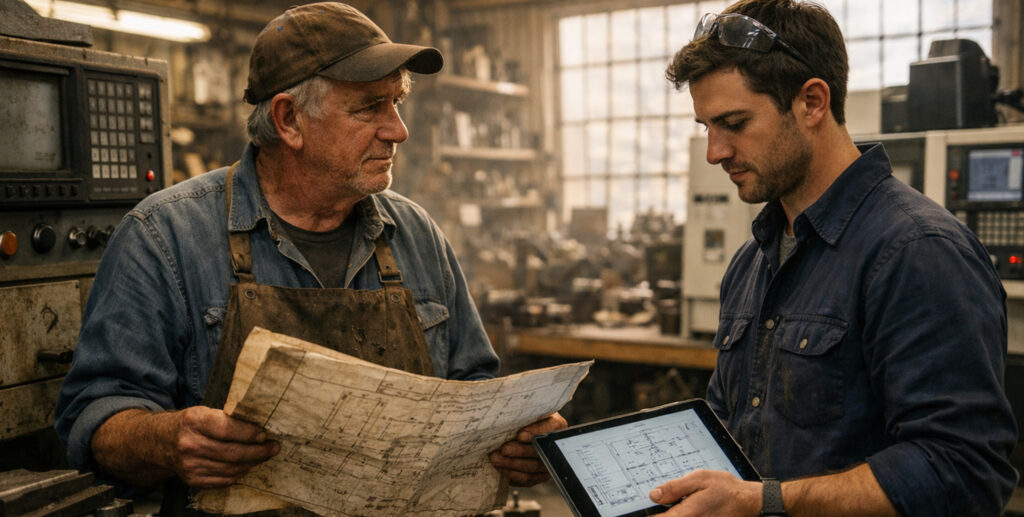
But preserving legacy is not just about ownership. It is also about skills. Many shops rely on veteran machinists and programmers with thirty or forty years of experience. As they retire, companies must capture their knowledge before it disappears. Some manufacturers are pairing senior workers with apprentices. Others are using digital tools to document processes, standardize setups, and train new hires more efficiently. The companies that succeed in this transition will be the ones that treat knowledge as an asset, not an afterthought.
There is a positive side to this moment. A new generation is showing interest in manufacturing careers, especially as wages rise and automation creates more technical roles. The average manufacturing wage reached $29 per hour in 2026, according to the Bureau of Labor Statistics. Community colleges and trade schools are expanding CNC and mechatronics programs. And federal incentives for domestic production are encouraging companies to invest in modern equipment that appeals to younger workers.
 Spotify
 Apple Podcasts
 Podbean
 YouTube
 Spotify
 Apple Podcasts
 Podbean
 YouTube