
Summary
JetZero’s Z4, a 250-seat blended-wing-body aircraft backed by major airlines and the U.S. Air Force, is disrupting global aviation before it has even flown. The company has built a factory in North Carolina, plans to hire 14,000 employees, and has already secured over $1 billion in orders from carriers including United Airlines and Japan Airlines. The catch: the first flight isn’t scheduled until 2027, making this one of the boldest bets in modern aerospace.
Why the JetZero Z4 Is Causing Shockwaves Across Aviation
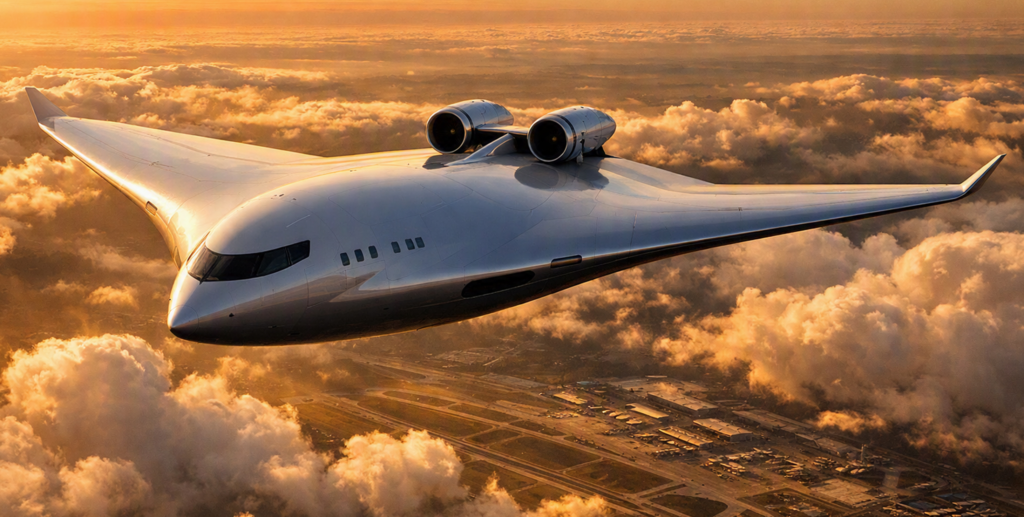
For 60 years, commercial aircraft have followed the same formula: a long aluminum tube, two wings, and under-wing engines. JetZero’s Z4 breaks that mold entirely.
The Z4 is a blended-wing-body (BWB) aircraft, a single smooth flying shape where the fuselage itself generates lift. This design unlocks:
- 50% lower fuel burn
- Massive structural efficiency
- Reduced bending stress and metal weight
- Longer range with less energy
It’s the first commercial-scale BWB platform aimed at mainstream passenger service, not just military stealth aircraft.
Massive Industry Buy-In — Before the First Flight
Although it hasn’t flown a prototype yet, JetZero has already attracted enormous commercial interest.
Airline Commitments
- United Airlines: ~$200 million
- Japan Airlines: major early investment
- Additional carriers: collectively over $1 billion in pre-orders
Government Support
The U.S. Air Force has committed $235 million, partnering JetZero with Northrop Grumman, the aerospace giant behind the B-2 and B-21 stealth bombers.
Manufacturing Expansion
JetZero has built a new factory in North Carolina and plans to hire 14,000 employees to support production, testing, and supply-chain operations.
This level of commitment before a first flight is virtually unheard of in commercial aviation.
The Catch: The First Flight Isn’t Until 2027
JetZero’s full-scale demonstrator is scheduled to fly in late 2027.
That means airlines and investors are betting billions on:
- A radical new airframe
- A new manufacturing process
- A new passenger-experience model
- A new aerodynamic and structural paradigm
It’s one of the biggest “long-shot” bets in modern aerospace, but the potential payoff is enormous.
Inside the Z4: A Completely Reimagined Passenger Experience
Four Wide Aisles
No more single-aisle bottlenecks; boarding and deplaning happen in minutes.
Central Kitchen Island Galleys
Crew can serve 250 passengers quickly and efficiently.
Spacious Restroom Clusters
Replaces cramped, scattered lavatories.
Flat Ceilings & Giant Overhead Bins
A one-to-one carry-on ratio for every passenger.
Extra-Wide Seating & Micro-Climate Zones
Temperature control down to the square foot no more freezing front rows and overheated rear cabins.
The cabin feels more like a flying theater than a traditional tube-and-wing aircraft.
The Engineering Breakthroughs Behind the Z4
Advanced Composite Structure
Built from out-of-autoclave carbon composites cured in open air using vacuum-bagging, dramatically reducing manufacturing cost.
Internal Tensile Pillar Web
Prevents cabin ballooning at altitude and naturally divides the interior into “rooms.”
Top-Mounted Engines
Placed to ingest boundary-layer airflow, reducing wake drag.
Shortened Landing Gear
Shaves off tons of steel weight.
No Vertical Tail
Replaced by active split drag rudders and elevons controlled by a gust-load system.
Low-Altitude Cabin Pressure
Equivalent to 4,000 feet, reducing jet lag and fatigue.
Cargo Flexibility
The deep center bay accommodates LD3 containers and flat pallets for fast turnaround.
Why the Z4 Could Reshape Global Aviation
- 50% Fuel Burn Reduction
A game-changer for airlines facing sustainability mandates and rising fuel costs.
- Lower Operating Costs
Less fuel, less weight, fewer structural stress points.
- Military & Commercial Dual-Use Potential
Cargo, tanker, and passenger variants all benefit from the BWB platform.
- Manufacturing Scalability
Composite construction enables faster production than traditional aluminum airframes.
- Passenger Comfort Revolution
The cabin design solves nearly every pain point of modern flying.
Key Takeaways
- JetZero’s Z4 is a 250-seat blended-wing-body aircraft promising 50% lower fuel burn.
- The company built a North Carolina factory and plans to hire 14,000 workers.
- Airlines including United and Japan Airlines have already invested over $1 billion.
- The first flight won’t happen until 2027, making this a massive industry gamble.
- The Z4’s design revolutionizes aerodynamics, manufacturing, and passenger comfort.
- The U.S. Air Force has invested $235 million, partnering JetZero with Northrop Grumman.
FAQ
Why are airlines investing before the first flight
Because the Z4 promises dramatic fuel savings, lower operating costs, and a competitive advantage.
What makes the Z4 different from traditional jets
Its blended-wing-body design generates lift across the entire aircraft, reducing fuel burn and structural stress.
When will the Z4 fly
The first full-scale demonstrator is scheduled for late 2027.
Where is JetZero manufacturing the aircraft
At its new North Carolina factory, with plans to hire 14,000 employees.
How much money has the project attracted
Over $1 billion in airline commitments plus $235 million from the U.S. Air Force.
 Spotify
 Apple Podcasts
 Podbean
 YouTube
 Spotify
 Apple Podcasts
 Podbean
 YouTube