
Energy has always been one of the most important inputs in manufacturing. Every machine, furnace, conveyor system, and industrial process relies on reliable energy supplies to operate. But in recent years, energy has evolved from a basic operational cost into a major strategic issue shaping the future of manufacturing.
According to the International Energy Agency, the industrial sector accounts for roughly 30 percent of global energy consumption and nearly 25 percent of carbon emissions worldwide. Manufacturing makes up the largest portion of that energy demand.
For some industries, energy costs represent a massive share of operating expenses. Steel manufacturing, aluminum production, cement manufacturing, and chemical processing all require enormous amounts of electricity and heat. In many cases, energy can account for 20 to 40 percent of total production costs.
Those costs have become increasingly volatile due to geopolitical tensions, fuel price fluctuations, and changing global energy markets.
Manufacturers have experienced dramatic swings in electricity and natural gas prices over the past several years. In some regions, industrial electricity prices have increased by more than 30 percent in a single year, forcing companies to rethink long-term energy strategies.
As a result, manufacturers are investing heavily in renewable energy solutions and energy efficiency technologies.
One of the most common approaches is the use of renewable power purchase agreements. These agreements allow companies to purchase electricity generated by solar or wind farms under long-term contracts, often locking in stable energy prices for 10 to 20 years.
Major manufacturers, including General Motors, Apple, and Microsoft, have signed large renewable energy agreements as part of broader sustainability commitments.
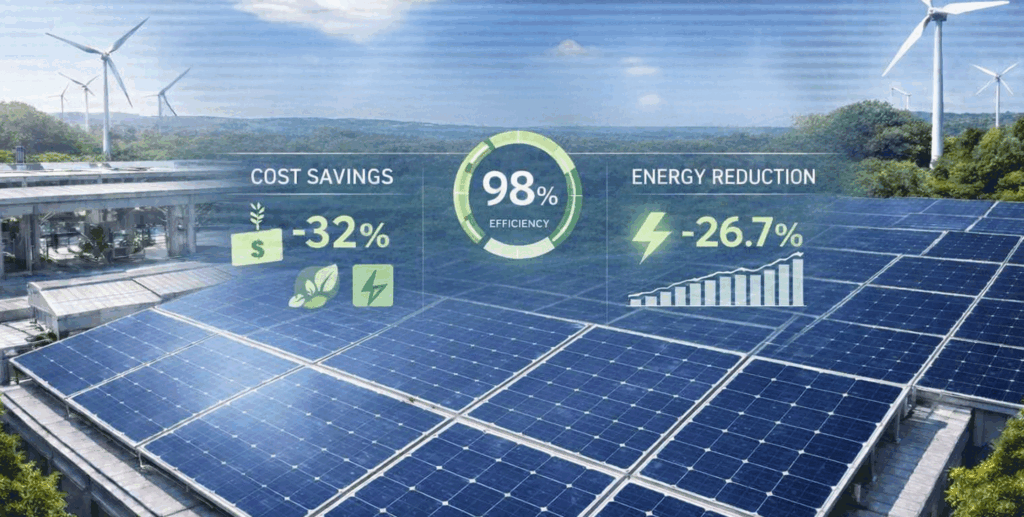
Solar energy installations are becoming increasingly common at manufacturing facilities. Large factory roofs and nearby land areas provide ideal locations for solar panels capable of generating significant amounts of electricity.
Energy storage technology is also advancing rapidly. Battery systems allow manufacturers to store excess energy generated during periods of low demand and use it later when electricity prices rise.
Smart energy management systems are helping manufacturers reduce waste as well. These systems use sensors and data analytics to monitor energy consumption across production lines, identifying inefficiencies and optimizing equipment usage.
Another emerging trend is the electrification of industrial processes. Historically, many manufacturing operations relied on fossil fuels such as natural gas or coal to generate heat for industrial processes. Electric heating technologies such as induction furnaces and electric arc furnaces are now providing more efficient and environmentally friendly alternatives.
Governments around the world are encouraging these transitions through tax incentives and sustainability regulations. In the United States, the Inflation Reduction Act includes billions of dollars in incentives designed to help manufacturers adopt cleaner energy technologies.
Many companies view energy investments as both an economic and environmental opportunity.
“Energy efficiency improvements are one of the fastest ways manufacturers can reduce costs and emissions at the same time,” said Fatih Birol, executive director of the International Energy Agency.
Looking ahead, energy strategy is likely to play an increasingly important role in global manufacturing competitiveness. Companies that can stabilize energy costs and reduce environmental impact will have an advantage in attracting investors, meeting regulatory requirements, and appealing to sustainability-conscious customers.
In an industry where margins can be tight and global competition intense, controlling energy costs may become one of the defining factors separating successful manufacturers from the rest.
 Spotify
 Apple Podcasts
 Podbean
 YouTube
 Spotify
 Apple Podcasts
 Podbean
 YouTube