
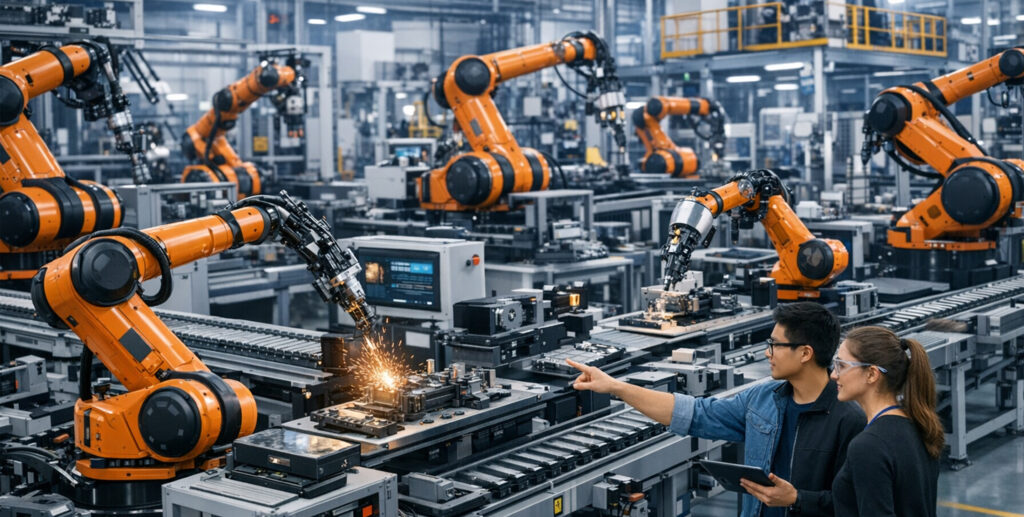
Manufacturing companies across the United States are facing a workforce challenge that could shape the future of the entire industry. As experienced workers retire and technology reshapes factory operations, manufacturers are racing to attract a new generation of skilled employees.
According to a study by Deloitte and the Manufacturing Institute, the U.S. manufacturing sector could face a shortage of 2.1 million workers by 2030 if current workforce trends continue. At the same time, more than 25 percent of the current manufacturing workforce is expected to retire within the next decade.
This demographic shift is creating a major talent gap at precisely the moment when manufacturing jobs are becoming more technologically complex.
For many years, manufacturing struggled with an image problem. Factory jobs were often associated with repetitive manual labor and limited career advancement. But the reality of modern manufacturing is dramatically different.
Today’s factories rely on robotics, automation systems, advanced analytics, artificial intelligence, and sophisticated engineering tools. Many manufacturing roles now require expertise in programming, data science, robotics maintenance, and digital systems management.
In other words, manufacturing is becoming a high-tech industry.
That transformation may actually align well with the interests of Generation Z. Born between the late 1990s and early 2010s, Gen Z workers grew up surrounded by digital technology and tend to be comfortable working with advanced software systems.
Manufacturers are increasingly targeting this generation through educational partnerships and workforce development programs.
High schools, community colleges, and technical institutes are expanding programs focused on robotics, automation, and advanced manufacturing skills. Many companies are also launching apprenticeship programs that allow students to gain hands-on experience while completing their education.
These programs are designed to show students that modern manufacturing offers exciting career opportunities.
Robotics competitions, engineering workshops, and factory tours are helping reshape perceptions of manufacturing careers. Students who visit advanced production facilities often discover environments filled with automation systems, digital dashboards, and cutting-edge technology.
Industry leaders believe changing perceptions is essential.
“We have to show young people that modern manufacturing is about innovation, problem solving, and technology,” said Carolyn Lee, president of the Manufacturing Institute.
Manufacturers are also adapting workplace culture to appeal to younger employees. Flexible work environments, opportunities for continuous learning, and clear career advancement pathways are becoming more common.
Another factor attracting younger workers is the opportunity to work on meaningful technological challenges. Many manufacturing companies are developing products that support renewable energy, electric vehicles, medical devices, and advanced aerospace systems.
These industries align with Gen Z’s strong interest in sustainability and innovation.
The competition for talent remains intense, however. Technology companies, startups, and other industries are also competing for digitally skilled workers.
For manufacturers, attracting Gen Z employees will require continued investment in education, training, and workplace culture.
If successful, these efforts could reshape the future workforce of manufacturing.
The factories of tomorrow will not just need machines and assembly workers. They will need data scientists, robotics engineers, and software developers working alongside advanced machines.
And the next generation of manufacturing talent may already be preparing for those roles in classrooms today.
 Spotify
 Apple Podcasts
 Podbean
 YouTube
 Spotify
 Apple Podcasts
 Podbean
 YouTube