
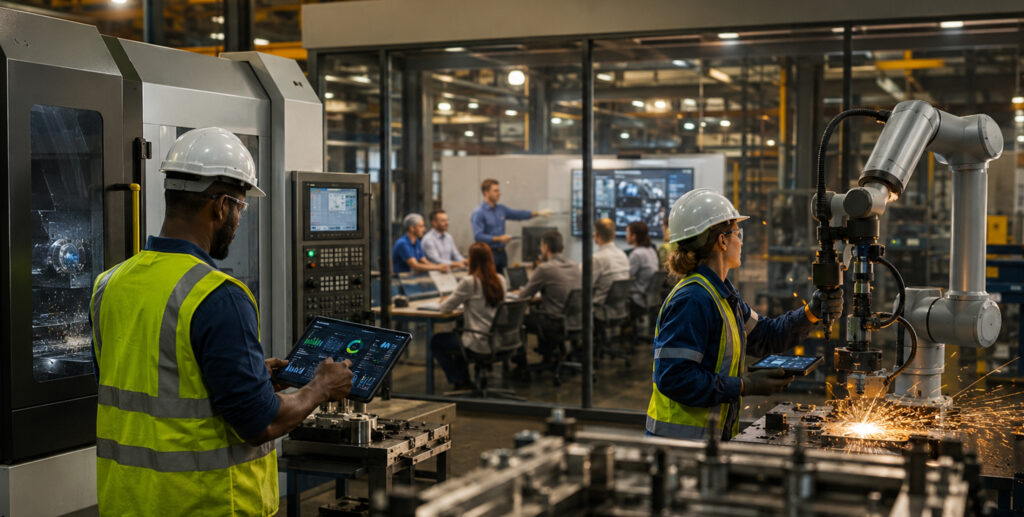
Google is making one of the most significant workforce-development investments the manufacturing sector has seen in years, committing $10 million to the Manufacturing Institute to help frontline workers build the artificial-intelligence skills that modern production now demands. It is a move that signals something bigger than a single donation. It reflects a growing recognition that the future of American manufacturing will depend on workers who can confidently use AI-powered tools on the shop floor, not just engineers and data scientists behind the scenes.
The Manufacturing Institute, the nonprofit workforce arm of the National Association of Manufacturers, will use the funding to create two new training programs designed specifically for production workers, technicians, and team leads. These courses will not be abstract or academic. They will be hands-on, practical, and grounded in real manufacturing tasks. Workers will learn how AI systems make recommendations, how to interpret machine-generated insights, and how to use digital tools to improve quality, reduce downtime, and solve problems faster.
This investment comes at a moment when manufacturers are adopting AI at a pace that would have been unthinkable even five years ago. Predictive-maintenance systems identify failures before they happen. Computer-vision tools are catching defects that human inspectors miss. Scheduling engines are optimizing production in real time. Generative AI is helping engineers design parts and helping operators troubleshoot equipment. But while the technology is advancing quickly, the workforce training needed to support it has lagged.
That gap is becoming a real barrier. The Manufacturing Institute estimates that the industry will need to fill more than two million jobs by 2030, many of which will require digital fluency. Deloitte reports that manufacturers who successfully integrate AI into operations can see productivity gains of 10 to 20 percent, but only if workers know how to use the tools. Without training, AI becomes another layer of complexity. With training, it becomes a force multiplier.
Google’s donation is designed to accelerate that shift. The new courses will help workers understand AI in a way that feels accessible rather than intimidating. Instead of treating AI as a mysterious black box, the programs will break down how the systems work, how they support decision-making, and how workers can use them to make their jobs easier and more efficient. The goal is not to replace workers. It is to empower them.
This initiative also reflects a broader trend in the tech sector. Companies like Google are increasingly recognizing that the next wave of AI adoption will not happen in offices. It will happen in factories, warehouses, and production facilities where physical work meets digital intelligence. Manufacturing is becoming one of the most important frontiers for AI, and tech companies want to be part of that transformation.
For the Manufacturing Institute, the investment strengthens its mission to prepare workers for the future. The organization already runs programs for veterans, women, students, and emerging leaders. Adding AI-focused training gives manufacturers a new tool to help workers grow their careers and stay competitive in a rapidly changing environment. It also helps companies introduce AI in a way that supports workers rather than overwhelming them.
The message behind the initiative is clear. AI is not replacing the manufacturing workforce. It is reshaping it. And with the right training, workers can use these tools to become more capable, more efficient, and more valuable than ever. Google’s investment is not just a donation. It is a signal that the future of manufacturing will be built by people who understand how to work alongside intelligent machines and that the time to prepare that workforce is right now.
 Spotify
 Apple Podcasts
 Podbean
 YouTube
 Spotify
 Apple Podcasts
 Podbean
 YouTube