
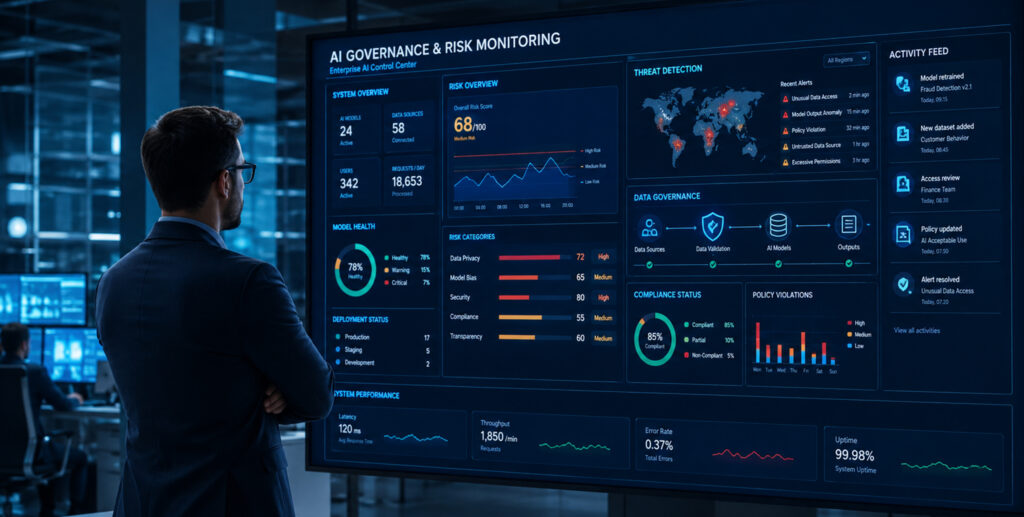
Summary
Organizations commonly make five major AI governance mistakes: unclear ownership, weak data controls, lack of model oversight, ignoring ethical risks, and failing to monitor AI systems after deployment. These gaps increase operational, legal, and reputational risk and prevent companies from safely scaling AI across the enterprise.
Why AI Governance Is Now a Critical Business Requirement
AI adoption is accelerating across manufacturing, logistics, finance, healthcare, and enterprise operations. But without strong governance, organizations face risks ranging from biased outputs to regulatory violations, IP leakage, and uncontrolled shadow-AI usage.
IEN reports that many companies rush to deploy AI tools without establishing the policies, controls, and accountability structures needed to manage them responsibly. As AI becomes embedded in core workflows, governance is no longer optional; it is foundational.
Mistake #1: No Clear Ownership or Accountability Structure
Many organizations fail to define who is responsible for AI oversight. Without clear ownership:
- Policies remain inconsistent
- Risk assessments are incomplete
- AI tools proliferate without guardrails
- Compliance teams lack visibility
Effective governance requires a cross-functional structure involving IT, security, legal, compliance, operations, and business leadership with explicit accountability for
decision-making and risk management.
Mistake #2: Weak Data Governance and Poor Input Controls
AI systems are only as reliable as the data they consume. Common failures include:
- Unvetted data sources
- Poor data quality
- Lack of labeling standards
- No controls on sensitive or regulated data
- Employees feeding proprietary information into external AI tools
Strong data governance ensures AI systems operate on clean, compliant, and secure datasets, reducing bias, errors, and leakage.
Mistake #3: No Model Validation or Performance Monitoring
Organizations often deploy AI models without:
- Testing for accuracy
- Checking for bias
- Stress-testing edge cases
- Monitoring drift over time
- Establishing retraining schedules
IEN notes that AI systems degrade if not continuously monitored. Without validation and lifecycle management, models become unreliable and potentially harmful.
Mistake #4: Ignoring Ethical, Legal, and Compliance Risks
AI introduces new categories of risk:
- Bias and discrimination
- Privacy violations
- Intellectual-property exposure
- Regulatory non-compliance
- Misuse of autonomous decision-making
Companies frequently overlook these risks until an incident occurs. Governance frameworks must include ethical guidelines, compliance reviews, and clear rules for acceptable use.
Mistake #5: No Post-Deployment Monitoring or Incident Response Plan
AI governance does not end at deployment. Organizations often fail to:
- Track model performance
- Monitor user behavior
- Detect misuse or drift
- Respond to failures or harmful outputs
- Update systems as regulations evolve
Without ongoing monitoring, AI systems can quickly become unpredictable or unsafe.
What Strong AI Governance Looks Like
- Clear Ownership and Cross-Functional Leadership
Defined roles for IT, security, legal, compliance, and business units.
- Robust Data Governance
Clean, secure, compliant datasets with strict input controls.
- Model Validation and Lifecycle Management
Testing, monitoring, retraining, and documentation.
- Ethical and Regulatory Safeguards
Bias mitigation, privacy controls, and responsible-use policies.
- Continuous Monitoring and Incident Response
Real-time oversight and structured remediation processes.
Key Takeaways
- Organizations commonly make five major AI governance mistakes.
- Lack of ownership and weak data controls create systemic risk.
- Model validation and ethical safeguards are essential for safe deployment.
- AI systems require continuous monitoring and lifecycle management.
- Strong governance enables safe, scalable enterprise AI adoption.
FAQ
What is the biggest AI governance mistake organizations make?
Unclear ownership without defined accountability: governance collapses.
Why is data governance so important?
AI outputs depend entirely on the quality, security, and compliance of the data used.
Do AI models need ongoing monitoring?
Yes, models drift, degrade, and become unreliable without continuous oversight.
How can organizations reduce AI risk?
By establishing clear governance structures, ethical guidelines, validation processes, and monitoring systems.
 Spotify
 Apple Podcasts
 Podbean
 YouTube
 Spotify
 Apple Podcasts
 Podbean
 YouTube