
Summary
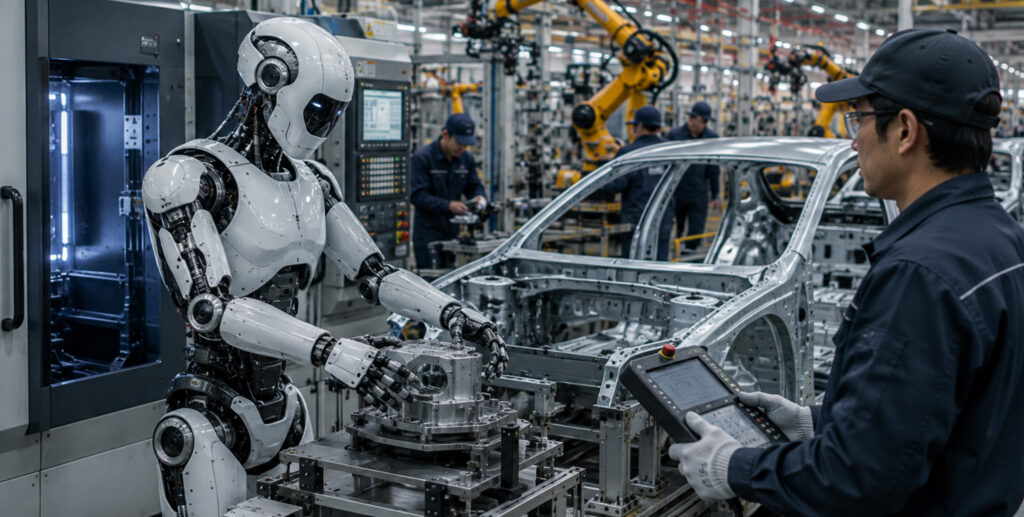
Mitsubishi Heavy Industries is launching a new initiative to test, build, and deploy humanoid robots for manufacturing, partnering with Tokyo-based startup MELTIN to accelerate development. The program aims to address labor shortages, improve safety, and expand automation capabilities across factories, logistics centers, and industrial environments.
Why Mitsubishi Is Entering the Humanoid Robotics Market
Manufacturers worldwide are facing severe labor shortages, rising production costs, and increasing pressure to automate complex tasks. Traditional industrial robots excel at repetitive, fixed-position work, but they struggle with tasks requiring mobility, dexterity, or human-like manipulation.
ThomasNet reports that Mitsubishi sees humanoid robots as the next major leap in industrial automation, capable of performing tasks that previously required human workers, especially in environments where flexibility and mobility are essential.
The move positions Mitsubishi alongside other global players investing heavily in humanoid robotics for manufacturing.
Mitsubishi’s Partnership With MELTIN: A Strategic Technology Alliance
Mitsubishi is collaborating with MELTIN, a robotics startup specializing in human-like movement and teleoperation systems. MELTIN’s technology focuses on:
- Highly dexterous robotic hands
- Human-like joint movement
- Advanced sensing and control systems
- Remote operation capabilities
By combining MELTIN’s robotics expertise with Mitsubishi’s manufacturing scale, the partnership aims to accelerate development and commercial deployment of humanoid robots across industrial sectors.
What Mitsubishi Plans to Test and Deploy in Manufacturing Environments
The initiative will explore humanoid robots for tasks such as:
- Machine tending
- Materials handling
- Assembly operations
- Inspection and quality checks
- Hazardous-environment work
- Logistics and warehouse mobility
These robots are designed to operate in human-built environments without requiring major facility redesigns, a key advantage over traditional automation systems.
Why Humanoid Robots Are Becoming Attractive to Manufacturers
Labor Shortages
Factories and logistics centers continue to struggle to hire enough workers for physically demanding or repetitive tasks.
Safety Improvements
Humanoids can perform dangerous work, reducing injury risk for human employees.
Flexibility and Mobility
Unlike fixed industrial robots, humanoids can walk, climb, and navigate complex environments.
Faster Deployment
Humanoids can be integrated into existing workflows without major infrastructure changes.
Higher Throughput and Consistency
Robots can operate continuously, improving productivity and reducing downtime.
How Mitsubishi’s Move Fits Into Global Robotics Trends
Mitsubishi joins a growing list of companies investing in humanoid robotics, including:
- Tesla (Optimus)
- Figure AI
- Agility Robotics
- Sanctuary AI
- Apptronik
The manufacturing sector is emerging as one of the strongest early markets for humanoid robots due to its combination of labor shortages, repetitive tasks, and safety requirements.
Mitsubishi’s entry signals that humanoid robotics is shifting from experimental to commercially viable.
What This Means for the Future of Manufacturing
- More Human-Like Automation on Factory Floors
Humanoids will complement traditional robots, expanding automation into new categories of work.
- Stronger Industrial Resilience
Robots can stabilize production during labor shortages or supply-chain disruptions.
- New Workforce Models
Human workers will increasingly supervise, program, and collaborate with humanoid robots.
- Faster Adoption of Advanced Robotics
Major manufacturers entering the market will accelerate commercialization and standardization.
- Competitive Advantage for Early Adopters
Companies integrating humanoid robots early will gain efficiency, safety, and throughput benefits.
Key Takeaways
- Mitsubishi will test and build humanoid robots for manufacturing.
- The company is partnering with robotics startup MELTIN.
- Humanoids will support machine tending, assembly, logistics, and hazardous-environment work.
- Labor shortages and safety needs are driving adoption.
- Mitsubishi’s move aligns with global momentum in humanoid robotics.
FAQ
Why is Mitsubishi investing in humanoid robots?
To address labor shortages, improve safety, and expand automation capabilities in manufacturing.
Who is Mitsubishi partnering with?
Tokyo-based robotics startup MELTIN, known for human-like movement and dexterity.
What tasks will humanoid robots perform?
Machine tending, materials handling, assembly, inspection, and hazardous-environment work.
Is this part of a global trend?
Yes, major companies worldwide are accelerating investment in humanoid robotics for industrial use.
 Spotify
 Apple Podcasts
 Podbean
 YouTube
 Spotify
 Apple Podcasts
 Podbean
 YouTube