TRANSCRIPT
Lewis A Weiss (00:01.793)
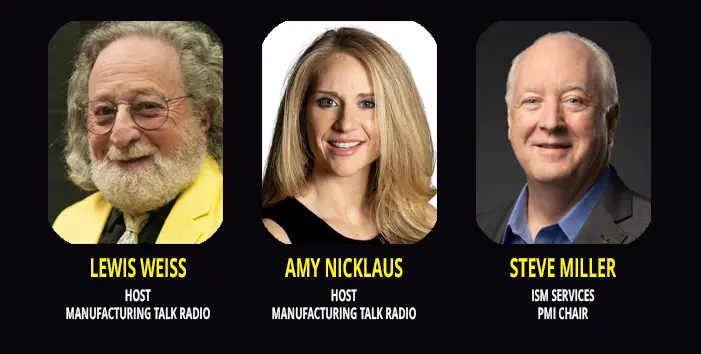
Good afternoon everyone. This is Lew Weiss and Amy Nicklaus at Manufacturing Talk Radio. We’re here again with Steve Miller, the committee chair for services at the Institute for Supply Management. And we are going to have the July twenty twenty-six report. Things are looking pretty good. Let’s get the rundown from Steve.
Steve Miller (00:28.812)
Very very good overall number this this month. We’re a little bit low below expectations. I think when I looking at you know the commentary before the numbers were released, it was 54.5 was the expectation, and our actual number was 54.1. So very close. up 0.0 or 0.01, sorry, 0.1 from last month. real good strength in business activity. when you see that that number
Lewis A Weiss (00:46.623)
No.
Steve Miller (00:58.838)
it is the highest number second highest number we’ve seen in the last twenty-six months. And then the new orders number was a good number as well. not quite as good as the as the business activity. It was about the fifth highest in the last twenty-six months. So good numbers there. You see the employment index though down at at forty-seven point four. It was only one month in expansion territory and then it dropped back into contraction.
and then the supplier deliveries is continuing to moderate. It’s still indicating slower deliveries than last month overall for the services sector, but but it’s a lower number meaning fewer industries are seeing that slowness increase than than last month.
Amy Nicklaus (01:46.521)
Okay, great.
Lewis A Weiss (01:47.283)
In in the respondent comments, it seems as though that there’s some conflicting views. It seems as though there’s a fair amount of not so happy people and but the numbers indicate otherwise. What what do you contribute that to?
Steve Miller (02:08.583)
well a a number of of fifty-four means fifty-four percent of the industries are feeling good. industry participants are feeling good, and it’s a blend within each industry. and then forty-six percent are saying, you know, not as good not as good as I’d like it to be. So so that that to me is explanation of of the mix. And what’s great is we get commentary that shows those that are growing and those that are shrinking within each of the
Amy Nicklaus (02:25.784)
Okay.
Steve Miller (02:38.165)
of the indexes. So we get a sense for for example, in employment, we’re seeing shrinking, but the shrinking is a result of people not backfilling attrition, rather than across the board headcount reductions. But there’ll be a few companies that’ll say, lost big orders, needed to do a headcount reduction, shift in business, so we’re hiring, but we’re not hiring as many as we were. Only one comment around AI.
but I included it just because that seems to be the topic of the day for the last several months is are we really seeing an AI impact on the employment side? On the the new business construction is one Lew that really stands out to me as Tale of Two Cities, where you see the housing construction guys very unhappy and the the data center construction people
unhappy that things are costing more or might be delayed, but very happy at their level of business activity.
Lewis A Weiss (03:43.86)
Saw an interesting comment made by someone regarding AI you know, ’cause people are concerned that they’re gonna lose their jobs and so on because of robotics and so on. And the comment was made that they’re gonna still always need somebody to pick the robots up when they fall down.
Steve Miller (04:02.221)
Very, very good.
Lewis A Weiss (04:05.547)
I think we’re gonna be really in trouble when the robots and AI know how to turn themselves back on when humans turn them off and build themselves. Yeah, yeah.
Steve Miller (04:14.559)
And build themselves. Yeah. We’ve seen a movie or two about that.
Amy Nicklaus (04:16.248)
Right. Yeah, one of the things that we talked about when we did the manufacturing report in, you know, we kind of Susan left us with a final comment really, which was what what what the one of the things that they’re finding is that the the importance of upskilling now bec even in your current position.
Because of AI and understanding it and because of, you know, the replacement of AI of certain jobs and maybe s keeping those and like growing and that’s how they’re gonna kinda keep what they have in employment. is that something that anybody’s commented on?
Steve Miller (04:55.799)
Well so
There have been, I don’t think in this report, but in prior reports, there have been commentary around the skill set to be able to make it work. I was at a a business dinner a month ago. we had a CFO from a sports team, a CFO from a large marketing media organization, and a VP of finance from a technology company. And the first two said,
Yep, we’re trying AI, we’re using various packages, seeing where it can benefit us. And the technology guy was saying, Yeah, I come in the first day of the month and my full month-end report is already done. It was done overnight using the bots, getting the information, and people are like staring at him like, wow, this is this is a big gap between those that have and those that don’t have, in terms of that internal technical capability.
Amy Nicklaus (05:52.684)
Yeah.
Amy Nicklaus (05:58.724)
Yeah.
Lewis A Weiss (06:00.157)
I think that the numbers that I’m hearing is that basically in from ma in manufacturing, something like sixty or seventy percent of manufacturing still has not not gotten into the swing of things in regards to AI. Is is are you following that at all?
Steve Miller (06:21.277)
so we’re not seeing a lot of commentary in the services industry around application of AI and where it’s delivering benefits. in specifically in the procurement field, there’s a lot of areas where AI is being provided and speeding up work or making less touches, which really at the end of the game means fewer people. whether you do layoffs or whether you just don’t hire as fast if you’re a growing company.
depends. But certainly it’s it’s taboo to talk about we’re investing in AI and we’re gonna be reducing headcount. it’s a it’s a very touchy subject, but to me in some business areas it’s just inevitable. whether we talk about it or whether it just happens on the side. There are administrative roles that you know just look at spell check. you know editors in terms of
Lewis A Weiss (07:06.123)
No, no.
Steve Miller (07:19.351)
grammar and I mean that’s AI that’s been in systems for twenty years. there’s a lot of AI already in application which we can see has either increased the amount of stuff we turn out, which sometimes is not good, or reduces the amount of labor we need and the amount of secretaries that we need. You know, look 20 years ago the amount of secretaries and admins we have now it’s very unusual to find anyone other than C suite that has a dedicated admin.
because travel’s automated, you know, writing is automated, email, that all have elements of AI incorporated into them. We just don’t call it AI right now.
Amy Nicklaus (07:57.486)
Yeah.
Lewis A Weiss (07:58.967)
I had the opportunity fairly recently to go to a steel mill and it was a tubing steel mill. And I was taken on a tour of the plant and the the production line in the in the the production of steel tubing was about three quarters of a mile long. And we walked along the plank watching the process continue.
I don’t think I saw five people below us. I mean, it was totally automated. Totally automated.
Steve Miller (08:38.881)
Yeah, in the data center business, you know, we’re seeing it drive employment right now because of construction. But there aren’t going to be a whole bunch of people pushing buttons on computers in the data centers. You know, the idea there is it’s going to be lights out. You build it and then you let it run. so it’d be really interesting to see over the next two to three years, or maybe it’s ten years, as a data center investment starts to shift from building to operating.
Lewis A Weiss (08:49.591)
Mm-hmm.
Amy Nicklaus (08:50.2)
That’s true.
Steve Miller (09:07.293)
and the operating is really just utility costs, not people.
Amy Nicklaus (09:11.884)
You know, one of the things that I noticed in the report and it just stuck out for me was healthcare. and not seeing a ton of back orders like
you know, like we used to see. And I wonder if and I wanted to get your opinion on if that is a shift ’cause I remember like during COVID we couldn’t nobody could get a talk about back orders in healthcare. Like getting a mask was like, you know, finding gold. You know, the p they couldn’t get like a needle to even implement some of the for some of the the the vaccines. So I’m wondering if that’s just like we we learned our lesson and that’s because it’s been, you know, we’ve l brought a lot back into the US to help
fulfillment for those orders, so we’re ahead of that, or if that’s just something that’s happening just as of right now, as of this year, because of, you know, anything else? Or I wanted to get your your thought process on that.
Steve Miller (10:05.623)
Sure. Specifically for that, Amy, I think it’s just worth seeing w we didn’t see a lot of shortages before COVID. COVID we saw radical spikes in demand. for things that really it from a Kanban standpoint, they were just pull system type things. You run out of something, you reorder it, it comes out of the distribution center, they reorder it, goes into their area. But as a as an end user, you ordered it when you needed it. Nobody thought PPE or needles.
Amy Nicklaus (10:12.332)
Right.
Steve Miller (10:35.307)
was anything that they would put as an A SKU that they needed to make sure that they had high inventories. And so now we’ve seen that level out. We’re back to more stable demand. So the types of shortages we’ve seen has been have been specific manufacturing sites that have gone out, or specific contamination, which has caused shortages for specific substances. But in general, yeah, your your observation is the same thing I’m seeing is that very stable, very few shortages.
Amy Nicklaus (10:51.509)
Right.
Amy Nicklaus (11:04.397)
Yeah.
Steve Miller (11:05.259)
The the big issue it was two years ago, probably still is in some cases, was all of the hand sanitizer, flammable, and people were actually losing their or at risk of losing their insurance coverage for their warehouses because of the amount of flammable product they were storing that their insurance wasn’t set to cover. And they couldn’t get rid of it. Nobody wanted it.
Amy Nicklaus (11:12.838)
yeah.
Lewis A Weiss (11:32.811)
We still have an extra slip supply of toilet paper and hand towels at home.
Steve Miller (11:36.902)
Yeah. Yeah.
Amy Nicklaus (11:41.24)
I will say that I think it’s just like a natural thing now. I feel like every time I go to Costco I get two. Just in case. I think it’s just like a mental like paper towels and toilet paper. I just I just grab two every time. Just I don’t know what.
Steve Miller (11:47.565)
Just to make sure. Yeah.
Steve Miller (11:56.822)
After the Great Depression, people were putting money under the mattresses, right? Grandparents, they weren’t they weren’t putting money in the bank again, no way, no how.
Amy Nicklaus (12:06.028)
Yeah. I see that.
Lewis A Weiss (12:08.615)
So getting back to the report, your the pricing has gone up a bit, but that’s partly a normal inflationary thing. what about tariffs? What kind of impact is tariffs having on the services side?
Steve Miller (12:31.501)
So the commentary that we got around tariffs was specifically around Canadian tariffs in agriculture and lumber, a concern about a fifty percent tariff and what that would do to product that’s coming in. I’m not a tariff expert, so I don’t know exactly how the the Canadian tariff surcharges are going into effect if they go into effect for for those products long term.
but those were two areas where we got commentary on and concern. That that prices index, I wouldn’t be surprised to see it in the seventies for as for two to four months following full solution of the petroleum pricing getting back down to where it was before. You know, that’s I Lew, I gotta restate that.
since the prices index shows is really an indication of up in price, I don’t see a shift down into the fifties for for a while because we’re not gonna see continued up in price, but compared to January, you know, we’re still twenty dollars a barrel higher, and we haven’t seen a full impact of petroleum related products flowing through the supply chain that we’re gonna continue to pay higher prices on than last month.
For several months here still. and then what we’ll see is that’ll that’ll start to moderate and we’ll be back down into the sixties, I think, by the end of the year. Maybe high fifties, but that would have to be something really dramatic, you know, price of oil down in the fifty dollars range.
Lewis A Weiss (14:14.083)
you’re not gonna see that any time soon. I’ll be surprised to see it at in the eighties any time soon. Which is where it historically has been in recent times.
Steve Miller (14:16.481)
I don’t think so either.
Steve Miller (14:27.499)
Yeah, well right now I think we’re around eighty-four, eighty-four, eighty-five. so you know, anybody’s guess as to whether that’s gonna go up or down over the next two months as we get, you know, multiple information in the press, things are going better, things are going worse. and you know, the good news though, what’s the the old saying? necessity is the mother of invention. We’re seeing alternate pipelines getting funded.
Lewis A Weiss (14:30.529)
Yeah. Right.
Steve Miller (14:56.809)
and other ways of moving oil increasing and that’s gonna have long term benefit, at least for those that are buying oil, not for those who are selling oil.
Lewis A Weiss (15:09.035)
There’s there’s an interesting story f floating about that Iran may have known this was coming and they floated something like a hundred and ninety million barrels of oil on ships before the Iranian war started. And that was a way of trying to stabilize the pricing of oil, at least for
Steve Miller (15:30.017)
Well.
Lewis A Weiss (15:39.073)
sixty days if in fact there was a war and it only lasted a week or two or three. that’s a story that I’m gonna be checking out and we’ll we’ll be reporting on that sometime soon. So
Steve Miller (15:53.633)
China buys a lot of oil, for sure.
Lewis A Weiss (15:55.893)
Yeah they do. Yeah they do. so getting again, getting back to the report, I see the the import we talked about the imports. regarding backlog, which seemed to have taken a hit, minor hit.
Steve Miller (16:16.651)
Yeah. Yeah, it’s it’s been it’s been strong. You know, it’s been above fifty for is it five or six months? it’s got a pretty good run going. but it’s just slightly above fifty now where it was it was much stronger last last few months. that one, Lew, I see directly related to employment. if you’re able to if you’re able to keep your backlog around
you know around fifty, not increasing or decreasing, same as last month. And you don’t need to hire more people, you’re not gonna hire more people. and that’s the big for me, that’s the one that I keep watch on. Is are we continuing to see a backlog and backlog increase? If we see significant backlog increasing, if we’re seeing 56, 57, 58, I’d expect to see that employment number going up. If we see 50s, 52,
Lewis A Weiss (16:50.988)
Mm-hmm.
Steve Miller (17:10.193)
it seems like people are able to or companies are able to keep up with the backlog without hiring more people. There isn’t a reason for them to increase increase employment. And then when you compound that with potential benefits of AI, are those pilot projects going to be able to sustain from a productivity standpoint, then some of the some of the folks who leave or retire, you know, maybe we don’t need to or at least should wait.
a couple of extra months to see if we can do without hiring another person to that role. Except for the very specialized roles, which still seem to be difficult to hire for.
Amy Nicklaus (17:49.847)
You know, I did notice that and I thought that this was this looked good to me is for business services and management for small businesses, the comment was there’s growth. We’re seeing consistent growth. And I think, you know
for the most part, small businesses are really what make up a tremendous amount of the country, right? So when we’re t talking about a lot of these businesses, we’re talking from like a thirty thousand foot scale. But to hear to hear that number and really relate that to the small business, I think that sounds incredibly promising. So why do you th I mean what do you attribute to that to?
Steve Miller (18:28.013)
So I I think that Amy, we we have small businesses that are included in the survey, but not to the level, you know, not not to the level that you see them making up the number of companies in you know in the US industry. so I think that’s an area where we could we could continue to make the ISM services survey more robust, especially in the conversation of AI, because there are a lot of things that AI
Amy Nicklaus (18:33.452)
Yeah.
Amy Nicklaus (18:44.215)
Right.
Steve Miller (18:58.029)
From an administrative standpoint, can help you with. And you don’t need to have a whole bunch of people reviewing invoices, and you don’t have to buy an ERP. If you’re a fairly simple business, you can reconcile invoices and receipts and payments from your bank statement and really just look at exceptions very easily using AI. You can automate sales and sales distribution.
with some AI tools. Is it gonna be as good as you writing it yourself? Not yet. But and boy, when you see it coming across, if you’re like me, you delete it right away. But I think that’s I think that’s cer that’s a huge area where AI is going to benefit the US is the ability for people to grow small businesses faster.
Amy Nicklaus (19:47.737)
agree, I also I also personally believe that AI or no AI, at the end of the day, people do business with people that they like and there has to be that element of connection. And in a small business, you still need that. That’s that’s still a very important part of, you know, who people choose to do business with on a day to day level. So I think there’s still a lot of growth opportunity for actual people jobs.
Steve Miller (20:15.105)
That’s one of the the the unpleasant consequences of have for some people of having a procurement organization. Because as you grow from a small business to a larger business, it’s about who’s the best provider, not who’s the one that you’ve grown to trust over a period of time who you know. and and so that as companies grow bigger and bigger, it becomes a more and more and more of a financial consideration.
Amy Nicklaus (20:22.54)
Yeah.
Amy Nicklaus (20:33.165)
Yeah.
Steve Miller (20:42.285)
You know, when you’re spending twenty thousand dollars, do you wanna spend fifty thousand dollars doing a supply review? No, never. but if you’re spending twenty million dollars, yeah, you’re gonna look at that every year.
Amy Nicklaus (20:55.318)
Yeah. Yeah, that’s true. That’s very true. Well, keep rooting for the small businesses. That’s absolutely true.
Steve Miller (21:02.303)
Absolutely. They’re the ones that make America run.
Lewis A Weiss (21:07.157)
Considering that’s the backbone of our economy, the small business. And I I I thought I heard the numbers recently about the number of new businesses that are opening up have hit record numbers. d do you know of anything about that, Steve?
Steve Miller (21:27.903)
No, that’s not that’s not on my radar. But if that’s true and and that the the number of failures reduces from ninety five percent over five years to eighty because of of better capabilities, that would be awesome.
Lewis A Weiss (21:30.283)
Yeah.
Lewis A Weiss (21:45.835)
Yeah, absolutely. Absolutely. Amy, any other points you want to touch on?
Amy Nicklaus (21:52.791)
No, I just just I guess my last question would be like what sh what would you be have us be looking for for next month? What are the hopes for for next month or what are you for maybe forecasting?
Steve Miller (22:05.303)
Well, the the business activities second highest in twenty-six months. new orders fifth highest in the last twenty-six months. so I would love to see that backlog grow a little bit. Enough that we’re gonna we’re gonna increase employment. that’s what I would like to see. and then we get, you know, we get a PMI that’s in that’s fifty five, fifty six because our employment number gets to fifty two. that would be that would be a great sign that
more people are winning in the economy, and that that would be great.
Amy Nicklaus (22:39.372)
Yeah, I think that sounds like cross our fingers, let’s help me get there.
Lewis A Weiss (22:41.367)
I I can’t speak to the services area, but on the manufacturing side, June, July and August typically things go down, and yet this past summer everything has gone up. so I don’t know if that’s an anomaly or is that a forecast for what’s coming in September, October, which typically is when things pick up in manufacturing. so the indication to me is that it’s gonna get even better. Or
It’s an anomaly and it’s gonna bottom’s gonna fall out. One or the other.
Steve Miller (23:15.755)
Yeah, there’s there’s you know, old sayings are old sayings for a reason. war makes good business. so so in your services industry, if Tim, who we we both know and trust, Tim’s perspective of services trails manufacturing by three to four months, we’re pretty excited in the services industry that there’s more to come with the numbers that we saw in the manufacturing PMI.
Lewis A Weiss (23:19.681)
Ha ha ha.
always.
Lewis A Weiss (23:43.543)
Well, from from your lips. Steve, any parting comments?
Steve Miller (23:50.199)
Watch out for those those petroleum related product price roll through, you know, and make some deals with suppliers that you know you’re you’re they need to hold tight for the next six months and you’ll share benefit on the downside when oil prices come down, or you’ll make good, you know, when you get down there at at the end if that hasn’t happened, so that everybody can win together rather than you know, it being a constant struggle of price up, price down.
Lewis A Weiss (24:20.279)
Okay, folks, that’s that’s a wrap. If you liked the show, give us a like. If you would like, sign up and subscribe and you’ll know be notified when our other shows are being broadcasted. Amy, thank you for joining. Steve, thank you. We will see you next month. Take care, everyone.
Steve Miller (24:38.07)
My budget.
 Spotify
 Apple Podcasts
 Podbean
 YouTube
 Spotify
 Apple Podcasts
 Podbean
 YouTube