
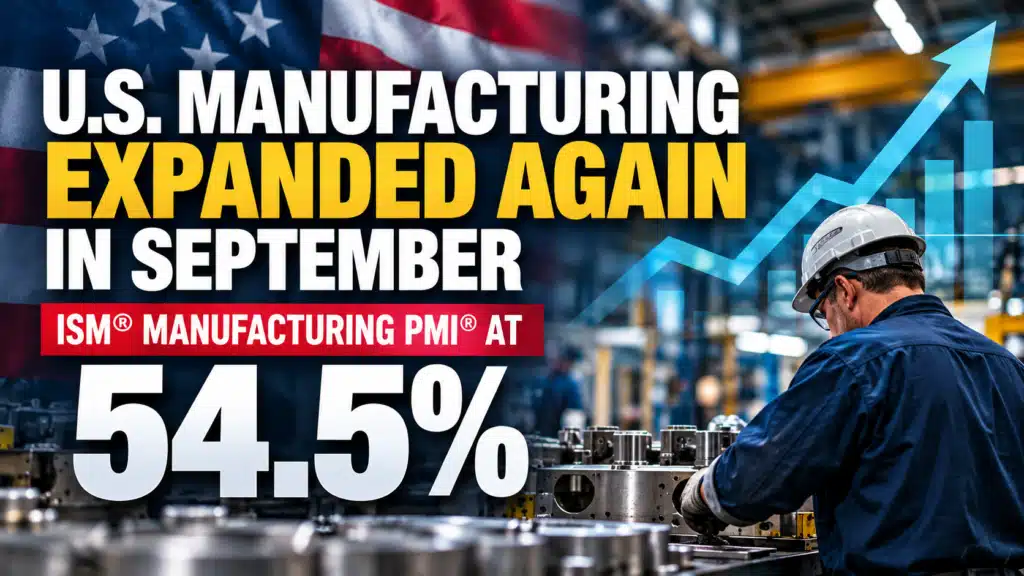
U.S. Manufacturing Expanded Again in September: ISM® Manufacturing PMI® at 54.5%
U.S. manufacturing expanded for the ninth consecutive month in September 2026, according to the latest ISM® Manufacturing PMI®. The index registered 54.5%, just 0.1 percentage point below August.
September 2026 Manufacturing PMI Summary
The September PMI® shows a U.S. manufacturing sector that continues to expand despite increasing cost pressures and supply-chain challenges. New orders, production, employment, supplier deliveries, prices, imports and exports remained in expansion territory, while inventories contracted.
Cost pressures intensified sharply during the month, particularly for steel, aluminum, tariffs and petroleum-based inputs.
September 2026 ISM Manufacturing PMI: Key Numbers
| Index | September | Change | Status |
|---|---|---|---|
| Manufacturing PMI | 54.5% | -0.1 | Expansion |
| New Orders | 55.3% | +1.6 | Expansion |
| Production | 56.7% | -1.6 | Expansion |
| Employment | 52.7% | +1.5 | Expansion |
| Supplier Deliveries | 59.0% | — | Slower |
| Inventories | 48.6% | — | Contracting |
| Customers’ Inventories | 41.6% | — | Too Low |
| Prices | 77.9% | +6.8 | Increasing |
| Backlog of Orders | 56.4% | +4.6 | Expansion |
| New Export Orders | 50.9% | -2.3 | Expansion |
| Imports | 51.0% | -1.5 | Expansion |
The most significant movement came from the Prices Index, which registered 77.9%, an increase of 6.8 percentage points from August.
Manufacturing Activity Holds Firm Despite Cost Volatility
The September PMI® indicates that the manufacturing sector remains firmly in expansion, although manufacturers are dealing with growing price pressure and continued supply-chain friction.
Demand remains relatively strong, employment improved and order backlogs increased. At the same time, rising input costs and slower supplier deliveries continue to create challenges for manufacturers heading into the fourth quarter.
What’s Driving September’s Manufacturing Performance?
1. Demand Strengthens Again
New orders expanded for the ninth consecutive month, increasing to 55.3%. The Backlog of Orders Index jumped 4.6 points to 56.4%, suggesting that manufacturers continue to have a solid pipeline of demand.
Three of four demand indicators remained in expansion, while the Customers’ Inventories Index remained in “too low” territory.
2. Production Remains Strong, Though Slightly Cooler
The Production Index declined 1.6 points to 56.7%. Despite the monthly decline, production remains comfortably above the 50% threshold that separates expansion from contraction.
3. Employment Improves
The Employment Index increased 1.5 points to 52.7%, indicating that manufacturing employment expanded during September. The report also recorded a 1.5-to-1 ratio of positive to negative comments regarding labor conditions.
4. Prices Surge to Near Four-Year Highs
Cost pressures were one of the biggest developments in the September report. The Prices Index climbed 6.8 points to 77.9%.
Higher prices were reported by 58.6 percent of respondents, driven by steel and aluminum, tariffs, and petroleum-based products.
The increase highlights the growing impact of raw-material costs and trade policy on manufacturers’ operating expenses.
5. Supplier Deliveries Slow for the 10th Straight Month
The Supplier Deliveries Index remained elevated at 59.0%, indicating that supplier delivery performance continued to slow.
Persistent delivery delays point to continued tightness in portions of the manufacturing supply chain as demand remains strong.
Industry-Level Manufacturing Performance
Twelve manufacturing industries reported expansion in September, while two industries contracted.
Industries Reporting Expansion
- Electrical Equipment
- Nonmetallic Minerals
- Primary Metals
- Plastics & Rubber
- Computer & Electronic Products
- Fabricated Metal Products
- Furniture
- Food & Beverage Products
- Transportation Equipment
- Machinery
- Miscellaneous Manufacturing
- Chemical Products
Industries Reporting Contraction
- Printing
- Textile Mills
Manufacturers Cite Tariffs, Steel Shortages, Labor and AI Demand
Comments from manufacturers participating in the ISM survey highlight several of the challenges facing the industry, including tariffs, labor shortages, steel availability and strong demand associated with artificial intelligence and data-center construction.
“Canada tariffs have impacted cross-border costs… hurting the very lead times government buyers are concerned about.”
— Machinery
“Our biggest challenge continues to be a severe shortage of workers… The second challenge is general availability of steel; the market is getting worse.”
— Fabricated Metal Products
“Due to booming demand of AI and data centers, domestic steel capacity has been stretched and pushed.”
— Machinery
“Every month, we are faced with new headwinds… this month, it is the trade war with Canada… causing prices to go up and uncertainty.”
— Transportation Equipment
What the September PMI Means for U.S. Manufacturers
1. Strong Demand Heading Into Q4
Low customer inventories and rising order backlogs suggest that demand could remain supportive as manufacturers enter the fourth quarter.
2. Cost Pressures Are Now the Dominant Headwind
The Prices Index reaching 77.9% demonstrates how significant inflationary pressure has become across metals, components, petroleum-based products and other manufacturing inputs.
3. Labor Availability Is Improving Slightly
The increase in the Employment Index suggests some improvement in manufacturing labor conditions, although workforce shortages remain a significant concern for many companies.
4. Supply Chains Remain Tight
Slower supplier deliveries and reported shortages involving electronics, printed circuit boards, steel and DRAM indicate that supply-chain constraints remain an issue for manufacturers.
5. Tariffs Are Reshaping Sourcing Strategies
Manufacturers continue to cite tariffs involving Canada and China as significant sources of cost increases and operational uncertainty. Companies may need to continue evaluating suppliers, sourcing strategies and inventory levels as trade conditions evolve.
Key Takeaways From the September 2026 ISM Report
- September’s Manufacturing PMI® registered 54.5%, marking the ninth consecutive month of expansion.
- New orders, employment and order backlogs strengthened during the month.
- The Prices Index surged to 77.9%, reflecting significant increases in manufacturing input costs.
- Inventories contracted while customer inventories remained “too low.”
- Supplier deliveries slowed for the 10th consecutive month.
- Tariffs, steel availability and strong AI and data-center demand are creating additional operational pressure.
- Overall manufacturing activity continues to contribute to broader economic expansion.
Frequently Asked Questions About the September 2026 Manufacturing PMI
Is U.S. manufacturing still expanding?
Yes. The September 2026 ISM Manufacturing PMI® registered 54.5%, marking the ninth consecutive month of manufacturing expansion.
Why did the manufacturing PMI dip slightly in September?
The headline PMI declined only 0.1 point from August. A decline in production offset gains in new orders and employment, leaving the overall index essentially unchanged.
Are manufacturing prices still rising?
Yes. The ISM Prices Index increased 6.8 points to 77.9%. Manufacturers cited steel, aluminum, tariffs and petroleum-based products among the factors contributing to higher costs.
What does a PMI above 50% mean?
A Manufacturing PMI® reading above 50% generally indicates that the manufacturing sector is expanding compared with the previous month. A reading below 50% indicates contraction.
Source: Institute for Supply Management® (ISM®), September 2026 Manufacturing ISM® Report On Business®.
ISM®, Manufacturing PMI® and related terminology are trademarks or registered trademarks of the Institute for Supply Management®.
 Spotify
 Apple Podcasts
 Podbean
 YouTube