
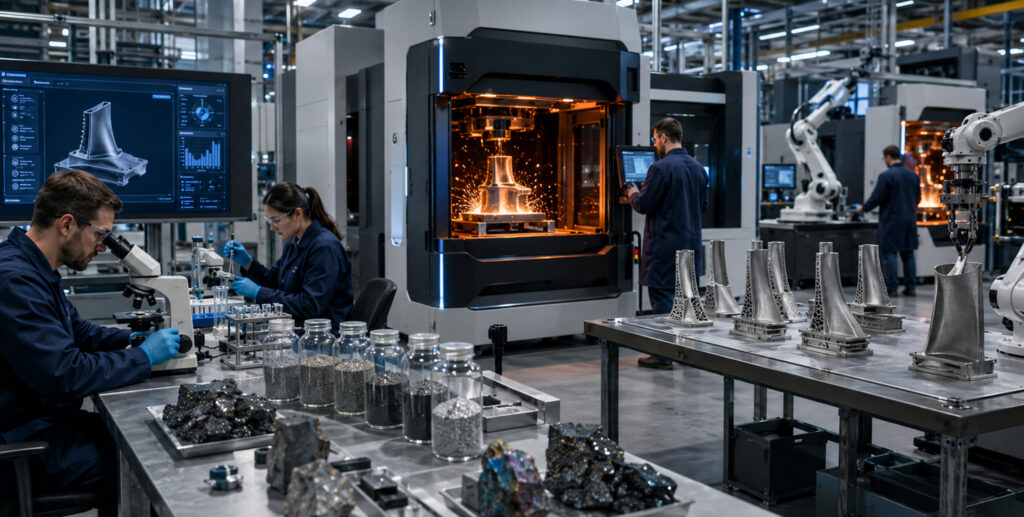
NIST has launched a new Manufacturing Extension Partnership (MEP) pilot program aimed at strengthening the U.S. industrial base by accelerating additive manufacturing for aerospace components and establishing a domestic critical-minerals supply chain. Each pilot project will receive approximately $20 million in federal funding to support advanced manufacturing, supply-chain resilience, and national security priorities.
Why NIST Is Launching This Pilot Program Now
The U.S. is facing two major industrial challenges:
- Aerospace manufacturers need faster, more flexible production methods to meet rising demand for defense systems, commercial aircraft, and space technologies.
- Critical minerals remain a strategic vulnerability, with the U.S. heavily dependent on foreign sources for rare earths, battery materials, and specialty metals.
NIST’s new MEP pilot program directly targets both issues by funding projects that:
- Expand additive manufacturing capabilities
- Strengthen domestic mineral processing
- Support small and mid-sized manufacturers
- Improve supply-chain transparency and resilience
The initiative is part of a broader federal effort to rebuild U.S. industrial capacity and reduce reliance on foreign suppliers.
What the MEP Pilot Program Will Focus On
- Accelerating Additive Manufacturing for Aerospace Components
Additive manufacturing (AM) is increasingly essential for:
- Lightweight aerospace structures
- Rapid prototyping
- Complex geometries
- High-performance materials
- Faster production cycles
The pilot program will help manufacturers adopt AM technologies, improve part qualification, and integrate digital production methods into aerospace supply chains.
- Establishing a Domestic Critical Minerals Supply Chain
Critical minerals — including rare earths, lithium, cobalt, nickel, and specialty metals — are essential for:
- Defense systems
- Semiconductors
- EV batteries
- Aerospace components
- Clean-energy technologies
NIST’s pilot will support efforts to:
- Identify domestic mineral sources
- Improve extraction and processing
- Build refining and separation capacity
- Strengthen downstream manufacturing
- Reduce dependence on foreign suppliers
Each pilot project will receive about $20 million, signaling a significant federal commitment to supply-chain resilience.
How This Strengthens the U.S. Industrial Base
- Improved National Security
Aerospace components and critical minerals are foundational to defense readiness. Domestic production reduces geopolitical risk.
- Support for Small and Mid-Sized Manufacturers
The MEP network specializes in helping smaller firms adopt advanced technologies, a key step in modernizing U.S. supply chains.
- Faster Innovation Cycles
Additive manufacturing enables rapid iteration, lower tooling costs, and faster time-to-market for aerospace and defense products.
- Stronger Domestic Supply Chains
Critical minerals development ensures U.S. manufacturers have reliable access to essential materials for high-tech production.
Industry Context: A Broader Federal Push on Critical Minerals
The NIST pilot complements other federal initiatives, including:
- DOE investments in domestic critical minerals projects
- DOD funding for rare-earth processing
- International agreements with Japan, Mexico, and the EU
- National efforts to build resilient supply chains for EVs, semiconductors, and defense systems
The U.S. is clearly moving toward a long-term strategy of industrial independence and supply-chain security.
Key Takeaways
- NIST launched a new MEP pilot program to strengthen the U.S. industrial base.
- The program focuses on additive manufacturing for aerospace and domestic critical-minerals supply chains.
- Each pilot project will receive about $20 million in federal funding.
- The initiative supports national security, supply-chain resilience, and advanced manufacturing adoption.
- The program aligns with broader federal efforts to rebuild domestic mineral processing and high-tech production.
FAQ
What is the purpose of the NIST MEP pilot program?
To accelerate additive manufacturing adoption and build a domestic critical-minerals supply chain.
How much funding is allocated?
NIST has committed about $20 million per pilot project.
Why are critical minerals a priority?
They are essential for aerospace, defense, semiconductors, EV batteries, and clean-energy technologies, and the U.S. relies heavily on foreign suppliers.
Who will benefit from the program?
Aerospace manufacturers, critical minerals developers, small and mid-sized manufacturers, and U.S. supply-chain partners.
 Spotify
 Apple Podcasts
 Podbean
 YouTube
 Spotify
 Apple Podcasts
 Podbean
 YouTube