
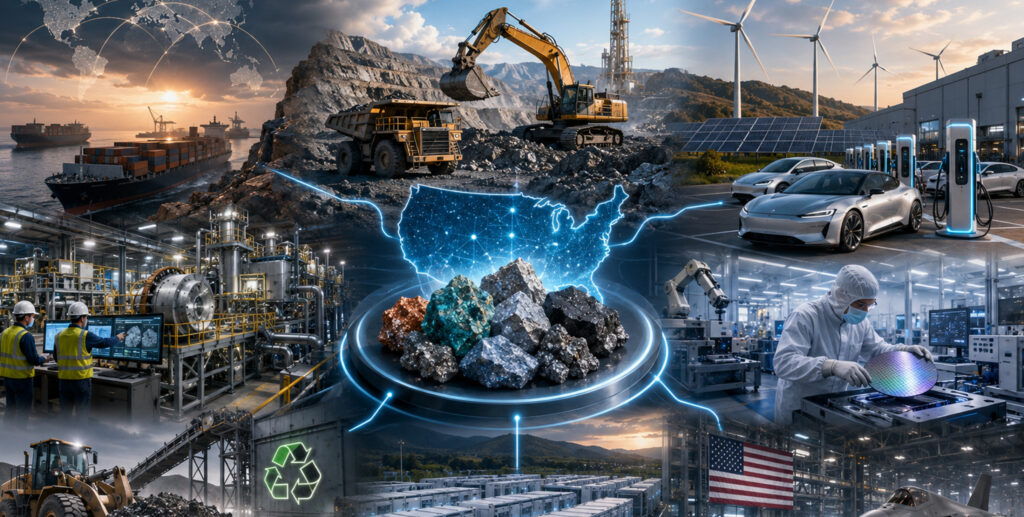
The Department of Energy announced new investments and partnerships to expand U.S. critical minerals production, processing, and recycling. The initiative aims to reduce reliance on foreign suppliers, accelerate domestic mining and refining capacity, and support technologies essential for clean energy, defense, and advanced manufacturing.
Why DOE Is Prioritizing Critical Minerals Right Now
Critical minerals, including lithium, cobalt, nickel, rare earth elements, and graphite, are the backbone of modern industry. They power EV batteries, wind turbines, semiconductors, defense systems, and grid-scale energy storage.
But the U.S. remains heavily dependent on foreign sources, particularly China, for both raw materials and processing. DOE’s latest actions reflect a strategic shift toward:
- Domestic production and refining
- Secure, transparent supply chains
- Reduced geopolitical risk
- Support for clean-energy manufacturing
- National security resilience
The agency is signaling that the U.S. cannot meet its energy and industrial goals without rebuilding its mineral supply chain from the ground up.
What DOE’s New Investments and Partnerships Include
The DOE initiative spans multiple fronts, including funding, research, public-private partnerships, and cross-agency coordination.
- Funding for Domestic Mining and Processing Projects
DOE is directing new funding toward companies developing:
- U.S.-based mining operations
- Refining and separation facilities
- Rare earth magnet production
- Battery-grade mineral processing
These investments aim to close the gap between U.S. mineral demand and domestic supply.
- Support for Recycling and Circular Supply Chains
Recycling is a major pillar of DOE’s strategy. Funding will support:
- Battery recycling facilities
- Recovery of critical minerals from industrial waste
- Technologies that extract minerals from coal ash, mine tailings, and other byproducts
Recycling reduces environmental impact and strengthens supply resilience.
- Partnerships With Universities and National Labs
DOE is expanding collaborations with:
- National laboratories
- Research universities
- Geological survey teams
- Advanced materials researchers
These partnerships accelerate innovation in mineral extraction, refining, and substitution technologies.
- Collaboration With Industry and State Governments
DOE is working with manufacturers, mining companies, and state agencies to:
- Identify high-potential mineral regions
- Support permitting and development
- Build regional processing hubs
- Align workforce development programs
This ensures that investments translate into real industrial capacity.
How This Strengthens U.S. Manufacturing and Energy Security
DOE’s actions are designed to support multiple national priorities:
Clean Energy Manufacturing
Critical minerals are essential for:
- EV batteries
- Solar panels
- Wind turbines
- Grid storage systems
Domestic supply ensures the U.S. can scale clean-energy production without foreign bottlenecks.
Defense and Aerospace
Rare earth elements and specialty metals are vital for:
- Jet engines
- Precision-guided munitions
- Satellites
- Radar systems
Strengthening domestic supply is a national security priority.
Advanced Manufacturing and Semiconductors
Critical minerals support:
- High-performance magnets
- Microelectronics
- Robotics
- AI hardware
DOE’s investments help anchor these industries in the U.S.
What This Means for Industry and the U.S. Economy
For Manufacturers:
- More reliable access to essential materials
- Reduced exposure to geopolitical disruptions
- Opportunities for domestic sourcing and reshoring
For Mining and Processing Companies:
- New funding pathways
- Federal support for permitting and development
- Stronger demand from U.S. manufacturers
For the U.S. Economy:
- Job creation in mining, processing, and advanced manufacturing
- Strengthened industrial competitiveness
- Greater energy independence
DOE’s strategy is clear: critical minerals are the new industrial foundation, and the U.S. intends to secure them.
Key Takeaways
- DOE announced new investments and partnerships to expand U.S. critical minerals supply chains.
- Funding supports domestic mining, refining, recycling, and advanced extraction technologies.
- The initiative reduces reliance on foreign suppliers and strengthens national security.
- Critical minerals are essential for clean energy, defense, and advanced manufacturing.
- DOE is coordinating with industry, states, universities, and national labs to accelerate development.
FAQ
Why are critical minerals important?
They are essential for EVs, batteries, wind turbines, semiconductors, defense systems, and advanced manufacturing.
What is DOE trying to achieve with these investments?
To build a secure, domestic supply chain for critical minerals and reduce reliance on foreign sources.
Will this lead to new mining projects in the U.S.?
Yes, DOE funding and partnerships are designed to support new mining, refining, and processing capacity.
How does this support clean energy goals?
Critical minerals are required for nearly every clean-energy technology, from batteries to solar panels to grid storage.
 Spotify
 Apple Podcasts
 Podbean
 YouTube
 Spotify
 Apple Podcasts
 Podbean
 YouTube