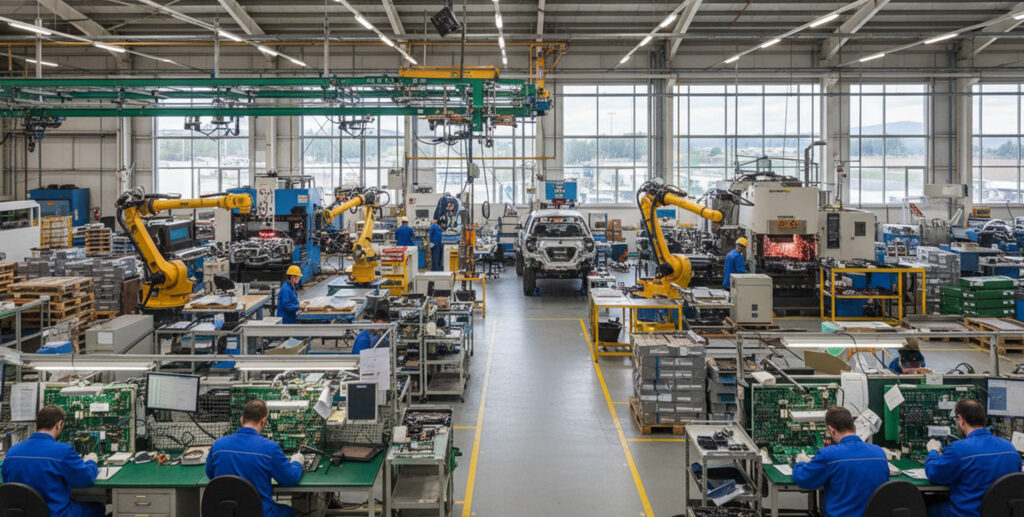
For all the hype around AI-powered factories and robot-run production lines, the reality on the ground is far less futuristic: most U.S. manufacturers still aren’t automating. That’s the surprising takeaway from new data highlighted by Manufacturing Dive, and it paints a picture of an industry that knows it needs to modernize but hasn’t yet made the leap.
Despite years of headlines about Industry 4.0, only 1 in 10 U.S. manufacturers reports using AI in their operations today. Robotics adoption isn’t much higher. And while the largest companies are investing aggressively, small and mid-sized manufacturers, the backbone of the American supply chain, are lagging far behind.
This gap matters. Productivity growth in U.S. manufacturing has been sluggish for more than a decade, rising just 0.4% annually since 2010, according to the Bureau of Labor Statistics. Meanwhile, global competitors are racing ahead. South Korea, Germany, and Japan deploy robots at 3–5 times the rate of U.S. factories, and China now installs more industrial robots each year than the rest of the world combined.
So why aren’t American manufacturers automating faster?
A big part of the answer is cost. Automation requires upfront investment, often hundreds of thousands of dollars, and many smaller manufacturers operate on thin margins. Another barrier is workforce readiness. A 2026 Deloitte survey found that 72% of manufacturers say they lack the in-house skills to deploy or maintain AI and robotics systems. As one plant manager told researchers, “We know automation would help, but we don’t have the people to run it.”
There’s also a cultural hurdle. Many manufacturers still rely on decades-old processes that “work well enough,” even if they’re inefficient. Change feels risky. But the risk of not changing is growing. Supply chain volatility, labor shortages, and rising energy costs are putting pressure on factories to do more with less, and automation is one of the few proven ways to boost output without adding headcount.
The companies that have embraced automation are seeing results. McKinsey reports that AI-enabled quality systems can reduce defects by up to 40%, while robotics can increase throughput by 20–30% in machining, assembly, and packaging operations. Predictive maintenance powered by machine learning can cut unplanned downtime by up to 50%, saving manufacturers millions each year.
But the divide between early adopters and everyone else is widening. Large OEMs, especially in aerospace, automotive, and electronics, are pushing automation deeper into their supply chains. Boeing, Lockheed Martin, and major EV manufacturers now expect suppliers to meet higher quality and delivery standards that often require digital tools. Smaller shops that don’t modernize risk losing contracts.
The federal government is trying to help close the gap. The CHIPS and Science Act includes billions for manufacturing innovation, and the National Institute of Standards and Technology (NIST) is expanding programs to help small manufacturers adopt automation. But awareness and adoption remain uneven.
The bottom line: the U.S. manufacturing sector is at a crossroads. Automation isn’t a futuristic luxury anymore; it’s becoming a competitive necessity. As one industry analyst told Manufacturing Dive, “The companies that automate will survive. The ones that don’t will struggle.”
The good news? Manufacturers don’t need to automate everything at once. Even small steps, such as a single robot, a basic AI quality tool, or a digital work instruction system, can deliver meaningful gains. And once the first step is taken, the rest becomes easier.
But the clock is ticking. The global race toward smarter, faster, more resilient manufacturing is accelerating. The question now is whether U.S. manufacturers will accelerate with it or get left behind.
 Spotify
 Apple Podcasts
 Podbean
 YouTube
 Spotify
 Apple Podcasts
 Podbean
 YouTube