
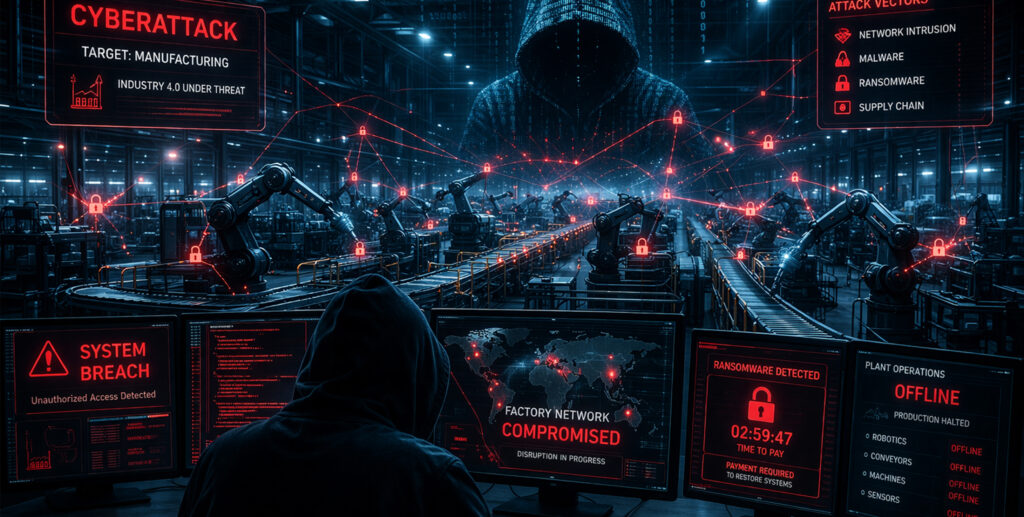
Manufacturing companies are increasingly finding themselves on the front lines of a growing cybersecurity battle. As factories adopt digital technologies and connect machines, robotics systems, and supply chains to the internet, cybercriminals are discovering that industrial operations offer lucrative opportunities for disruption and extortion.
According to IBM’s most recent X-Force Threat Intelligence Index, manufacturing has become the most targeted industry for cyberattacks globally, accounting for nearly 25 percent of all cybersecurity incidents worldwide. That represents a significant shift from just a decade ago, when industries such as finance and healthcare dominated cyberattack statistics.
The reason manufacturing has become such an attractive target is relatively straightforward. Factories depend on continuous production. When a cyberattack disrupts manufacturing systems, companies can lose millions of dollars in lost output, delayed shipments, and supply chain disruption.
Industry research shows that unplanned downtime in manufacturing can cost companies as much as $260,000 per hour, depending on the type of facility and production volume. In high-precision industries such as semiconductor manufacturing or automotive production, even brief disruptions can halt entire supply chains.
“Manufacturing has become the bullseye for cybercriminals because operational downtime translates directly into financial pressure,” said cybersecurity analyst Eric Goldstein of the U.S. Cybersecurity and Infrastructure Security Agency. “Attackers know manufacturers cannot afford to keep production lines idle for long.”
One of the most common threats facing manufacturers today is ransomware. In these attacks, hackers infiltrate company networks and encrypt critical systems or data. The attackers then demand payment to restore access.
Manufacturing facilities are particularly vulnerable to ransomware because their operational technology systems were not originally designed with cybersecurity in mind. Industrial control systems and programmable logic controllers were historically isolated from external networks. But the rise of digital manufacturing has connected these systems to broader corporate networks and cloud platforms.
These connections enable powerful capabilities such as predictive maintenance, real-time monitoring, and automated supply chain coordination. However, they also introduce new entry points for cybercriminals.
According to cybersecurity firm Dragos, ransomware attacks targeting industrial organizations increased by more than 80 percent between 2022 and 2024. Many of these incidents forced companies to temporarily shut down production facilities while systems were restored.
The increasing digitization of factories is accelerating the problem. Modern manufacturing facilities rely on interconnected systems including robotics platforms, industrial IoT sensors, cloud analytics software, and automated logistics networks.
Each of these systems generates valuable operational data, but they also create potential vulnerabilities if not properly secured.
Cybersecurity experts say one of the biggest challenges facing manufacturers is the convergence of IT and operational technology systems. Historically, corporate IT departments managed office networks while factory engineers managed industrial equipment.
Today, those systems are increasingly integrated. A vulnerability in an office computer network could potentially provide attackers with access to factory control systems.
To address these risks, manufacturers are investing heavily in advanced cybersecurity solutions. Artificial intelligence-driven monitoring platforms are becoming particularly valuable. These systems analyze network traffic patterns and machine behavior in real time, allowing them to detect suspicious activity before an attack can spread.
Some manufacturers are also adopting “zero trust” security frameworks, which assume that every user and device must be continuously verified before accessing sensitive systems.
Government agencies are also stepping in. In the United States, the Department of Homeland Security has designated manufacturing as critical infrastructure, meaning it receives additional cybersecurity guidance and protection programs.
Despite these efforts, cybersecurity experts warn that threats will likely continue to grow as factories become more connected.
“Smart factories offer incredible efficiency and productivity benefits,” said manufacturing cybersecurity consultant Theresa Payton. “But every connected device is also a potential doorway into your system. Manufacturers need to treat cybersecurity as a core operational capability, not just an IT expense.”
As digital transformation accelerates across the manufacturing sector, protecting industrial networks will become just as important as maintaining physical machinery. In the era of smart factories, cybersecurity may be the most important safeguard of all.
 Spotify
 Apple Podcasts
 Podbean
 YouTube
 Spotify
 Apple Podcasts
 Podbean
 YouTube