Summary
Our Next Energy (ONE), led by CEO Mujeeb Ijaz, is reshoring advanced battery manufacturing by building U.S. production capacity for lithium-ion and next-generation energy-storage technologies. The company’s strategy focuses on vertical integration, automation, and domestic supply-chain development to reduce reliance on foreign battery imports and strengthen U.S. competitiveness.
Why Battery Manufacturing Is Returning to the United States
Chief Executive reports that Our Next Energy (ONE) is part of a growing wave of U.S. companies localizing battery production due to:
- Rising EV and grid-storage demand
- Supply-chain vulnerabilities exposed during global disruptions
- Federal incentives for domestic manufacturing
- Strategic need to reduce dependence on overseas suppliers
CEO Mujeeb Ijaz, a veteran of Apple, A123 Systems, and Ford’s EV programs, is driving ONE’s mission to build a fully U.S.-based battery ecosystem capable of delivering high-quality cells with faster lead times and secure domestic sourcing.
How ONE Is Building a U.S. Battery Manufacturing Base
ONE’s reshoring strategy includes:
- New U.S. production facilities for lithium-ion and next-generation battery chemistries
- Advanced automation to reduce labor costs and increase consistency
- Vertical integration across materials, cell assembly, and pack manufacturing
- Domestic supplier partnerships for critical minerals and components
- Workforce development programs to train technicians and engineers
This approach allows ONE to compete with global manufacturers while maintaining U.S. quality and reliability standards.
The Role of Automation and Digital Manufacturing
Automation is central to ONE’s ability to scale domestically. Key technologies include:
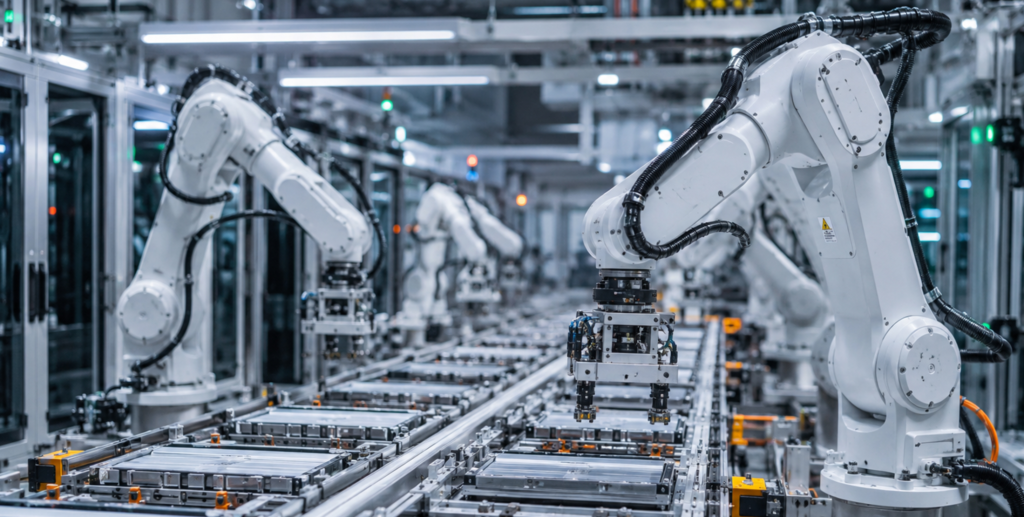
- Robotics for electrode production and cell assembly
- AI-driven quality inspection
- Digital twins for process optimization
- Real-time data systems for yield improvement
- Automated material-handling systems
These tools reduce production costs, improve throughput, and ensure consistent cell performance.
Why Domestic Battery Production Matters for U.S. Manufacturers
Reshoring battery manufacturing strengthens multiple sectors:
EV and Automotive
OEMs gain reliable access to U.S.-made battery cells, reducing lead times and geopolitical risk.
Energy Storage
Utilities and renewable-energy developers benefit from domestic supply for grid-scale storage systems.
Industrial Electrification
Manufacturers upgrading equipment for electrified operations need dependable battery suppliers.
Defense and Aerospace
Secure domestic sourcing supports mission-critical applications.
Challenges ONE Is Working to Overcome
Despite strong momentum, ONE faces:
- High capital-investment requirements
- Competition for skilled labor
- Complex permitting and regulatory processes
- Need for domestic mineral supply chains
- Pressure to scale quickly to meet demand
CEO Mujeeb Ijaz emphasizes long-term investment, automation, and strategic partnerships as the path to overcoming these barriers.
What This Means for the Future of U.S. Battery Manufacturing
- Stronger Domestic Supply Chains
More U.S. production reduces dependence on foreign suppliers.
- Increased Industrial Competitiveness
American manufacturers gain access to locally produced, high-quality battery cells.
- Acceleration of Electrification
EVs, storage systems, and industrial equipment benefit from faster, more reliable sourcing.
- Workforce Growth
New battery plants create high-skill jobs in engineering, automation, and advanced manufacturing.
- Long-Term Strategic Advantage
Reshoring positions the U.S. as a global leader in next-generation energy technologies.
Key Takeaways
- Our Next Energy (ONE) is reshoring lithium-ion battery production to the U.S.
- CEO Mujeeb Ijaz is leading the company’s domestic-manufacturing strategy.
- Automation, vertical integration, and workforce development are central to ONE’s approach.
- Domestic battery production supports EVs, energy storage, industrial electrification, and defense.
- Challenges include capital costs, labor shortages, and mineral-supply constraints.
- Reshoring provides long-term strategic and economic advantages for U.S. manufacturers.
FAQ
Who is the CEO of Our Next Energy (ONE)
Mujeeb Ijaz, a veteran of Apple, A123 Systems, and Ford’s EV programs.
Why is battery manufacturing being reshored to the U.S.
To strengthen supply-chain resilience, reduce foreign dependence, and support EV and energy-storage growth.
What technologies enable domestic battery production
Automation, robotics, AI-driven quality control, digital twins, and advanced materials processing.
Which industries benefit most
Automotive, energy storage, industrial electrification, aerospace, and defense.
 Spotify
 Apple Podcasts
 Podbean
 YouTube
 Spotify
 Apple Podcasts
 Podbean
 YouTube