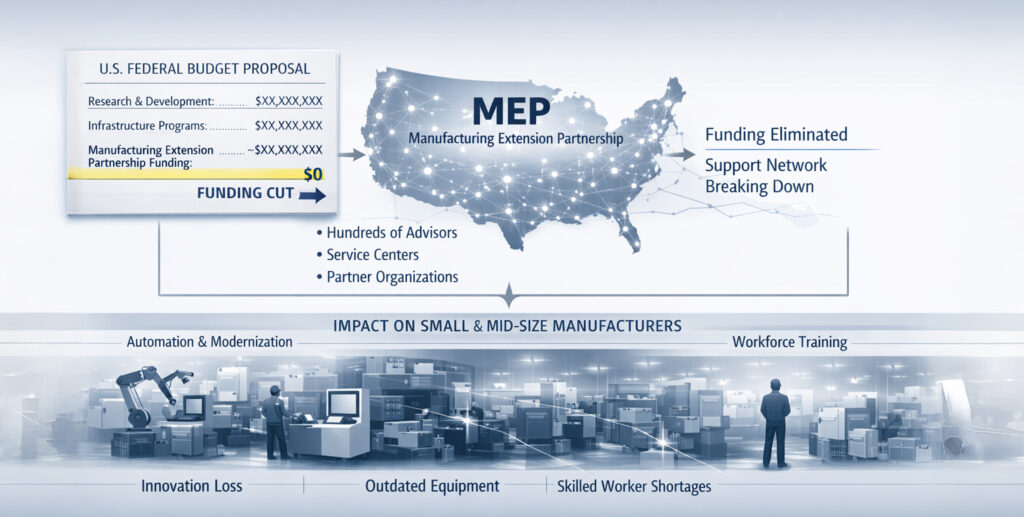
The latest federal budget proposal from the current administration has sent a wave of concern through the manufacturing community because it calls for eliminating all funding for the Manufacturing Extension Partnership. The program has been a backbone for small and midsize manufacturers since 1988, offering hands-on technical assistance, modernization support, and guidance on everything from automation to workforce development. It operates through a national network of about 1,400 advisors across 475 service locations and more than 2,100 partner organizations.
The proposal frames the program as unnecessary and suggests its services should be funded privately. It is part of a broader $993 million reduction to the National Institute of Standards and Technology, which would also cut its Circular Economy Program. Industry groups and lawmakers across both parties have pushed back, noting that the Manufacturing Extension Partnership has consistently delivered measurable economic value. According to federal data, the program generated $15 billion in new and retained sales in fiscal year 2024, drove $5 billion in new client investments, and helped companies achieve $2.6 billion in cost savings.
It also supported the creation or retention of more than 108,000 jobs.
Carrie Hines, CEO & President of the American Small Manufacturers Coalition, added, “The President’s budget request for MEP is unfortunate and just shows the Administration’s lack of understanding of what MEP is and does. Thankfully, MEP is widely supported by Congress, which holds the power of the purse and understands the value of the program to its individual constituencies and the overarching manufacturing industry. We hope that, through ongoing Congressional support, MEP will be fully funded so that it can continue to serve manufacturers nationwide.”
Outside research reinforces its impact. A study from the Upjohn Institute found that every $1 of federal investment in the program returns about $14 in economic activity. The National Association of Manufacturers has repeatedly cited the program as one of the most cost-effective tools for strengthening domestic production capacity. Meanwhile, the United States continues to face intense global competition. China now accounts for roughly 31 percent of global manufacturing output, compared with about 16 percent for the United States, according to United Nations industrial data. That gap has made programs that support modernization and supply chain resilience even more important.
The Manufacturing Extension Partnership has also played a quiet but critical role in helping smaller firms adopt automation and artificial intelligence. These technologies are becoming essential as the country faces a persistent labor shortage. The Bureau of Labor Statistics reports that the manufacturing sector has more than 600,000 open jobs, and Deloitte projects the industry could face 2.1 million unfilled positions by 2030 if current trends continue. Programs that help companies train workers, upgrade equipment, and improve productivity have been central to closing that gap.
Lawmakers have already begun voicing concern. Members of both parties have argued that eliminating the program would undermine efforts to strengthen domestic supply chains, especially after years of pandemic-related disruptions. Industry groups like the Alliance for American Manufacturing and the Coalition for a Prosperous America have also emphasized that the program is often the first-place small manufacturers turn when they need help improving efficiency or solving technical problems.
Even with the uncertainty, there is a potential upside. Moments like this often push Congress to take a closer look at what is working and what is not. In past years, lawmakers have restored funding after similar proposals, and the renewed attention could lead to an even stronger, more modernized version of the program. If Congress chooses to reinforce it rather than eliminate it, the Manufacturing Extension Partnership could emerge with clearer goals, updated tools, and broader bipartisan support. That would be a win for manufacturers who rely on practical,
on-the-ground assistance to stay competitive in a rapidly changing global economy.
 Spotify
 Apple Podcasts
 Podbean
 YouTube
 Spotify
 Apple Podcasts
 Podbean
 YouTube