Summary
Daimler Truck North America (DTNA) announced plans to build a new U.S. manufacturing facility, significantly expanding domestic production capacity for next-generation commercial vehicles. The investment strengthens U.S. industrial capability, supports advanced truck manufacturing, and aligns with DTNA’s long-term strategy for zero-emission and high-efficiency transportation.
Why Daimler Truck Is Building a New U.S. Manufacturing Facility
Daimler Truck reports that demand for advanced commercial vehicles, including battery-electric, hydrogen-powered, and next-generation diesel platforms, continues to rise across freight, logistics, construction, and vocational markets.
The new facility will help DTNA:
- Increase production volume
- Accelerate development of zero-emission trucks
- Strengthen domestic supply-chain resilience
- Support U.S. customers with faster delivery and localized manufacturing
This expansion reflects a broader industry shift toward reshoring and regionalizing heavy-vehicle production.
What the New Facility Will Produce
DTNA’s planned U.S. plant will support manufacturing of:
- Freightliner and Western Star trucks
- Electric and hydrogen-powered commercial vehicles
- Advanced vocational trucks
- Next-generation powertrain systems
- High-efficiency components and chassis platforms
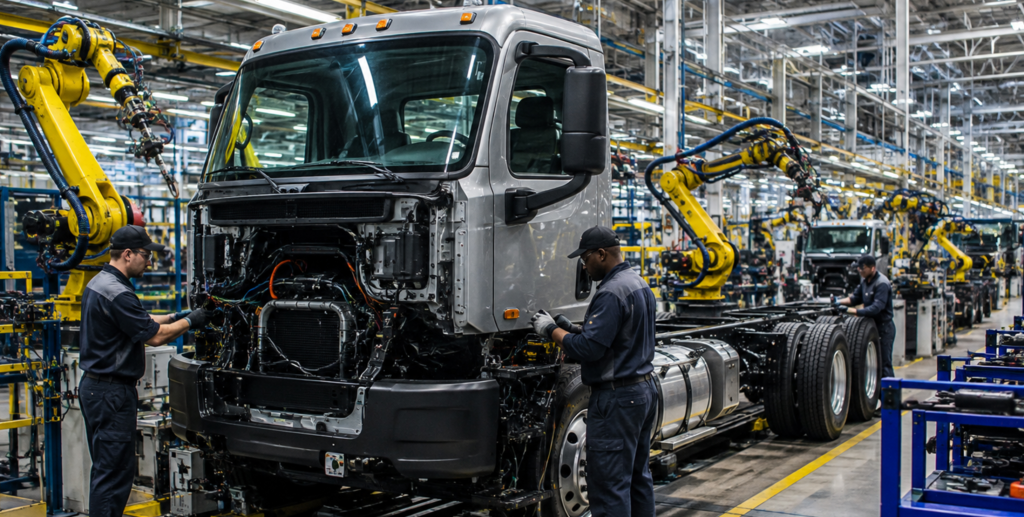
The facility will incorporate advanced automation, robotics, digital manufacturing systems, and sustainability-focused production processes.
How This Investment Strengthens U.S. Manufacturing
The new DTNA facility will:
- Expand domestic heavy-vehicle production
- Reduce reliance on overseas manufacturing
- Improve supply-chain reliability for fleets
- Support thousands of skilled jobs in engineering, machining, assembly, and logistics
- Accelerate adoption of zero-emission commercial vehicles across North America
It also positions the U.S. as a key hub for Daimler Truck’s global manufacturing strategy.
Impact on Transportation, Logistics, and Industrial Markets
- Faster Delivery for U.S. Fleets
Localized production shortens lead times and improves responsiveness.
- Stronger Support for Zero-Emission Adoption
More domestic manufacturing capacity accelerates deployment of electric and hydrogen trucks.
- Increased Workforce Development
DTNA will expand hiring and training programs to support advanced manufacturing roles.
- Supply-Chain Modernization
The facility will rely on U.S. suppliers for components, electronics, and powertrain systems.
- Long-Term Competitiveness
The investment strengthens DTNA’s position in the rapidly evolving commercial-vehicle market.
Key Takeaways
- DTNA plans to build a new U.S. manufacturing facility.
- The plant will support production of electric, hydrogen, and next-generation commercial vehicles.
- The investment expands domestic manufacturing capacity and supply-chain resilience.
- The facility will create skilled jobs and accelerate zero-emission truck adoption.
- The expansion strengthens U.S. competitiveness in heavy-vehicle manufacturing.
FAQ
Why is Daimler Truck building a new U.S. facility?
To expand domestic production capacity and support next-generation commercial vehicles.
What types of trucks will be produced?
Freightliner, Western Star, electric, hydrogen, and advanced vocational trucks.
How does this benefit U.S. fleets?
Shorter lead times, stronger support, and more reliable supply chains.
Will the facility create jobs?
Shorter lead times, stronger support, and more reliable supply chains.
Will the facility create jobs?
Yes, DTNA will hire engineers, technicians, machinists, assembly workers, and logistics specialists.
 Spotify
 Apple Podcasts
 Podbean
 YouTube
 Spotify
 Apple Podcasts
 Podbean
 YouTube