Summary
China’s growing industrial overcapacity, especially in EVs, batteries, solar panels, and other advanced-manufacturing sectors, is creating global market distortions that directly affect U.S. manufacturers. Analysts warn that China’s excess production leads to artificially low export prices, increased competitive pressure, and rising calls for U.S. industrial policy, tariffs, and domestic investment to protect key sectors.
Why China’s Industrial Overcapacity Is Becoming a Global Issue
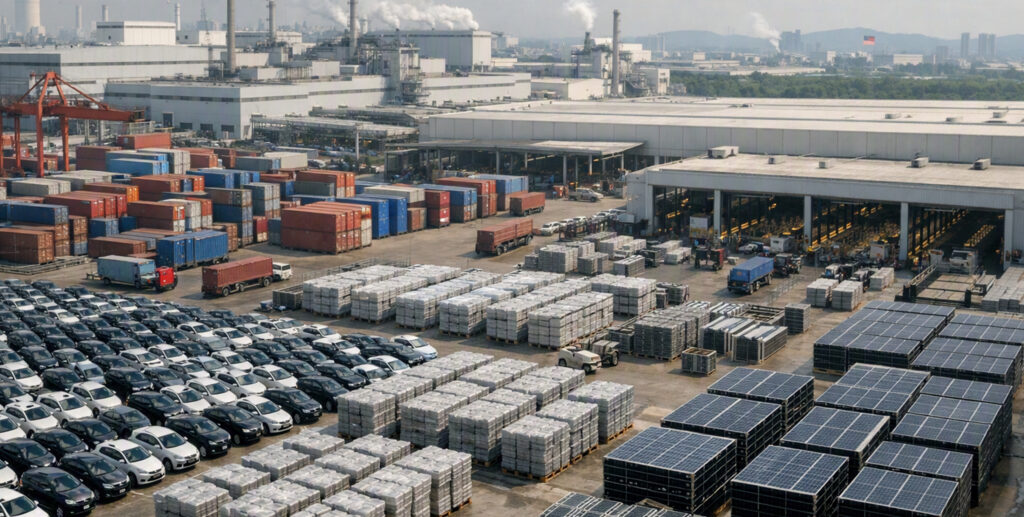
Manufacturing Today reports that China has significantly expanded production capacity across multiple industries, often beyond what domestic or global markets can absorb. This “overcapacity” results in:
- Surplus goods flooding global markets
- Depressed prices that undercut foreign competitors
- Increased reliance on exports to sustain domestic factories
- Heightened geopolitical and trade tensions
China’s strategy is driven by state-backed investment, long-term industrial planning, and efforts to dominate emerging technologies such as EVs, batteries, solar modules, and advanced materials.
How Overcapacity Impacts U.S. Manufacturers
U.S. manufacturers face several challenges when Chinese industries produce more than global demand requires:
- Price Pressure and Margin Compression
Excess Chinese supply pushes global prices down, making it harder for U.S. companies to compete, especially in sectors such as solar, EV components, steel, and aluminum.
- Market Share Loss
Low-priced imports can displace U.S.-made products, reducing domestic production and investment.
- Supply-Chain Distortion
Overcapacity can create unstable supply dynamics, with sudden surges of cheap imports followed by shortages when Chinese policy shifts.
- Increased Calls for Tariffs and Trade Enforcement
U.S. policymakers and industry groups argue that China’s overcapacity requires stronger trade tools to protect domestic manufacturing.
Industries Most Affected by China’s Overcapacity
Electric Vehicles (EVs)
China produces far more EVs than its domestic market can absorb, leading to aggressive export strategies.
Batteries & Energy Storage
Chinese lithium-ion battery production far exceeds global demand, driving down prices and challenging U.S. battery startups.
Solar Panels & Renewable Components
China’s solar manufacturing capacity is several times larger than global installation rates, creating persistent price suppression.
Steel, Aluminum & Industrial Metals
Long-standing overcapacity in metals continues to affect U.S. mills and fabrication shops.
Advanced Materials & Electronics
Semiconductor packaging, magnets, and critical minerals are increasingly influenced by Chinese oversupply.
How the U.S. Is Responding to China’s Overcapacity
- Tariffs and Trade Enforcement
The U.S. has implemented or proposed new tariffs on EVs, batteries, solar components, and metals to counter artificially low prices.
- Domestic Manufacturing Incentives
Federal programs including tax credits, grants, and loan guarantees aim to strengthen U.S. production in strategic sectors.
- Supply-Chain Diversification
Manufacturers are shifting sourcing to allied nations to reduce dependence on Chinese oversupply.
- Industrial Policy Coordination
Government agencies are working with industry groups to identify sectors most vulnerable to Chinese overcapacity.
- Investment in Advanced Manufacturing
The U.S. is accelerating investment in semiconductors, clean energy, critical minerals, and EV supply chains.
What This Means for U.S. Manufacturers Going Forward
- Competitive Pressure Will Remain High
China’s state-backed production capacity is unlikely to shrink quickly.
- Domestic Investment Will Increase
U.S. manufacturers will benefit from expanded federal support and reshoring initiatives.
- Trade Policy Will Play a Larger Role
Tariffs, anti-dumping actions, and supply-chain protections will shape market dynamics.
- Innovation and Differentiation Become Critical
U.S. companies will need to compete on quality, reliability, and advanced technology, not just price.
- Long-Term Strategy Requires Resilience
Manufacturers must prepare for ongoing global market volatility driven by Chinese industrial policy.
Key Takeaways
- China’s industrial overcapacity is flooding global markets with low-priced goods.
- U.S. manufacturers face margin pressure, market share loss, and supply-chain instability.
- EVs, batteries, solar panels, metals, and advanced materials are most affected.
- The U.S. is responding with tariffs, incentives, and supply-chain diversification.
- Long-term competitiveness requires innovation, resilience, and strategic investment.
FAQ
What is industrial overcapacity?
When a country produces more goods than domestic or global markets can absorb, leading to surplus exports and price suppression.
Why is China’s overcapacity a concern?
It distorts global markets, undercuts competitors, and creates geopolitical and economic tension.
Which U.S. industries are most affected?
EVs, batteries, solar, metals, and advanced materials.
How is the U.S. responding?
Through tariffs, domestic manufacturing incentives, supply-chain diversification, and industrial policy coordination.
 Spotify
 Apple Podcasts
 Podbean
 YouTube
 Spotify
 Apple Podcasts
 Podbean
 YouTube