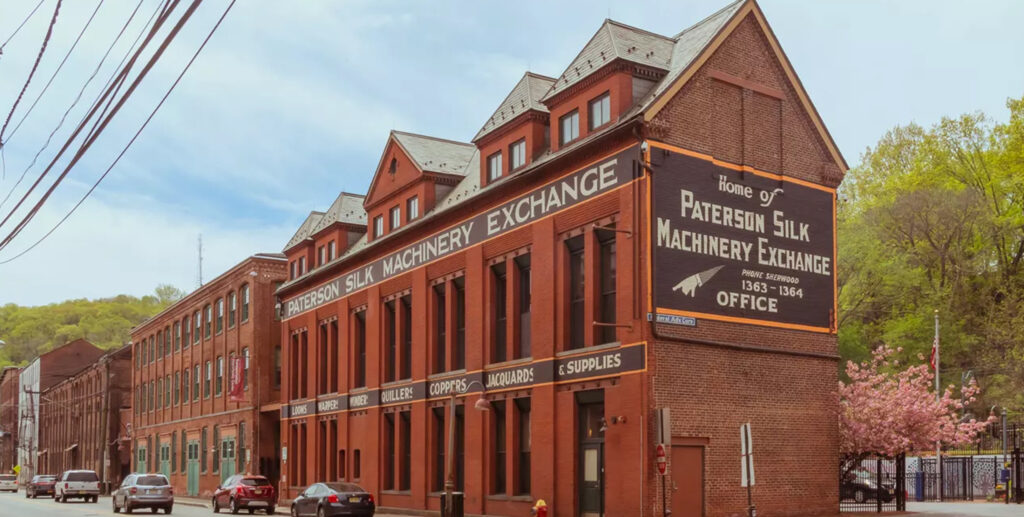
Paterson, New Jersey, founded in 1791 as America’s first planned industrial city, launched the nation’s manufacturing revolution. Powered by the Great Falls and Alexander Hamilton’s vision, Paterson became a hub for textiles, locomotives, and aircraft engines. Its legacy now fuels the modern Made in America movement and the resurgence of U.S. manufacturing.
How Paterson Became America’s First Industrial City
Paterson wasn’t an accident; it was a national strategy.
In 1791, Alexander Hamilton created the Society for Establishing Useful Manufactures (S.U.M.), choosing Paterson as the site for America’s first industrial city. His goal was bold: Make the United States economically independent by producing its own goods.
Paterson had the perfect advantage, the Great Falls of the Passaic River, one of the most powerful waterfalls east of the Mississippi. Hamilton saw hydropower as the key to breaking America’s dependence on British imports.
Paterson became the first place in the country where industry wasn’t just encouraged, it was engineered.
The Industries That Built Paterson and America
Paterson quickly became a powerhouse across multiple sectors, each one shaping the nation’s growth.
- Textiles — “Silk City”
Paterson became the center of American silk production, employing tens of thousands of workers and producing the majority of the nation’s silk by the late 1800s. Its mills powered fashion, upholstery, parachutes, and military textiles.
- Locomotives — Engines of Westward Expansion
Rogers Locomotive Works in Paterson built more than 6,000 locomotives, including engines used during the Civil War and throughout the expansion of the American rail network.
- Aviation — The Birth of American Flight
Paterson machinists built early aircraft engines, including those used by Charles Lindbergh and other pioneering aviators. The city became a hub for precision machining long before aerospace was an industry.
- Firearms, Tools & Precision Manufacturing
Paterson factories produced firearms components, machine tools, and precision parts that fueled America’s industrial rise.
Paterson wasn’t just a manufacturing city; it was a national workshop.
Why Paterson’s Legacy Matters in Today’s Made in America Movement
As the U.S. approaches its 250th anniversary, Paterson’s founding principles feel more relevant than ever.
Innovation as a National Imperative
Hamilton believed America must innovate to survive. Today, that spirit lives on in advanced manufacturing, AI-driven factories, robotics, and reshoring.
Craftsmanship as Identity
Paterson’s workers, machinists, weavers, and toolmakers set the standard for American quality. Modern Made in America brands still draw from that tradition.
Economic Independence
Hamilton’s vision was simple: America should make what America needs. That message resonates today as the U.S. rebuilds supply chains in semiconductors, steel, energy, and critical materials.
Community as the Heart of Industry
Paterson’s mills and factories built neighborhoods, schools, and local pride. Today’s manufacturing revival is doing the same in towns across the country.
Paterson as the Symbol of America’s 250th Anniversary
As the nation prepares for its semi-quincentennial, Paterson stands as the perfect symbol of:
- American ingenuity
- American resilience
- American craftsmanship
- American independence
The Made in America movement isn’t new; it’s a return to the values that started in Paterson.
Key Takeaways
- Paterson, NJ, was America’s first planned industrial city, founded by Alexander Hamilton in 1791.
- The city powered early textile, locomotive, and aviation manufacturing.
- Paterson’s legacy mirrors today’s Made in America movement.
- The U.S. is returning to Hamilton’s vision of domestic production and economic independence.
- Part 2 can expand into history, product lists, or a 250th-anniversary feature.
FAQ
Why is Paterson considered the birthplace of American manufacturing?
It was the first city intentionally designed for industrial production, powered by the Great Falls and founded under Hamilton’s national manufacturing strategy.
What industries started in Paterson?
Textiles, locomotives, aircraft engines, firearms components, and precision tools.
How does Paterson connect to the Made in America movement?
Its founding principles innovation, craftsmanship, and domestic production — mirror today’s push to rebuild U.S. manufacturing.
 Spotify
 Apple Podcasts
 Podbean
 YouTube
 Spotify
 Apple Podcasts
 Podbean
 YouTube