
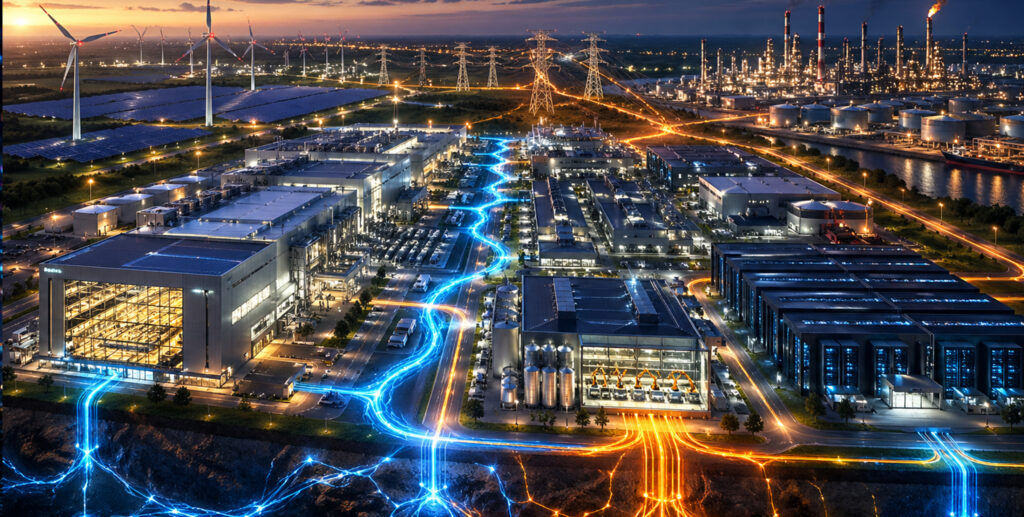
If you want to understand why the United States is experiencing one of the strongest manufacturing expansions in decades, do not start with subsidies or mandates. Start with a map. Look at where new semiconductor fabs, data centers, battery plants, and advanced materials facilities are being built in 2026. They are clustering in regions with abundant, affordable, and stable energy. Texas, Louisiana, Pennsylvania, Ohio, and parts of the Midwest are becoming industrial magnets because companies can count on consistent power at predictable prices. For modern manufacturing, energy is not just an input. It is the backbone of the entire business model.
Energy-intensive industries know this better than anyone. For metals, chemicals, plastics, and advanced materials, energy represents 10 to 20 percent of total production costs, according to the U.S. Energy Information Administration. That share climbs even higher for processes that require continuous heat or uninterrupted power. For data centers, energy is the single largest operating expense. For semiconductor fabs, even a minor voltage fluctuation can ruin batches worth tens of millions of dollars, which is why these facilities are built only where the grid is exceptionally stable.
This is where the United States has a major advantage. Natural gas prices in the U.S. remain among the lowest in the developed world. During the first quarter of 2026, U.S. natural gas averaged $4.56 per MMBtu, while Germany paid $13.51 per MMBtu, according to IMARC’s 2026 Natural Gas Price Index. China paid $1.93, but its industrial sector has faced repeated supply constraints and regional rationing. Europe has battled price spikes and volatility since 2021, and several countries have experienced industrial curtailments due to grid instability. The International Energy Agency notes that global LNG markets remain tight, but U.S. supply growth is easing conditions and reinforcing America’s role as a stable energy anchor.
This energy advantage is directly fueling a construction boom. Manufacturing-related construction spending reached $196.166 billion in January 2026, according to the U.S. Census Bureau via Macrotrends. Federal Reserve data shows total manufacturing construction spending hitting $15.22 billion in January 2026 on a monthly basis, continuing a multi-year surge. These are not small projects. Semiconductor fabs routinely cost $10 billion or more. Data centers can exceed $1 billion each. Battery plants, chemical facilities, and advanced materials factories all require enormous energy capacity and long-term reliability.
Permitting improvements have also played a quiet but powerful role. Faster approvals for pipelines, transmission lines, and LNG infrastructure have reduced bottlenecks that once slowed industrial projects. The U.S. Energy Information Administration’s April 2026 Short Term Energy Outlook notes that LNG export capacity is expanding, pipeline imports are stable, and storage levels remain healthy. This stability gives manufacturers confidence that the energy supply will remain predictable even as demand grows.
Tax incentives have amplified the effect. Full expense for equipment and 100 percent bonus depreciation allows companies to write off major capital investments immediately, shortening payback periods for energy-intensive projects. When a company can recover the cost of turbines, compressors, robotics, and industrial equipment in year one, the economics of building a new plant shift dramatically.
The global comparison is stark. Europe’s industrial sector has been constrained by high energy prices and supply volatility. China has faced rolling blackouts and regional rationing that disrupted production. Meanwhile, U.S. manufacturers benefit from a stable natural gas supply, expanding LNG capacity, and a grid that continues to improve reliability. The EIA’s 2026 outlook shows U.S. marketed natural gas production rising 2 percent in 2026 and 3 percent in 2027, reinforcing long-term supply confidence.
Energy is also shaping reshoring decisions. Automation alone cannot make domestic production cost-competitive if energy prices are unstable. But when companies can combine robotics, AI-driven optimization, and low-cost natural gas, the economics shift decisively. Nearshoring trends in Mexico complement this dynamic. Mexico’s energy costs are 40 percent below U.S. levels for some manufacturing operations, according to Worldmetrics’ 2026 Nearshoring Report, and cross-border supply chains are strengthening. But the U.S. remains the anchor because of its energy reliability and infrastructure depth.
The positive outcome is clear. Cheap and reliable energy is enabling companies to build more, hire more, and innovate more. It is powering the strongest manufacturing expansion the country has seen in more than a decade. As long as the United States maintains an all-of-the-above energy environment and continues improving permitting and infrastructure, the industrial boom of 2026 may be only the beginning.
 Spotify
 Apple Podcasts
 Podbean
 YouTube
 Spotify
 Apple Podcasts
 Podbean
 YouTube