
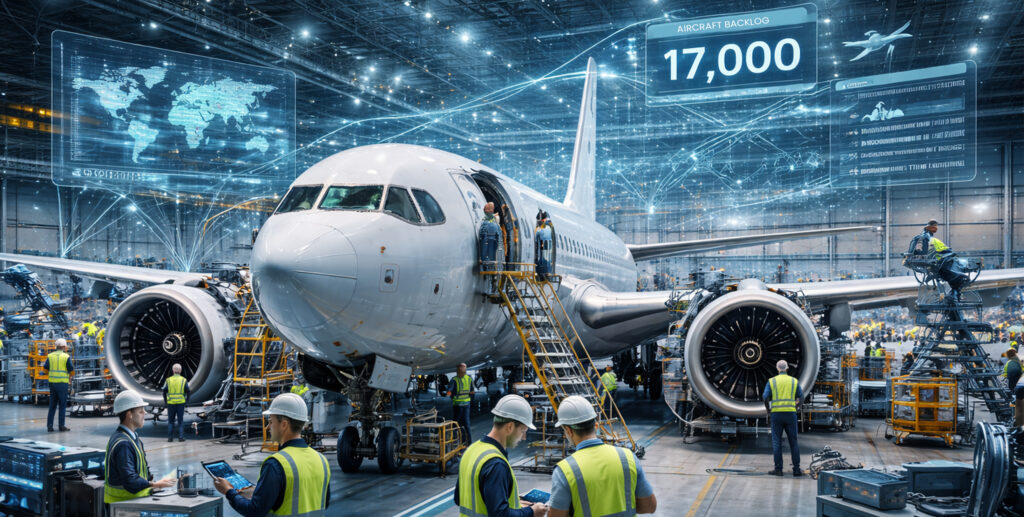
Few industries showcase the scale, complexity, and precision of modern manufacturing quite like aerospace. Every aircraft that rolls off an assembly line represents the coordinated effort of thousands of engineers, technicians, suppliers, and software systems working together across multiple continents. It is one of the most advanced manufacturing ecosystems on the planet, and it is growing rapidly.
The numbers alone tell an incredible story. The global aerospace manufacturing market is expected to reach approximately $1.23 trillion by 2030, driven by rising air travel demand, defense modernization programs, and the rapid expansion of satellite and space technologies. Commercial aviation continues to be the largest driver of that growth as airlines around the world expand fleets to accommodate growing passenger traffic.
Yet despite the enormous demand, aerospace manufacturers are struggling to keep up. Industry data shows aircraft manufacturers currently face a backlog of more than 17,000 aircraft orders worldwide, representing nearly 12 years of production at current manufacturing capacity. That backlog has been growing steadily as global travel rebounds and airlines replace aging fleets with more fuel-efficient aircraft.
Building an aircraft is not like manufacturing most products. A single commercial airplane can contain more than one million individual parts, sourced from hundreds of suppliers located across dozens of countries. Components range from precision-machined titanium parts and carbon fiber composite structures to advanced avionics and complex software systems that control everything from navigation to engine performance.
Because the supply chain is so vast, even small disruptions can ripple across the entire manufacturing system. In recent years, shortages of critical materials such as titanium, electronic components, and specialized aerospace alloys have slowed production. Labor shortages have also added pressure, particularly in highly specialized roles such as aerospace machining and avionics engineering.
Airlines have felt the impact directly. Some carriers have been forced to delay expansion plans because new aircraft deliveries are arriving slower than expected. Others are keeping older aircraft in service simply because replacement planes are not available yet.
To address these challenges, aerospace manufacturers are investing heavily in advanced digital technologies. One of the most transformative tools is the digital twin, which allows engineers to create a virtual replica of an aircraft and simulate its performance before any physical components are built. Digital twins allow engineers to test structural performance, analyze aerodynamic characteristics, and detect potential design flaws long before production begins.
Automation is also playing a larger role in aerospace assembly lines. Robotics systems now assist with drilling thousands of precision holes in aircraft fuselages, applying composite materials, and performing complex inspection tasks that previously required manual labor. These systems improve consistency and reduce production times while maintaining strict safety and quality standards.
The industry is also experimenting with additive manufacturing, more commonly known as 3D printing. Aerospace companies are using 3D printing to produce complex parts that would be difficult or impossible to manufacture using traditional methods. Some aircraft engines now contain components produced through additive manufacturing, reducing weight while improving performance.
The stakes are enormous. Aerospace manufacturing supports millions of jobs globally and plays a critical role in international trade, defense, and technological innovation. According to industry estimates, the aerospace sector supports more than 11 million jobs worldwide, including engineering, manufacturing, and maintenance roles.
Despite the challenges, the long-term outlook remains strong. Global passenger traffic is projected to double over the next two decades as emerging markets expand their middle-class populations and international travel continues to grow.
For aerospace manufacturers, the challenge is clear: scale production while maintaining the extraordinary safety and quality standards that define the industry. Those companies that can successfully modernize their production systems, strengthen supply chains, and embrace digital engineering will be best positioned to lead the next era of aviation.
 Spotify
 Apple Podcasts
 Podbean
 YouTube
 Spotify
 Apple Podcasts
 Podbean
 YouTube