TRANSCRIPT
Speaker 1 (00:00):
Welcome to Manufacturing Talk Radio, your Everything manufacturing podcast with host and veteran manufacturing industry expert Lewis Weiss and co-host Amy Nicklaus. Make sure to check out our catalog of 800 previous shows on YouTube, Spotify, or wherever you’re listening. Now, let’s get into the episode.
Speaker 2 (00:34):
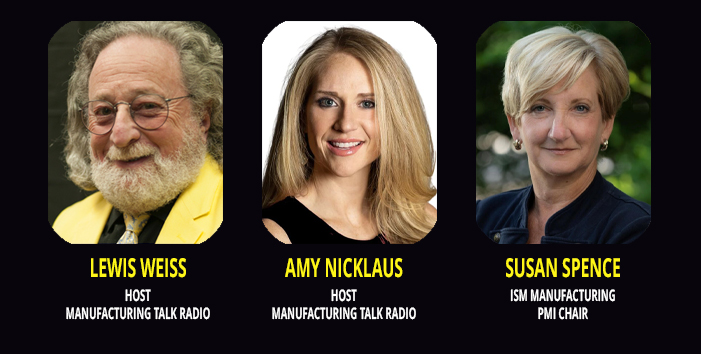
Good day everyone. Lewis Wise here from Manufacturing Talk Radio with my co-host Amy Nicholas, and we’re pleased and proud to have Susan Spence, who’s the ISM Committee chair for the manufacturing group. Welcome, Susan.
Speaker 3 (00:51):
Thank you. I should have worn my yellow jacket.
Speaker 2 (00:54):
Well, it wouldn’t be the first time that we gave somebody from ISMA yellow jacket. There was Brad Holcomb on his retirement. We gave him a yellow jacket.
Speaker 4 (01:06):
You’d be surprised. They’re not easy to come by.
Speaker 3 (01:09):
Well, it is spring. My daff Fis are up, so I love it. Let’s,
Speaker 2 (01:13):
All right, so we’re here today to talk about the March, 2026 ISM manufacturing report, which looks good. It looks like expansion, but there’s a couple of possible hiccups that Susan’s going to talk about. So Susan, let’s go.
Speaker 3 (01:31):
Okay, great. I’ll say good-ish. I am pleased to see our third month in a row with the PMI above 50, which is a 52.7. That’s tempered this month in my mind by the slowdown of growth in some of the very key indicators. New orders is still certainly an expansion, but lost 2.3 points, right? So new orders, the front of the supply chain, as new orders stay up and elevated, it starts to flow through. It flows through production and backlog, but we have lost some ground with new orders. We have lost about the same amount of ground and backlog and production is still up boosted by a new order run up. So the question in my brain is if new orders continue to come down and production probably within two months of that starts to have the same trajectory down how long before we’re back in contraction, right? Correct.
(02:38):
Yeah. So it’s a concern when it’s informed by comments from the survey takers and our panelists that say, even though our demand sentiment is better, we have had tariff chaos. We had a big sigh of relief with the SCOTUS ruling, but we have these other replacement terrorists being talked about and probed into. So when are those going to launch? And then, oh, by the way, we have a war in Iran, which broke out in the middle of the survey. So you saw in our report this month, we had 40% of the comments be negative citing the war. That is a very, very quick response. And we do know some sectors like petroleum immediate impact, and we’ve had our price index take a huge leap this month, not as big as last month. So unfortunately, as one reporter called it earlier today, the shock on top of the continued chaos is not good.
(03:39):
We will see how long or short live that impact is, but I do not like the ground that’s being lost. And when I look at the comments and they talk about, for instance, transportation survey panelists talking about the customers are replacing their fleet, not growing their fleet. So customer inventories get pretty low and you have to fill those shelves or whatever sector you’re in, but if there’s no confidence or there’s little confidence in the customer’s point of view, they’re not going to order a long purchase order worth of goods. They’re going to maybe do just what they have to, especially if they’re thinking that there’s a tariff change coming. So maybe I’m ordering a commodity or in an area where there’s been a tariff applied, but what if that gets overruled, right? Or what if there’s a replacement? What do I do? So all of this is causing
Speaker 2 (04:38):
Also with the purchasing of supplies, if you are buying less supplies, your quantity discounts go away and your costs go up. So your costs are going up on one or two bases. So that’s a negative in itself, which reflected
Speaker 3 (04:58):
Well, it could be as well. Again, it depends on the sector, but I know when I was in the job, if it was a bigger risk to buy long-term at a higher price than to pay for a little bit at a higher price for short-term order, that’s what I was going to do. But we would do the analysis and then frankly, it’s like, okay, well we’ve got this risk of I could get stuck with inventory at a high price. I’m going to bet, and then maybe I have really good supply relationships. I can negotiate my way out of it. But it’s business folks in general don’t like the uncertainty. They are not naive. They understand it’s there, but it’s not like you could predict bad things, but there are typical bad things that go on your unit. Price input, cost fluctuating 15, 40, no, 70, no nothing, no five. That’s nuts. That’s nuts. It’s nuts in that I’m not accusing people of being nuts. It’s nuts to try to deal with that with any predictability.
Speaker 4 (06:05):
Right? Uncertainty become the new norm. I said, uncertainty really seems to have become this new norm. I think that’s what we’ve been seeing consistently recently,
Speaker 3 (06:19):
And I saw last week the EU had voted to approve the 15% trade deal that had gotten negotiated before the SCOTUS ruling, but then they put guardrails on it to say there’s conditions now if another Greenland threat happens and we are going to reserve the right to back off, my understanding is that now had to go be renegotiated with the US counterpart. If that deal gets signed finally, and it’s at 15%, right? That’s no worse than the section. I think it’s 1 22 or 2 0 1 tariffs that can be lobbed for 150 days at 15%. If deals like that can be signed and kept to, then at least the manufacturers are going to know, okay, it’s 15%. I absorb some, I pass some along, whatever they’re going to do. But then it’s over, and then you’ve got this new world, but when it goes up, it goes down. We don’t know. Maybe you can, maybe you can’t. And now you’ve got oil shock affecting all these sectors. It’s chaos again by another name.
Speaker 2 (07:30):
It’s interesting also is, and this has nothing to do with manufacturing or maybe it does, and that is the tariff refunds. That was last week’s news cycle this week. You hear nothing about it. I mean
Speaker 3 (07:45):
Zero.
Speaker 2 (07:46):
So that if in fact, that’s real, that could have an effect on pricing if manufacturing companies start getting refunds, so their costs would be lower, but who knows? They’re not talking about it anymore.
Speaker 3 (08:03):
Well, how to administer that. It’s messy at best. And then there’s deals like the deal with Japan or the, I don’t know if it ever got signed actually, but Japan had to, was it invest some hundreds of billions of dollars in the US to get their low 15%? Well, now that’s the worst, except for a commodity tariff. It sounds like that’s the worst that can happen to you and only for 150 days. So if you’re them, it’s like, well, what I just paid 300 billion for to invest. Someone else gets that same deal and doesn’t have to do that. I mean,
(08:43):
It’s kind of what I think about. So in any event, as I’ve been saying since last summer, if there’s going to be tariffs, let them be done. Let them be hopefully reasonable ish and let them not change every other month. But that’s what folks are having a hard time dealing with. So if I got to pay more, I’ll know it. I’ll do other things, I guess to maybe make sure my profit doesn’t get impacted and then I get to move on. But when that is a good move on a Tuesday and three weeks later it’s a bad move, you maybe don’t do anything. You just don’t move,
Speaker 2 (09:23):
Sit back and wait. Everyone hopes that, well, maybe the tariff goes away next week, so I’m not going to buy it this week. I’ll buy it next week.
Speaker 4 (09:31):
Yeah,
Speaker 2 (09:32):
There’s too much indecision and too much surety. So let’s talk about some of the comments that have been made by your responders to the questionnaire that you ISM puts out. I do know that 40% of them are basically negative. Well,
Speaker 3 (09:57):
60%.
Speaker 2 (09:58):
60%, exactly.
Speaker 3 (10:01):
Yeah. We were following a nice trajectory for the last few months, Lew, where the negative comment was dropping down and it figured, alright, people are tired of complaining or they’re starting to see the light. And then we had our semi-annual forecast in December, which was pretty optimistic given everything that’s going on. So the tariff comments that are negative, oh, sorry, here we go. The tariff comments that are negative are down to 20%, but now we have 40% comments about the war. So we’re kind of back where we were and hopefully that’s short lived, but depends on how long the sink goes on for. Right.
Speaker 2 (10:48):
I’m going to ask you for a prediction. What’s next? And I know ISM doesn’t like doing that. What is next? What might it look like in regards to the negativity aspect of the war in Iran? Oh,
Speaker 3 (11:04):
I don’t know that that’s much of a prediction. I mean, if the straight remains closed or restricted, some folks have said even today, well, the US doesn’t get more than, what is it, 6% of their oil through there? Well, it doesn’t matter. It’s a global index. It’s going to affect everybody, right?
Speaker 2 (11:24):
Absolutely. Absolutely.
Speaker 3 (11:25):
So your prices are already going up. We’ll see if that was the cause of the 7.8% jump this particular month in prices, but it will affect us. We shouldn’t think it’s not going to right. I worry as much about the remaining tariffs, or I’d rather read something about what’s going on with these 150 day tariffs and the probes, and I don’t know how much y’all have studied it. I’m reading about, in order to be able to levy that kind of tariff, there has to be a case proven that a country has treated the US with harm or they’re doing something that’s restrictive or trade before you are allowed. So how long do these probes take? What kind of process is used? I don’t know if they’ve ever been used before or in a big way, but when It’s wide open like that or we’re not hearing anything, it’s like, okay, is that churning and swirling in the background and about to hit us just when we’re breathing a sigh of relief? So that unfortunately, after only a year and three months into the new administration, it looks like people are expecting uncertainty and that is not good for growth. It just isn’t. The stock market may be going way up to a record way down, and they seem to react so extremely. It’s like a roller coaster, but you can’t plan that way. So what are you going to do? Are you going to expand your footprint? Are you going to hire people? Are you going to put your money in capital? You’re probably, if you’re unsure of where your business is going or what your customer’s going to do, you’re holding still, and I don’t like that, but it’s the least risky thing to do. Right?
Speaker 2 (13:11):
Your employment numbers I believe was at 47%, and that’s been going on for 30 months. I think that sets a trend that employment is contracting, number one, and number two, you have less people in the market looking for jobs. People are retiring and kids are still not really joining the manufacturing world. There’s a lot of problems in that area, and I think it’s predicted by 2030 that we’re going to be short 3 million people in the manufacturing sector, which is only at 12 million now. So you’re talking about losing 25% of that population in the next four years.
Speaker 3 (13:58):
Yeah, so we haven’t talked about ai, but I remember in our December forecast the percent of manufacturing panelists that said they were actively working ai, it was very low. A lot of people were thinking about it, but it felt like the manufacturing sector was somewhat behind. That doesn’t mean there’s no automation and robotic process automation. That’s something my team was doing back in 2015, and we loved it because we didn’t have enough people to do the work, and so anything we could do to free ’em up and redeploy ’em, then the problem became did they want to be upskilled? Could we upskill ’em or did they need to move into something else? But I welcome that kind of productivity enhancer because I wanted to accelerate the capacity of my team.
Speaker 4 (14:50):
I would imagine that to your point just a minute ago, where you said right now things are somewhat at a standstill because of uncertainty, that implementing something like AI and these kind of structures at this point in time, while you have this uncertainty and can’t make big moves, is probably a good direction to go
Speaker 3 (15:13):
If you have the money to invest in it. But if you’re preserving capital because you aren’t sure what’s going on, read some of the comments. There’s one in the chemical product sector, we are maintaining a cautious posture regarding investment commitments and continuing to monitor the market because there were macroeconomic headwinds. I love that comment because it kind of says it all.
(15:37):
I think it’s also the same reason why people aren’t doing a lot of hiring because they’re not sure that order book is going to stay high. And yeah, it’s been up for three months. But yeah, it’s starting to creep down. And again, if the foundation were more solid, we know we can count on our trading partners and our international customers because it’s good to do business with the us. Well, they aren’t saying that, right? It’s like we get punished and we’ve got these whipsawing tariffs and it’s hurting companies at home. And if you’re not expanding your footprint, and even if you decide to expand your footprint, perhaps you’re in a sector where you’re just going to employ a lot of AI and the jobs may not come there anyway the way you wish they would. So part of the story is how do you upskill your workforce? But are you doing that if you’re not growing your workforce or you’re not making those investments because you aren’t sure what the input cost of your product’s going to be and what the next economic policy is going to do to you, not do for you?
Speaker 4 (16:41):
Right.
Speaker 2 (16:42):
Right. Well, I thank you, Susan. We’re at the end of our present segment. Again, I’d like to thank you for joining us, and I do want to mention that next week we are having Steve Miller not to be confused with Steven Miller. Steve Miller, who’s the committee chair of the ISM Services report, and he will be on reviewing the scenario as it pertains through Services industries. So Susan, again, thank you. Thank
Speaker 3 (17:19):
You. Pleasure.
Speaker 2 (17:21):
Until next time.
Speaker 3 (17:22):
All right. Have a great day, guys. Thank
Speaker 4 (17:25):
You.
Speaker 3 (17:26):
Thank you.
Speaker 1 (17:39):
Thanks again for joining us on another episode of Manufacturing Talk Radio. This hosts Lewis Weiss and Amy Nicolos. Before you head out, make sure to subscribe and leave us a review. For more information about the show and the manufacturing industry, head over to MFG talk radio.com. That’s M-F-G-T-A-L-K-R-A-D-I o.com.
 Spotify
 Apple Podcasts
 Podbean
 YouTube
 Spotify
 Apple Podcasts
 Podbean
 YouTube