
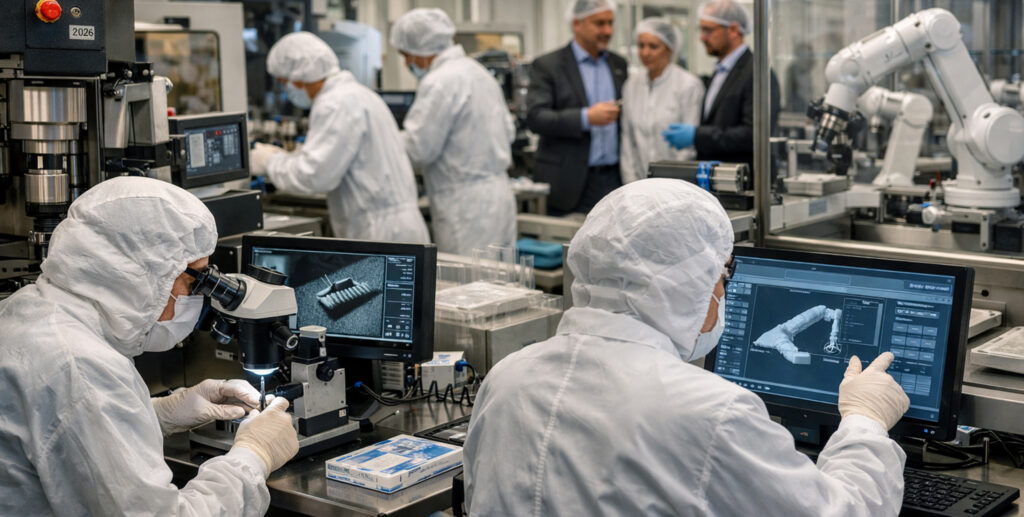
Medical manufacturing is undergoing a transformation that is bigger, faster, and more consequential than anything the sector has seen in decades. And while the headlines often focus on the largest device makers, the real momentum is coming from the small and midsize suppliers featured throughout the latest Design-2-Part ecosystem. These companies are machining tighter tolerances, molding more complex geometries, adopting cleaner and more traceable processes, and delivering rapid-turn engineering support that medical OEMs now depend on to stay competitive.
The shift is being driven by powerful forces reshaping global healthcare. The market for minimally invasive devices is projected to reach $41 billion by 2030, according to Grand View Research. Demand for wearable and implantable technologies is growing at more than 9 percent annually, fueled by aging populations and chronic-disease management. Diagnostics companies are racing to bring new point-of-care platforms to market, a segment expected to surpass $75 billion by 2032. Every one of these trends requires components that are smaller, cleaner, stronger, more biocompatible, and more precisely manufactured than ever before.
Suppliers across the Design-2-Part landscape are stepping up. Precision machining firms are holding tolerances measured in microns while working with titanium, cobalt-chrome, nitinol, and high-performance polymers like PEEK and Ultem. Injection molders are producing multi-material components with internal channels, micro-features, and complex gating strategies that support drug delivery, surgical navigation, and fluid control. Metal fabricators are developing proprietary cleaning, passivation, and electropolishing processes to meet the biocompatibility requirements of next-generation implants.
What stands out is the speed of adaptation. Many suppliers have invested in automation, in-process inspection, and digital traceability systems that allow them to meet the documentation demands of medical OEMs. According to the Medical Device Manufacturing Association, more than 60 percent of small suppliers have added automated inspection or digital quality systems in the past three years. Several have expanded engineering support, offering design-for-manufacturability reviews, prototype-to-production transitions, and small-batch pilot runs that help device makers accelerate regulatory submissions.
As one engineering director at a mid-sized machining firm put it, “Medical OEMs are no longer asking if we can hold a tolerance. They are asking how fast we can validate it, document it, and scale it. Speed and traceability have become as important as precision.”
Another major trend is the rise of vertically integrated shops. Instead of relying on multiple vendors, medical OEMs increasingly want partners who can machine, mold, finish, assemble, and package components under one roof. This reduces risk, improves quality control, and simplifies audits. Suppliers that have added cleanrooms, automated assembly cells, or specialized finishing capabilities are winning more complex programs and longer-term contracts. The Association for Manufacturing Technology reports that cleanroom capacity among small contract manufacturers has grown 28 percent since 2021.
Regulation is also reshaping the landscape. With FDA expectations rising and global standards tightening, suppliers are investing heavily in quality systems, validation protocols, and process control. Many are adopting digital documentation platforms that track every step of production, from raw material certification to final inspection. The push for full traceability is accelerating. A recent Deloitte survey found that 72 percent of medical OEMs now require digital traceability from their suppliers, up from 45 percent just five years ago.
The pressure is real, but so is the opportunity. As one quality manager told us, “The OEMs want fewer suppliers, but they want those suppliers to do more. If you can deliver precision, documentation, and speed, you will never run out of work.”
The broader market environment reinforces this momentum. Global medical device manufacturing is expected to grow to $799 billion by 2030. Orthopedic device demand is rising as joint-replacement procedures rebound. Cardiovascular device production is expanding as minimally invasive technologies replace open-heart procedures. Diagnostics and life-science tools are booming as healthcare systems invest in faster, more decentralized testing.
What ties all these developments together is a shift in mindset. Medical manufacturing is no longer a niche reserved for a handful of specialized suppliers. It has become a broad, fast-moving, innovation-driven market where small and midsize manufacturers can compete and win by combining precision, speed, and technical expertise. The companies highlighted throughout the Design-2-Part issue show that the future of medical manufacturing will be built not only by the industry’s largest players but by the agile, highly capable suppliers who are redefining what is possible on the shop floor.
As demand for advanced medical devices continues to grow, these suppliers are positioned to play an even larger role. They prove that innovation does not depend on size. It depends on capability, responsiveness, and the willingness to invest in the technologies and processes that will define the next era of healthcare manufacturing.
 Spotify
 Apple Podcasts
 Podbean
 YouTube
 Spotify
 Apple Podcasts
 Podbean
 YouTube