CONTINUED READING & RESOURCES
Queer Chronicles Book: https://mybook.to/queerchronicles
Beyond #MeToo Book: https://www.amazon.com/Beyond-MeToo-U…
Her Rights Advocacy: https://www.herrights.org/
Thoughts & Rights Platform: https://www.thoughtsandrights.com/
TRANSCRIPT
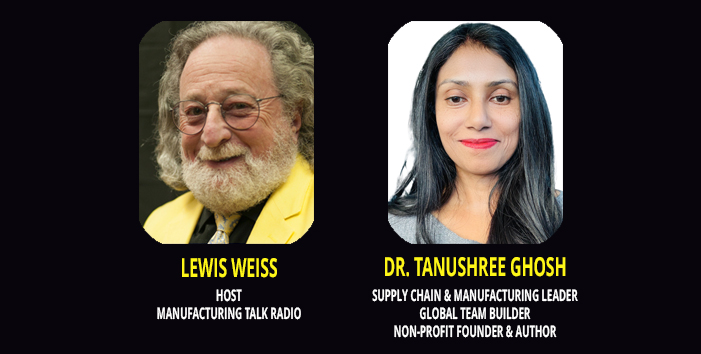
Lewis: Good day, everyone. This is Lew Weiss again at Manufacturing Talk, uh, Radio, and thanks for everybody joining us, uh, today. And we do have really a very special, special guest. Um, her name is Tanushree Ghosh, and sh- there’s so much about her that I don’t– the show is not long enough for me to go into her background.
But she’s a, an author, a poet, a, um, director of manufacturing. She’s a mother. She’s a pet lover, and it goes on. She wrote a book. She’s been on [00:01:00] NPR, uh, and I’m honored that she’s on Manufacturing Talk Radio. So Tanu, give us a little bit more of that background.
Tanu: Yes, yes. Let me just quickly, um, do that and also touch upon a few things. So I actually authored three books as single author and multiple anthologies, which are connections, so but three traditionally published works, and we can get into them at some point. Don’t need to. Now, today I work as the senior director plus at Medtronic, leading their Tempe site operations.
So manufacturing director is actually a role that reports into me. I have the site leadership, which has manufacturing, operations, some of supply planning and supply chain, uh, equipment maintenance, quality, and a lot of host of other things that goes into running a manufacturing site. Before Medtronic, I was a director at Intel.
There I had had a 17-year-old, um, long career. I have a PhD. My training is in science and material science, uh, chemistry and [00:02:00] material science, and I also founded a nonprofit called Her Rights, which works for women’s empowerment, and that’s actually how, Lewis, I got to know you and your wife Jan, uh, through one of our partners.
So thank you for having me on the show.
Lewis: I’ll tell her you said hello. Um, Tanu, uh, you’re now the director of manufacturing at Medtronics. How big of a plant is that?
Tanu: Yeah, actually the Tempe, where I am the senior director plus leading the site, is, uh, almost 800 popula- headcount population. It is nine buildings, manufactures a significant amount of Tempe’s, um, um, Medtronic’s products in terms of covering their, what it’s called operating units. So we cover cardiovascular, cardiac rhyth- uh, cardiac rhythm management, neurovascular and pelvic health, and we used to do diabetes products also.
Personally, in my [00:03:00] organization, I have around 670 people reporting, um Into the organizations that report to me. So it’s a very, very big sites. In terms of Medtronic’s sites, they have three categories. They have a site which is a single building, single product kind of a situation. Then they have what they call a campus, which is multiple buildings and some diversity in technologies.
And then they have complex, which is multiple buildings, multiple campuses, sometimes several different business units served and several different kind of technologies. And Tempe is actually a complex, so it’s a fairly large site.
Lewis: That’s, uh, quite a responsibility that you’ve got on your shoulders. Um, so I’m making an assumption, and correct me if I’m wrong, at Medtronic s- of having 600 plus people working for you, you have the same trials and tribulations that [00:04:00] most and many manufacturers in this country have. Everything from, uh, unions to skill gap to retirement to, um, declining workforce, uh, and so on and so forth.
Has that been a issue for Medtronic?
Tanu: No, unions not so much, but everything else you said around skill set gaps, making sure that your equipments are stable, making sure that your supply chain is healthy and you have, uh, you know, um, supply planning, demand supply equations that work out with each other. A lot of that is right. We also definitely in a large plant, it’s not that, um, there is n- there are no issues that are beyond the equipment and the process and technologies because people is at the core of it.
And I have always felt in manufacturing, the people are even more important because it’s an on-site job, it’s a [00:05:00] ops role, operations role. It’s constantly running, and people have to be present at every moment,
Lewis: Do you have apprentice programs?
Tanu: Internship, you mean? Yes, we do have internship programs. Yes. Actually, our summer interns are just about to start.
Lewis: And if you don’t mind going into a little bit of detail about that, because apprentice programs are opening up all over the country. Uh, everyone’s beginning to get smart about that. So give me a little insight into what Medtronic is doing
Tanu: At Medtronic and also Medtronics and at also my previous company, Intel, uh, there were pretty healthy internship programs which are managed centrally, meaning that, uh, managers put in their needs for interns, and usually there is a call during some time of the year to say, “Hey, we are soliciting.
Do you have a need for an intern?” Then you put it in, but then there is some kind of a centralized management of that. Interns are sourced and then like, you know, there is onboarding. The [00:06:00] interns usually are hired based on the project need. Sometimes it’s a summer intern. Now, the best possible way to talk about interns and value of interns probably would be in a role that I had in Intel as a director before my last couple of roles at Intel.
There, we were not only having summer interns, but we were also utilizing what you would call a long-term internship model, meaning that we would have a couple of people in the team where economically it would be better for us to have a intern with a targeted work scope defined, uh, than to have necessarily a per-permanent headcount.
And I had some excellent interns who then went on to go great things. One of them, I think, works at NVIDIA today. A couple of others also very talented. They were students at the time, and they come in with a summer program, but then they decide to elect to continue the internship as a part-time internship.
And all of these kind of models exist, as far as I understand, in most large [00:07:00] companies, definitely, um, at Medtronics also. Now, in terms of how– A question I often get, and might be very valuable for people listening to you, is what is a good way to get a successful internship? And in my opinion, first of all, uh, a internship, just like anything else, whatever you put into it is what you get out of it.
So research very well as you are getting into a internship that, yes, it’ll be a good experience for your resume, especially today when finding a permanent job is becoming harder and harder. But what will you put into it? How much will you network with people in the company when you are at the internship?
What kind of additional skill sets that you might not be bringing in as a intern but can be a great adjacency will you try to gain as you are there? So I have mentored a lot of interns in this. And for companies, I think internship programs can be very valuable. [00:08:00] Many times you will have work that is very seasonal, especially in manufacturing, especially with things like AI coming in.
You will have seasonal work. Let’s look into systems in this particular domain and see if someone can generate a agent or an app for us. Let’s look into a– even it doesn’t even have to be automation and software because that’s the first thing that comes into people’s mind. It can also be something similar like Ware management.
I have certain equipments where I have a safety or a 5S or a, you know, uh, requirement for lean manufacturing. I’m hiring someone to just take care of that seasonally. We do all of that kind of work through interns, and I think it’s a very healthy two-way model that works for both parties.
Lewis: Is AI part of your, uh, technology program and the internship?
Tanu: Uh, the answer is it depends. So AI is not [00:09:00] yet as penetrated into all manufacturing floors as it might look from outside. However, where it’s still coming in is using AI tools for work efficiency and specific use cases of using AI agents. Beyond that, it hasn’t really yet proliferated down into the manufacturing floor.
In fact, I got a question, uh, in one of my all-hands, I believe, all employee meetings two months back that, “Hey, are we going to lose our jobs because of AI?” I don’t see that happening in the next two years in the manufacturing floors that I run. What can happen eventually is definitely a lot of things getting automated, but most manufacturing floors today are a little bit further away from that.
Lewis: One of the things that I became, aware of recently in a report that I, I just, uh, got a hold of, [00:10:00] there’s a lot of AI hype. There’s a lot of new technology, and they’re pouring a lot of money into, uh, developing more and more and deeper technology in the AI concept. However, as of right now, here’s nine- uh, 2026, I was gonna say 1926.
2026 is that 70, 75% of manufacturing is not yet involved in AI. Uh, they’re taking sort of a let’s wait and see
Tanu: Let’s wait and see. Let’s also bring it in where it’s really needed and will actually be an improvement. But we have to remember, bringing it, bringing it in is not as simple in manufacturing as it might be in some other cases.
in most manufacturing places I have managed.
Equipment fleets will have obsolete, uh, [00:11:00] softwares, obsolete, you know Things that are just being maintained. It’s not like companies are going to recapitalize and change their entire plan and get this new enterprise, uh, applications on brand new computers which are running very fast with AI. That kind of overhaul takes time.
In my previous company, it would be a question of stitching between all the systems that are, you know, existing already, uh, to really harvest data that can be built into large language models that are clean. In my new company, it would be really looking at the entire fleet and seeing how can you even get this up to, and is that cost something you need to pay now to get the efficiency benefit.
So there is always misconception that I constantly hear of like, okay, AI is coming and all jobs are gone. I personally do not think that’s a right approach. I do think that everyone needs to upskill to understand AI and get some AI skills. As AI evolves, I think we need to keep an eye on [00:12:00] it and evolve with it.
Lewis: One of the things that, uh, I became aware of is that many of the companies who are involved in AI have not gone full bore in having their whole manufacturing, uh, entity involved in AI. And what they’ve done is taken certain manufacturing units and employed that into their system and see how it operates in, uh, unit one as opposed to unit two, three, five, and ten.
Uh, so that’s, I think, a smart approach. However, in the United States, 90-plus percent of manufacturing is done by small to medium-sized companies. They are even less involved in AI. But again, the hype makes it sound like everybody’s in, everybody’s, you know, joined the team and employing AI, and it’s really not the [00:13:00] case.
I think it will ultimately be the case, and I think that AI is here to stay. And then now there’s AGI, which is– You know, that’s the version where
Tanu: Yeah.
Lewis: smarter than people. So, uh…
Tanu: Just think about it this way, right? How much do you– Would you– You probably won’t have to guess, you probably know. But how much does a capital equipment cost typically?
It will range anywhere from 500K on the lower end up to few millions, and then can go up to a billion if it’s like, you know, advanced lithography or a huge tool.
So now you take it, and it comes with its own enterprise software systems, computers, and all of it. Will you really recapitalize that? Until you are absolutely sure that you can– you have fully depreciated what you have, you have a way to get rid of that, get entire new fleet, which is really talking to this artificial intelligence and giving you something in [00:14:00] return to recoup that cost.
That math isn’t just there yet, and therefore, you know, doesn’t… I always hear this, “Okay, if we don’t do this, we will fall behind.” There was this very interesting discussion I was having with my manager a few weeks back. He’s the VP of the West in Medtronic. When we have all these digital boards and we say, “Hey, in manufacturing, we follow…”
I cannot talk about what happens inside Medtronic, but let’s say Toyota production system, that is well known. We follow certain defcon, certain structures we manage daily. Just because you have made all of it digital doesn’t necessarily mean that has translated into something tangible. Sometimes you have lost something because when you actually had manual management looking every day into a pitch tracker, generating cards, you have much more involvement and ownership.
So for that to become something that has a tangible delta from what you have today, that translates into money, it will take time.
Lewis: Right. I, I think that, uh, as, as companies are recognizing that they [00:15:00] are losing their knowledge base because people are retiring, uh, they’re leaving, they’re going to, uh, Panama, uh, they’re dying. So there’s a lot of in-inherent, uh, uh, knowledge that’s disappearing, and that’s a big s- incentive to bring AI in before we lose all of that knowledge.
Tanu: That is absolutely an area where, you know, anywhere there is not a huge hardware, software overall needed, you can have AI, and that is absolutely like, you know, creating knowledge reserves, creating la-large language models from which knowledge can be easily translated back. Yes, that’s absolutely something that all companies potentially right now should be al-already looking into and onboarding into.
But if you look at manufacturing, Lewis, many companies, specifically small and medium manufacturing, have still not [00:16:00] fully onboarded onto automation, let alone AI. So we have to remember that, right? Automation has now existed for decades, so it’s not like something has come and we have adopted it
Lewis: think that one of the problems with AI right now is that the target for AI has been that five, 6% of the large corporations To buy into. And yet the big money is in the small to medium size, which represents, as I stated before, over 90% of manufacturing. They need to be able to come up with the, um, the cheap version, not the billion-dollar investment, but, you know, 50,000, 100,000.
Tanu: A-absolutely. Another bigger problem, another problem, for example, last week, so Friday, uh, sorry, Thursday, Friday through Saturday, I was in this conference, which is the [00:17:00] annual global meet of IIT, X-IIT. So IIT is Indian Institute of Technology. So this has, this was happening in Long Beach.
They said people from all over, had people like Guy Kawasaki and multiple folks from, you know, Microsoft and others in executive positions. 80% of the conference was AI. What can AI do in healthcare? What can AI do in manufacturing? How is AGI developing? And the, the interesting thing where though, as you sit in there, you have to understand that is still very general.
To adopt it to the small and medium and your manufacturing, the first thing you’d n-need is a discovery. You’d need to have someone to be paid some money to look into what data exists for you and what can be done, and that is a hurdle for many small and medium companies to be able to cross today.
Lewis: it, it’s a problem, but I think [00:18:00] the problem is be- be- becoming, uh, more mainstream because some of the manufacturers, small companies here, for example, in New Jersey, you know, they’re all anxious to get involved, but they’re scared to death about the cost disruption of their business and so on.
Tanu: You are right, but what I also saw is you are right that it’s becoming more mainstream and maybe it will bridge itself. Because what I saw in this conference is every other person was a CEO or a founder of a very small AI startup. And what they’re doing is they’re trying to reach new customer base to see if they can develop agentic AIs, AI agents for these people.
Now, there is not enough big corporations in the world for all of them to be, you know, uh, satisfied. So the demand and supply will meet, and these smaller startups will have to do free of cost or low cost investment into discoveries and generating and penetrating the small and medium manufacturing market.[00:19:00]
But the point to remember is, even as they do it, let’s say for med tech, they will probably look into, hey CAPAs, uh, uh, the, the thing documentations, data collection around equipment efficiency, what can we do for you? It will not replace hardware and manufacturing operation workforce in the next two years.
At least that’s what I believe.
Lewis: I, agree with that. And also, some of the issues in small to medium-sized companies really involve not the hardcore manufacturing aspect of their business, as you just pointed out, but for example, customer relationship management, CRM, um, uh, accounting, um, those areas where a small to medium-sized manufacturer can see, one, an immediate or a more immediate cost savings and efficiencies without spending a billion dollars.
Tanu: Yep, absolutely. Absolutely.
Lewis: [00:20:00] So, um, can you, aside from you being, uh, who you are and being in- involved at a, such a high corporate level, let’s talk a little bit about, uh, your activism, uh, gender equality, and some of your side projects, which takes up page two of your bio.
Tanu: So I have from as long as I can remember, quite passionate about social activism, and my principle around that was really simple. Uh, it was very hard for me to understand why human beings will not be equal or will not have equal rights. And, you know, it doesn’t matter if you’re talking man or woman or you are talking gender spectrum, you are talking caste, race, religion or something like that.
I always found myself to be bothered by the fact that one human might be having less opportunities or allowed to be lesser, [00:21:00] um, or forced to be lesser just because of who the person is. So early on, I volunteered when I was doing my PhD in Cornell. I volunteered for an organization called Asha for Education, which helps disadvantaged children in India.
Then I moved on to more broader activism through Association for India’s Development. And at still at this point, I was quite con– uh, quite looking into broader social justice. But in 2016, I really wanted to found something personally being affected by some gender violence that happened in India, which was unimaginable.
It’s a pretty known case in 2012. Uh, but in 2013, I gave birth to my daughter, and this incident happened just as I was pregnant with her, and I started being very mentally affected on what am I trying to do to prevent the deeper root causes that caused this kind of gross violence against women. So I founded Her Rights Incorporated Um, I have been writing from the same time.
I [00:22:00] wrote an article on The Huffington Post, which actually went viral, got picked up by Yahoo News, also kind of catapulted my writing career. So my first book was “From Another Land,” published by Redomania Publishing. This was interestingly first time when, um, now we are under Trump administration. This was released in his first term.
This talks about, um, just stories. These are connected short stories. I try not to ever make a judgment on what is right or wrong because I feel I don’t know. But I do try to tell stories as I see them, so I write fiction, nonfiction, op-ed, poems. This was the first book. The second one was actually, uh, “Beyond #MeToo.”
This was by Sage Publication, and this was then republished. Uh, this was available in Barnes & Nobles until not too long ago, and all of these are on Amaz-Amazon. “Beyond #MeToo” is for Her Rights. I did a lot of research looking into the different movements of [00:23:00] feminism, the backlash, and what really can solve some of the issues we see and why gender parity is very important, not just for social, uh, metrics, but also economic metrics.
This is a nonfiction. This is– And then my last one is “Queer Chronicles.” These are again short stories. This was keeping in mind what this book was released just before the strong backlash against DEI. But what I was trying to observe there were human behaviors on both sides of the spectrum as a lot of change is coming in terms of gender and sexuality and how we accept divergence in it.
And again, no right or wrong. I tried to portray through short stories what I pursue– uh, I observed. Now, all of this actually draws in a lot from my corporate life because I always observe people a lot, no matter what role I am. Uh, but honestly, I have, um, [00:24:00] since then, I have also written in several magazines, op-ed columns and stuff.
This year, I have been a little bit of backseat from writing, but Her Rights is doing very well. We have multiple collaborations supporting women’s education. We run a program in Arizona for seventh-grade girls with, in disadvantaged schools, teaching them leadership mindset. This is in a nutshell, all the things that are around me.
But I truly believe in, you know, uh, doing well by doing good. One of my bosses told me this long time back, and I don’t do this for any selfless reasons. I actually just find me being able to cope better with my own troubles and personal things when I invest myself into solving other problems or talking about other problems.
So that might be a very selfish reason on why I’m doing this, but that’s the entire picture.
Lewis: Tanu, um, like I said, we didn’t have a– We only have a [00:25:00] 30-minute show and it’s, uh, your bio takes 40 minutes to read and digest. But there’s one aspect of it that I’d like to bring up, and that’s the work-life balance. How do you do that? How do you write three books, numerous, uh, articles, m-managing Medtronics, being a director at Intel?
Um,
Tanu: I, I have been asked about this and I gave a s–
Lewis: tired, I’m tired even hearing it, but go ahead.
Tanu: I, I hear this often, and actually I gave a small TEDx-style talk at a Woman at Intel conference, I think in 2017 on the same. One of the things is, Lewis, you always have to like phase your life, I feel, with the waves and tides and waves that come. For example, when workload is high, I take a seat back from writing.
I don’t try to do all of them all at once. I follow the opportunities as they emerge. Uh, writing the [00:26:00] books, for example, when my daughter was younger, I had to take her to gymnastics, dance, ballet, lot of stuff. So as she’s dancing, I will sit and write on my computer. And then the other benefit of becoming a mother is I used to watch a lot of TV and mostly crime shows, so when I have a young child, I couldn’t watch them anymore.
So a lot of time freed up, I would work on my computer instead, you know, uh, when that kind of, you know, she’s playing by herself. And then the– So it’s just time management across things that come. The other thing is, I feel the first step is to define success in your own terms. I see so many people who say, “I can never write a book.
I will have no time to finish it.” And I think I said it somewhere, you know, just because you can’t finish a book doesn’t mean you shouldn’t write a sentence. You should just start doing things that you like, and then you can see where they take you. For example, if I got attached to, okay, I have written three books, how much PR do I have around that?
How [00:27:00] many copies have they sold? I think I will demotivate myself from writing any book ever again. But I look at it like, okay, I get to do the things that I enjoy, helps me with my mental health. I have never checked, you know, how many copies any of my books sold, and one of my publishers actually got very mad at me saying that you have to be more vested into these things.
Same thing about Her Rights. When I founded it, if I put a goal on myself that, okay, I will solve the gender right problem or raise this much money in this many years, I feel like I would have demotivated myself. I basically said, you know, even if I’m running this organization alone, I will just do 1% every month whenever I find some time.
So that’s the, that’s the second thing. And then the third thing is, this is where AI comes in Has made my life so much easier. Nowadays, if I have to write anything from my performance self-evulation, uh, evaluation, which I did yesterday, to something about books, I just put [00:28:00] points in there. Then I say, “Hey, ChatGPT, convert this into a performance evaluation, pointing out into these high impact points, bulletize it, and give me back.”
Now, of course, AI didn’t exist many years back, but one of the key things of efficiency is Googling, researching, finding out what tools can help you. So before AI, my life was completely efficientized by OneNote. I would just have multiple tabs of the multiple things I do, and I would port them, copy-paste them into there.
When I had a smartphone, I would sit somewhere and I have nothing to do, I’m stuck in something and meditate for some time, and I will just use my phone to take notes, email it to myself. Maybe I will write a poem. These tricks don’t have to be the same for everyone. What is very important for everyone is when you are doing these things, are you doing this because you are chasing a goal and someone has told you [00:29:00] you have to prove yourself to someone, or you would still do it if no one reads the book?
So that’s what I think is my thought on this.
Lewis: I think your next book should be entitled “Making Empowerment Easy.”
Tanu: Doing slow yoga, this might not be, this might not be a bad idea. Whenever, you know, I have bandwidth again.
Lewis: ‘ cause you made it sound easy and, uh, sounded like there’s a lot of… not a lot of downtime.
Tanu: No. You know what? I actually want to caution, even though I will completely take that title, but I will caution about one thing. We are all, I feel, Stanford ducks. We look flat on the water, but everyone is paddling crazily underneath. So when I make something look easy, I never want to make a statement associated with it that it is easy for me.
No, it’s a struggle, and it’s very important to talk about all the different [00:30:00] struggles you go through in this, because otherwise what happens is you demotivate a lot of people from achieving their best by giving them the message that, you know, you can never do this because you have struggles. And this happened to me.
I was in a, a book launch in Delhi, and a mother came and told me, a single mother who has actually raised a child in a very different, difficult ecosystem, “I also want to write a book, but you know what? I struggle so much with my mental health, I could never do it.” So I always make an effort to really be as vulnerable as possible about, I have some trips and tricks, tips and tricks, but it is very hard for me also, and that’s okay.
Lewis: care how easy you make it sound, I know it’s hard. Do you have any final words for us today?
Tanu: Well, definitely, first of all, thank you for doing this. I really enjoyed this conversation. And the, the second thing is that we have had a previous discussion [00:31:00] on women in manufacturing. I wish to see more and more women in this space. And just in general, if I could leave any final words, it’s not just for women, but anyone who feel like they’re lesser because they don’t see enough number of them or people who look like them in a certain space, I don’t think you should be demotivated by that.
Lewis: Tanu, I think that because you have so much downtime, maybe we should be talking off air about women in manufacturing and perhaps a
couple of other things. So, so thank you for that. I appreciate you being on the air today. Um, and, folks, I want you to remember to listen to our show, hit the like button, give a thumbs up, subscribe.
Important to subscribe. This way you never miss a show. And, uh, I’m sure that Tanu has subscribed and [00:32:00] did all kinds of thumbs up and so on. So folks, we’ll be here every Tuesday going forward, and I look forward to having more shows, uh, like the one we just had. Uh, Tanu, thank you very much again. Appreciate your input.
Thank you
 Spotify
 Apple Podcasts
 Podbean
 YouTube
 Spotify
 Apple Podcasts
 Podbean
 YouTube