
Summary
Micron and GlobalWafers are expanding U.S. semiconductor manufacturing capacity through major investments in Texas and New York, strengthening domestic supply chains for memory chips and silicon wafers. These projects support CHIPS Act goals, reduce reliance on foreign suppliers, and reinforce U.S. competitiveness in advanced semiconductor production.
Why Semiconductor Supply-Chain Expansion Matters in 2026
The U.S. semiconductor industry continues to rebuild domestic capacity after years of dependence on overseas manufacturing. Memory chips, silicon wafers, and advanced materials remain critical to national security, AI development, automotive electronics, aerospace systems, and consumer devices.
Micron and GlobalWafers’ new investments directly support CHIPS Act priorities by expanding upstream and midstream production areas where the U.S. has historically lagged behind Asia. Strengthening these segments reduces vulnerability to global disruptions and ensures a more resilient supply for high-growth industries.
Micron’s New York Expansion Strengthens U.S. Memory-Chip Production
Micron’s multibillion-dollar project in New York represents one of the largest memory-manufacturing investments in U.S. history. The company is building advanced fabrication facilities capable of producing leading-edge DRAM and NAND technologies used in AI systems, data centers, autonomous vehicles, and defense applications.
The project is designed to create thousands of jobs, accelerate domestic chip output, and anchor a long-term semiconductor ecosystem in the region. Micron’s investment also supports workforce-development programs and partnerships with universities to train future semiconductor engineers and technicians.
GlobalWafers’ Texas Facility Expands Critical Wafer Capacity
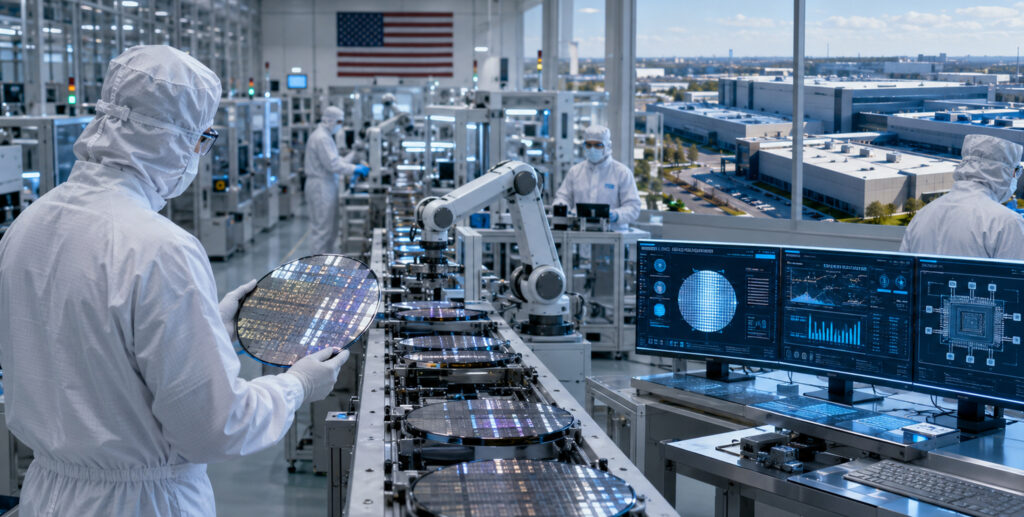
GlobalWafers’ new Texas plant focuses on producing 300-mm silicon wafers, a foundational material for nearly all advanced chips. The U.S. has long relied on foreign suppliers for wafers, making this investment strategically important.
The facility increases domestic access to high-purity wafers, reduces supply-chain bottlenecks, and supports downstream chipmakers, including Micron, Intel, Texas Instruments, and other U.S. fabs. By expanding wafer production inside the country, GlobalWafers strengthens the entire semiconductor manufacturing pipeline.
How These Investments Support CHIPS Act Goals
Both projects align with federal CHIPS Act objectives:
- Expanding domestic semiconductor manufacturing
- Strengthening upstream materials supply
- Reducing reliance on foreign wafer and memory production
- Supporting workforce development
- Building regional semiconductor ecosystems
- Increasing national-security resilience
Together, Micron and GlobalWafers are helping rebuild a vertically integrated U.S. semiconductor supply chain capable of supporting future AI, defense, and advanced-electronics demand.
What This Means for U.S. Competitiveness and the Industrial Base
These investments position the United States to compete more effectively with global semiconductor leaders. Domestic wafer and memory-chip production reduces exposure to geopolitical risk, improves supply reliability, and supports high-growth industries that depend on advanced electronics.
For manufacturers, the expanded supply chain means shorter lead times, more predictable sourcing, and greater access to critical materials. For the broader economy, it means stronger innovation capacity, more high-tech jobs, and long-term industrial resilience.
Key Takeaways
- Micron and GlobalWafers are expanding U.S. semiconductor capacity in New York and Texas.
- Micron’s project strengthens domestic memory-chip production for AI, automotive, and defense.
- GlobalWafers’ Texas facility boosts U.S. supply of 300-mm silicon wafers.
- Both investments support CHIPS Act goals and reduce reliance on foreign suppliers.
- The projects reinforce national-security resilience and long-term U.S. competitiveness.
FAQ
Why are Micron and GlobalWafers investing in U.S. facilities?
To strengthen domestic semiconductor supply chains and reduce reliance on foreign production.
Why are silicon wafers important?
They are the foundational material used to manufacture nearly all advanced semiconductor chips.
How does Micron’s New York project support U.S. competitiveness?
It expands domestic memory-chip production essential for AI, defense, and advanced electronics.
How do these projects align with the CHIPS Act?
They expand manufacturing capacity, support workforce development, and strengthen upstream materials supply.
 Spotify
 Apple Podcasts
 Podbean
 YouTube