TRANSCRIPT
00:00 Welcome and Introductions 00:40 Tim’s Career Origin Story 01:18 From Seminars to Global Supply Chain 02:56 Launching Tompkins Ventures 03:51 How Ventures Helps Manufacturers 04:42 No Fee Model Explained 06:19 Success Fees and Partner Network 07:45 Why Outside Expertise Matters 10:12 Virtual Companies and Outsourcing 11:07 Quality Control in Outsourcing 13:44 VUCA Defined for Supply Chains 17:10 Reshoring as Risk Mitigation 18:19 Surfing the Next Disruption Wave 22:25 Resilience Over Pure Efficiency 25:13 What to Reshore Four Criteria 26:59 Tariff Refunds Supreme Court Fallout 32:12 Wrap Up Contact and Subscribe
Lewis Weiss (00:04.162)
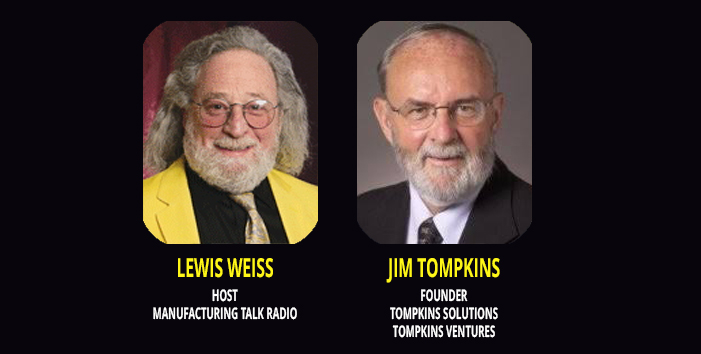
Good day everyone, this is Lew Weiss with Manufacturing Talk Radio again. We’re gonna have an interesting conversation with Tim Tomkins of Tomkins & Ventures. Welcome Tim.
Jim Tompkins (00:19.115)
Thank you, Luke. Good to be here.
Lewis Weiss (00:20.984)
Great. Tim, give us a little background story of who you are, what you are, and what adventures is all about.
Jim Tompkins (00:29.973)
Well, I grew up in Chicago, went to Purdue. I have a bachelor’s, a master’s, and a PhD in industrial engineering from Purdue. And after Purdue, I went in the Army for three years, came out of the Army, and came down here to Raleigh, North Carolina, and was a professor at NC State. My wife and I were behind all of our friends. All our friends got their bachelor’s degree and went out and made money. And we went out and got degrees and the Army done.
And so we were trying to catch up quickly. So I taught a seminar of all things. I taught a seminar in 1975 on planning and managing warehouse operations. That seminar exploded. Lew, it was the best warehousing seminar in the world. The reason I say that with such confidence, it was the only warehousing seminar in the world. No one else would have thought to teach that. And what I did is I applied industrial engineering to warehousing. And that
course resulted in another course, another course, another course. Some people attended and said, could you do consulting on that? And so I started a little consulting company. That little consulting company, four years later, my wife pointed out to me that my part-time income was six times larger than my full-time income. So I left the university and made my life’s work consulting with a company that we called Tompkins Solutions. That company did well. We grew, we prospered.
By 2000, we decided to go global. We sold a portion of the company to private equity and we opened a business in Australia and China and Europe and Africa and North America and South America and business was going very well. The first private equity sold their 35 % to Blackstone. Things went very well. We grew further and we left kind of doing warehousing and transportation work.
and went into full supply chain work. That firm then sold to a Chinese private equity firm. That all ended with COVID in 2020. And the official word was I retired. I wasn’t very good at that, only stayed retired for three weeks. And I started Tompkins Ventures, where Tompkins Ventures is not a consulting firm, but it is a firm that provides matchmaking. One client…
Jim Tompkins (02:53.383)
has a problem, another partner has a solution, and we put them together and we solve problems. We do that in logistics, we do it in entrepreneurial growth, we do it in technology, we do it in procurement, and we do it in organizational development. So that’s the firm that I run today is Tompkins Ventures, as well as I’m now back as chairman of my original firm, Tompkins Solutions again.
Lewis Weiss (03:19.544)
So the conclusion that I draw from that long multi-year journey is always listen to your wife.
Jim Tompkins (03:30.975)
Yes, absolutely.
Lewis Weiss (03:33.006)
Okay, so typically what is Tompkins Ventures typically doing for manufacturing? Because this is what we’re all about. We’re about manufacturing and solutions to their issues and problems.
Jim Tompkins (03:50.656)
Probably the largest body of work we do is in the technology area. Today, a lot is in the artificial intelligence area where they want to include artificial intelligence in their forecasting, in their scheduling, in their inventory planning. They want to create autonomous operations. We also do a lot of work in automation in manufacturing, as well as we handle their supply chains. We do the
logistics portion, we do the procurement portions. So a lot of our work is done with manufacturers.
Lewis Weiss (04:25.72)
Do you do these services as an outside remote vendor or do you actually come into the manufacturing sector and take a visible presence in one’s business?
Jim Tompkins (04:40.645)
kind of a combination. And so what we do at Tompkins ventures is we analyze the problem and determine a path forward. We then select the partner who goes in and does the work, but we don’t charge consulting fees. There’s no consulting fees. We come in, we do the work, we make a recommendation and the client then has the choice of saying yes or no. If they say no, no harm, no foul. They keep the report and we go away.
Lewis Weiss (04:43.246)
you
Jim Tompkins (05:08.615)
If they say yes, then they’ll buy the service. And so it might be buying a new AI agent that’s going to help them do scheduling. It might be buying new transportation. It might be building a new plant. It might be relocating the plant. It may be going to a third party logistics provider. It may be consolidating some of the procurement spend. So those are the types of things we do through our partners. Our partners, have…
263 business partners, and then we have commercial partners over 200. We have capital partners over 400,000. And then we have some consulting partners that handle projects that can’t be solved without doing some consulting. But we’re 90 % of the time not doing consulting. We’re doing free advice that then leads to an implemented solution where clients get results.
Lewis Weiss (06:06.126)
So how does Tompkins Ventures make money? Not that I’m worried about.
Jim Tompkins (06:12.553)
So, hey, you and my wife, she must have called you. And so what happens is when we, let’s say we bring a transportation provider and a guy says to me, Jim, our transportation spend is too high. We’ll analyze what they’re doing and we will identify a carrier or a company that has a transportation capacity to come in and look at the study. They’ll come in, they’ll do the study, they’ll make recommendations.
Lewis Weiss (06:19.895)
I’m gonna listen.
Jim Tompkins (06:41.021)
If they say yes, they then hire the transportation company to do that. They pay for the transportation. And in that transportation fee is a small success fee that comes back to us for us recommending it. So we get a success fee based upon how well our partners provide. It’s an interesting model because although we have very low overhead, we’re asset light.
but what we have is unlimited capacity. If someone has a problem that we can’t solve, we go find someone who can solve it and provide that capability so the client gets a free look at how they can make things happen and save money without spending money. And then if they decide to do it, they move forward. We plan on about 80 % of the time moving forward and it works out about right. So we are doing well.
Lewis Weiss (07:33.63)
One of the things that I’ve learned along the way of my 60 years in manufacturing is that manufacturers, and I’m sure you’ll agree with this, manufacturers really know how to make stuff. They know how to make it. They know how to sell it. They know how to promote it. They don’t necessarily know all the things that you just mentioned because they’ve been busy running a business. So one of things that I’ve found is that
having outside resources, which wasn’t always the way business ran. Today, I feel you have to rely on outside resources to help build your company, grow your company, monetize your company.
make your company efficient and so on and so forth and introduce the company. And this is the most important part is bringing new technology that was not available or even discovered 10, 15, 20 years ago when they first started their business or in my case even longer than.
30, 40 years. So I think it’s imperative that companies realize the value in a service such as the one that you’re providing.
Jim Tompkins (08:52.405)
Well, Lew, I could not agree more. We find many manufacturing firms that have a core competency that is absolutely world class. And so what we wanna help them do is focus on what they really, really do well. But oftentimes that means their procurement isn’t so good. Their transportation is terrible. They don’t have the right technology.
You said 10 or 15 years ago, we’re talking now about technology that didn’t exist 10 or 15 months ago when we’re talking about robotics and humanoids and AI. So there’s so much potential there. So absolutely, the more time we can help manufacturers focus on what they’re really, really good at, the more successful they’re going to be. And then we can handle the things that are around that core and maybe
They shouldn’t be in the warehousing business. Maybe they should use a 3PL. Maybe they shouldn’t do their own tooling. Maybe they should outsource that. And so let’s define what’s core, really focus on that, and then let the other stuff get taken care of with people, though at that is their core.
Lewis Weiss (10:04.152)
Being that you brought that particular point up, have you experienced a client where you literally turned their whole business upside down and got rid of certain services that they provided and farmed it all out? Is that something that you have done?
Jim Tompkins (10:22.495)
Yes, yeah, have, I would say three years ago we had not done that, but now we do have virtual companies. And what’s enabled that is the full acceptance of e-commerce and how companies now, it’s two guys and two women in a garage and they’re doing $25 million a year, but they outsource everything.
other than the sales relationship and the fulfillment of orders. it’s very interesting. Virtual companies do exist and are being successful.
Lewis Weiss (11:01.39)
But you brought up an interesting point. My previous life, I had a raw material metals company that supplied metals to manufacturers. And in 1978 or 80, I don’t recall,
we brought on ISO certification to our company, which I’m sure you’re quite familiar with that. ISO meaning the International Standards Organization, which I’m sure most of the manufacturers are aware of today. We were one of the first metal companies that implemented that within our company. And it proved to be invaluable and saved us a lot of money.
That aside, it’s a little bit more difficult when you have outside providers where you don’t have the control of the quality standards on vendor A, vendor B, vendor C. And there was a way that I did it in my prior life, but how is that become an issue with regards to the services you’re providing?
Jim Tompkins (12:15.793)
Absolutely, absolutely. And what we find is that oftentimes when we are selecting the providers, we’ll do it with a impersonal, not personal RFP process. And then we’ll go through an evaluation process and go with the low bid. And the low bid is not necessarily the low bid. And so what we need to do is work on building the teamwork, the cohesion, the communication.
that works together. I actually wrote a book on that subject. This is a book called Logistics and Manufacturing Outsourcing. And I’m the primary author of that book. And so absolutely, it’s an art to create a virtual business and you really need to make that a core competency.
You need to make a core compsiny your ability to retain others to outsource to. And if you don’t have that as a core compsiny, you shouldn’t be doing it.
Lewis Weiss (13:21.24)
Shouldn’t be doing remote.
Jim Tompkins (13:23.155)
Right. If you don’t have a core competency in outsourcing, you shouldn’t be going outsourcing.
Lewis Weiss (13:28.398)
So ISO quality standards really runs through the whole process of remote business functions.
Jim Tompkins (13:39.996)
Absolutely. Yep.
Lewis Weiss (13:42.19)
Okay, so going back to the beginning, FUCA, F-V-U-C-A. Tell us about that.
Jim Tompkins (13:52.941)
So, VUCA was invented by the Corps of Engineers back when Reagan was talking about the Berlin Wall falling. And Reagan wanted to know what are the implications of this? And they came up with the word VUCA, volatility, uncertainty, complexity, and ambiguity. The word VUCA was used a lot back then in the 1980s, but then it kind of went away.
But when we started getting into 2000, 2002, 2003, there was a tremendous amount of disruption and uncertainty. And so I was looking for a word that I wanted to put on this and I went back and I found VUCA. And so VUCA is where we live today. And if we’re talking about reshoring, as you and I did in the pre-show, VUCA,
is alive and prominent in everything we do. Volatility, today we have volatility in tariffs, in freight rates, in energy costs, and any thought process of us reaching steady state and traveling along a normal path where business as usual is going to be wonderful is not true. Volatility is out there and it’s really having its way with us. Uncertainty, my goodness sakes, alive.
Is it Iran? Is it Ukraine? Is it the Chinese? Is it the Russians? Is it Venezuela? Is it Cuba? There’s huge, huge, huge uncertainty. If we look at how a company is going to operate, there’s only really three things that are uncertain. The supply, the demand, and the lead times. Unfortunately, that’s everything. Everything is what’s, what are the supply for my providers?
What is the demand for my customers and what is the lead time? And so with the uncertainty there, what we’re gonna have is volatile times because of the uncertainty. Complexity is unbelievable today. We have complexity with optionality. We do not want to single source anything. We don’t want a single country anything. And so we need to have optionality.
Jim Tompkins (16:15.56)
and optionality needs to be done at the same time that you’re doing resilience and you’re still trying to keep the cost low. What people say as well, optionality is going to increase cost. Yes, it will. Some people say, well, resilience is going to increase the cost. Yes, it will. Well, we can increase cost. Well, that’s why this is a very complex situation. And then the A is ambiguity. And that’s actually the hardest part, because today there is no normal.
People keep saying to me, Jim, when’s it going to get back to normal? The answer, never. Disruption is the new normal, and so we need to deal with it. So volatility, uncertainty, complexity, and ambiguity makes it very, very, difficult to run a global supply chain and to meet our manufacturing client customers’ requirements. And so what we’re looking at is a hedge to allow us to do better with VUCA.
is to do reshoring because if we’re going less distance, we’re making it closer, we’re putting demand closer to supply, what we’re gonna find is our forecast errors are gonna be going down and we’re gonna have less volatility, uncertainty, complexity and ambiguity. so resourcing is a basic risk mitigation strategy that’s gonna help manufacturers do a better job of managing VUCA.
and providing resilience optionality while not increasing cost.
Lewis Weiss (17:49.836)
We touched on this a little bit ago about reshoring. We’ve had Harry Moser, who is the master of reshoring, in my opinion, and everybody loves Harry. I’m sure you know Harry. So tell me how all this works with your services in regards to reshoring, bringing back your supply chain to reshoring, nearshoring, and so on.
Jim Tompkins (18:19.168)
Well, I think the key is to, let me use an analogy. Let’s say you’re sitting on the beach and I’m on my surfboard out in the water. And so I’m not gonna be looking at you because you’re on the shore, you’re where I’m going. What I’m going to be doing is I’m gonna be looking over at my shoulder and I say, Lew, see that, not the second wave, but see the third wave?
That third wave is coming and it’s going to break right here. And what I need to do is I need to harness the power of that wave. And so I know it’s a third wave. So I have the intelligence to look and understand where the disruption is going to be coming. And I know it’s coming. And so when it starts to approach, I start paddling. I get in front of the wave. OK. And when I get in front of the wave, the power of the wave, I mean,
Lewis Weiss (19:12.726)
Mmm.
Jim Tompkins (19:17.66)
Even my hair, which there’s not much of, you would be like a hairball, but I mean, even my little hairs will blow because I’m traveling so fast. But I’m now on the wave, but I can’t just hang there straight. What I have to do is the wave has some twists and turns and some side currents. And so I have to have agility to play up that wave, to come back down the wave, to play up the wave, to get underneath the curl and to really, really
ride that wave all the way to the shore. And when I get to the shore, I’m then gonna have a big smile on my face because I had a great ride and I didn’t wipe out. That’s what reshoring is about. We need to have the visibility to see what’s coming, to have an understanding of what’s taking place, to understand that sole sourcing everything from China is no longer viable. You can’t.
do that because the supply can be irregular and now you’re going to be disappointing your customers. And so we got to have once we get once we understand what the power of that next wave is, we got to have the agility to move our business around and they have the ability to vary inventory, have the availability to change lead times, to change transportation, to alter the way my supply chain works.
so that I have the ability to bring that baby home and actually get on shore and now be able to optimize my adaptability. Okay, and so what we have been doing for years and years and years leading up to 2020 was we were optimizing the efficiency. So I’m an industrial engineer. I love to optimize efficiency, but guess what? Efficiency.
which minimizes costs, no longer works because it’s fragile. It’s brittle, it breaks. And so what we need to do is we need to have the adaptability. We wanna therefore invest in things like digital twins. We wanna invest in scenario planning. We wanna invest in AI so that we have the ability to move with the wave and therefore to be able to drive that home, to get in front of the VUCA, to stay in front of the waves.
Jim Tompkins (21:39.904)
just sit there in the water and you don’t get in front of a wave, guess what? That wave’s gonna take you out and you’re gonna wind up eating sand. And so what we need to do is we need to understand where we are and where we’re trying to get and then do it with adaptability and resilience while still trying to minimize cost.
Lewis Weiss (21:59.79)
Great analogy, great insight. And you sort of proved out what I said some 10 minutes ago, and that is that manufacturers know how to make things, but they don’t know the things that you know. And especially on a cost basis, your services must be incredibly on demand.
Jim Tompkins (22:13.769)
Amen.
Jim Tompkins (22:24.211)
Absolutely. Yep.
Lewis Weiss (22:26.292)
Excellent. What other points would you like to talk about, Tim?
Jim Tompkins (22:32.0)
Well, I think one of the challenges we have is really grasping resilience. You know, if you look at us in 2019, we were doing everything just in time. Inventory was evil. And so we wanted to minimize the cost of that inventory. But what we found is we had a brittle environment. We were fragile. And one
Lewis Weiss (22:46.552)
Yeah.
Jim Tompkins (23:00.044)
miss shipment and all of a we couldn’t ship. And so now what we see is resilience is not an option. Resilience is a mandate. The definition from a mechanical engineering point of view of resilience is your ability to bounce. And so what is your ability to bounce? What is your ability to deal with VUCA? And so what we see is that resilience has a cost associated with it.
And so the CFO says, I don’t want resilience. Well, guess what? Fragility also has a cost to it. And so what we need to do is balance those costs. And so what we did is we went from just in time, COVID hit, we couldn’t get anything that we wanted. So what we did is we went crazy with inventory and we went back to just in case, and just in case was evil.
because now we had all our money tied up in inventory that wasn’t turning and therefore we lost profitability. And so the thinking was, well, we can’t do just in time because we’ve got this VUCA thing killing us. And so what we need to do is we need to do just in case, but we can’t afford that. So what it really becomes into, we have to have it just in region.
And that brings us back to reshoring. And so we need to get the product available in the region when we need it. And so reshoring is a portion of the equation, but it’s only a portion. In addition to that, we need to be able to add the technology components. We need to understand that we have greater ability to reshor things when we’re automating it and when we have artificial intelligence.
The more AI we have and the more automation we have, the easier it is to reshore. And so when someone says, well, what’s more important, reshoring, automation, and AI? I say yes. I mean, it’s one, it’s, you know, what’s most important, the cherry filling or the crust? Well, we got to have both to have a good cherry pie. And so it works like that. So I think that’s really important. You know, how do companies decide what to reshore?
Jim Tompkins (25:22.124)
I think there’s four points there that you need to think on. The first one is value density. Now what’s value density? Well value has to do with the value of the product and density has to do with the size and the weight. And so what’s the ultimate value density product? Value density product would be jewelry. It’s got a lot of dollars, but it’s very small. Transportation doesn’t really matter.
And so that would be something you can do globally. Microcomputers, chips, microprocessors, medical devices, pharma, that stuff’s all stuff that’s got a high value density as opposed to inexpensive things that are bulky. Inexpensive things that are bulky, you probably wanna either reshore or nearshore, either bring that back to America or do it in Mexico. Second,
point is demand volatility. The greater the demand volatility, the more I want to reshore because I don’t know what to make and don’t have enough time to make it with the lead time. The third issue is IP sensitivity is our intellectual property at risk. If it is, if we have substantial IP, I want to make it in the United States. And then the fourth thing is the automation potential.
Lewis Weiss (26:29.133)
Right.
Jim Tompkins (26:42.324)
The higher the automation potential, the lower the labor, and therefore, the better we can do it in the US because the United States is expensive. So I think if we think about those four things, we can think about what to reshore. We’ve talked about how to reshore, and then what we have is an opportunity to really make sure we have the ability to address VUCA with resilience. And that’s kind of the story.
Lewis Weiss (27:05.004)
Makes a lot of sense. In our final moments, I’d like to introduce, and we don’t talk politics and our audience knows that I never talk politics.
Not that I don’t want to, but it’s just smart or not to. I’d like to bring up the new issue, and that is about tariff refunds based on the Supreme Court ruling of these last few days. I see it personally as a major foobar that it’s not going to be quick and easy, yet some of the talking heads over the last several days have been talking about how easy it’s going to be.
What’s your thoughts on that, Tim?
Jim Tompkins (27:49.015)
Well, both positions have some validity. The fact of the matter is all those payments are made electronically and there is a database that has who paid what amount of money and you could push the button and get that money refunded. That theoretically could be done. Now, is that gonna get done correctly that way? No, because it’s not necessarily who paid the tariff is the one that should be refunded because let’s say
Lewis Weiss (27:57.582)
Thank you.
Jim Tompkins (28:17.708)
you sold me something and I paid a hundred dollar tariff on it. Should I then be refunded that hundred dollars? Well, no, because I went to you and said, hey, Lew, we’re working together on this. I tell you what, I got a hit with a hundred dollar tariff. Why don’t you take 50 and I take 50 and you take 50 off your price and I’ll take the other 50. And so we work together so we maintain our position in this market. And so we do that. Well, but now,
I’m going to get the refund, but you paid half of it. Or what about the firm that used to sell that item for $100 to the United States, but now all of sudden, since there’s a tariff on it, they decide to sell it for $50 to the United States and get our profit after it hits the shore by creating a phony company in the US and have that take place. That’s rampant out there. And so what we have is the concept of easy refunds is absolutely malarkey.
Lewis Weiss (29:10.413)
Right.
Jim Tompkins (29:16.94)
There’s no rationale for that at all. In addition to that, if we want to just talk about the Republicans and Democrats without getting political, guess which one of them wants to give up $180 billion? Neither. They neither do. Both of them, the Democrats and the Republicans, and there’s probably some independents in there too if we want to get totally right, and they don’t want to give up the $180 billion.
What they wanna do is they wanna keep it, because they have things they wanna spend that money on. And so the political machine is not in favor of it. The thought process of pushing a button is total baloney. It’s not relevant. And so what we have is we actually have a failure on the part of the Supreme Court. Now, if you look at how the Supreme Court is structured, when it was created back when our founding fathers,
Guess what percent of the founding fathers were lawyers? 45%. 55 % were farmers and newspaper people and retail owners and production people. 55 % was the majority. Today, what percent of the Supreme Court are business people? Zero. Which part of my manufacturing people? Zero. Which part of supply chain people? Zero. We’ve got nine lawyers sitting there.
Lewis Weiss (30:18.115)
Yeah.
Lewis Weiss (30:33.196)
Zero.
Yeah.
Jim Tompkins (30:40.299)
And so what the lawyers did is what they were supposed to do is supposed to make a legal decision. And they made it legal decision, which it was obvious from day one, EPA was not the right act to use to put in place the tariffs. But President Trump decided to use that act because that gave him the best negotiating power. And so he was trying to help the country. And so he tried to do what was right. Unfortunately, it turned out that that’s not legal. so the court possibly said it’s not legal.
But what they did is they said, it’s not legal. Okay, don’t tell me what’s legal or illegal. Help me solve this problem. The Supreme Court had nothing to say. So they left us all hanging. And so now what we have is more vuka because we don’t know if there is gonna be a refund or where it’s gonna go. People say, well, we’re funded to Americans. Well, okay, how do you do that? Your deduction from your income tax?
What if you don’t pay income tax? you don’t get, mean, so it’s a real, real, real screw up. Bottom line here, the thing that we can learn from this is the Supreme Court are brilliant men and women. They’re excellent lawyers and they should continue to help us design what the founding fathers wanted us to do. But we need another court that’s at least a fourth manufacturing people, a fourth supply chain people, and then maybe some lawyers if we have to.
maybe half manufacturing, half supply chain, would like better, and let them guys look at it, because what they’re going to do is give us solutions to the problem and not just some legal ruling.
Lewis Weiss (32:20.92)
Tim, let us know when you are running for office. I know that you had some great insight as you have throughout this half hour discussion. I thank you for your input. I think that our audience will find value. Would you give us your email address so that our
Jim Tompkins (32:25.325)
I’m not political. I’m not political.
Lewis Weiss (32:48.796)
if they want to get in touch with you, they can do that.
Jim Tompkins (32:51.521)
Yes, it’s the letter J as in Jim. The name Tompkins T O P K I N S at Tompkins Ventures. That’s T O P K I N S V E N T U R E S.com.
Lewis Weiss (33:08.482)
Thank you very much and perhaps we’ll have you on the show later in our season. We’ll see how things are progressing with the tariff refunds. That would actually be a great show.
Jim Tompkins (33:21.361)
I would enjoy it and yeah, it would be a great discovery how we’re gonna handle that, because it’s a mess today.
Lewis Weiss (33:28.916)
It sure is not getting better. Thanks again for joining us and make sure that if you like the show, hit the like button and subscribe button and any other positive buttons that you have on your screen. And thanks for showing up. Have a good day, everyone.
Jim Tompkins (33:45.933)
You
 Spotify
 Apple Podcasts
 Podbean
 YouTube