
Summary
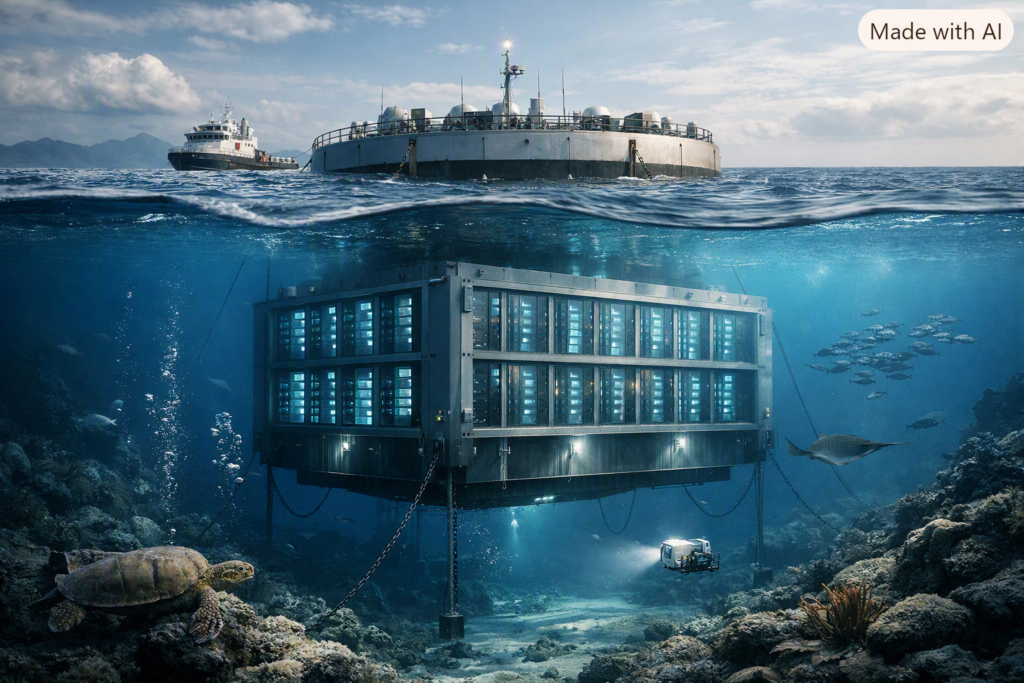
AI companies are exploring ocean-based data centers to address rising energy consumption, cooling demands, land constraints, and community resistance to traditional facilities. Underwater and floating platforms promise improved cooling efficiency, reduced land use, and access to renewable ocean energy, but they also introduce new environmental, regulatory, and technical challenges.
Why AI Companies Are Turning to the Ocean
The global AI boom is driving unprecedented demand for data-center capacity, straining electricity grids, water supplies, and available land. Developers are now evaluating the ocean as a potential location for next-generation AI infrastructure.
Researchers note that underwater environments offer natural cooling, reduced land footprint, and potentially lower failure rates, making them attractive alternatives to traditional land-based facilities.
At the same time, public opposition to local data-center construction is rising sharply. A 2026 Gallup poll found 70% of Americans oppose new AI data centers in their communities, prompting companies to seek unconventional real estate options such as offshore platforms and even outer space.
The Rise of Ocean-Based AI Infrastructure
Microsoft’s Early Underwater Experiments
Microsoft launched a multi-year research project beginning in 2015, deploying a sealed underwater data-center module near Scotland’s Orkney Islands. The 864-server unit demonstrated one-eighth the failure rate of comparable land-based servers due to reduced exposure to oxygen, humidity, and temperature fluctuations.
Microsoft ended the project in 2024, citing regulatory complexity and the need for faster upgrade cycles.
China’s Wind-Powered Undersea Data Center
China launched the world’s first wind-powered underwater data center off Shanghai, using 95% green electricity and reducing power consumption by 22.8%. Natural ocean cooling eliminates water use.
Panthalassa: The Leading U.S. Ocean-Data-Center Startup
Portland-based startup Panthalassa is emerging as the most advanced U.S. player in ocean-powered AI infrastructure.
Its Ocean-3 floating, orb-shaped platform:
- Converts ocean waves into electricity via pressurized seawater turbines
- Uses natural ocean cooling to eliminate freshwater demand
- Houses a modular AI compute environment inside a sealed sphere
- Operates hundreds of miles offshore
- Has attracted $225 million in funding and a nearly $2 billion valuation pre-launch
Panthalassa’s earlier prototypes Ocean-1 and Ocean-2 have already been tested at sea.
Naver’s Strategic Investment
South Korean tech giant Naver invested in Panthalassa to secure next-generation AI infrastructure powered by renewable ocean energy. CEO Choi Soo-yeon emphasized the importance of wave-powered offshore compute for global competitiveness.
Benefits of Ocean-Based Data Centers
- Natural Cooling Efficiency
Ocean water provides a stable, cold environment that reduces cooling energy and eliminates freshwater use.
- Renewable Energy Potential
Wave-powered platforms like Panthalassa’s Ocean-3 can generate clean electricity without land-based power plants.
- Reduced Land and Community Impact
Offshore siting avoids local opposition, noise complaints, and land-use conflicts.
- Lower Failure Rates
Sealed underwater environments reduce exposure to oxygen, humidity, and human interference.
- Modular, Scalable Deployment
Floating platforms can be deployed where needed and expanded without major construction.
Challenges and Risks
Environmental Concerns
Underwater structures attract marine life and may disrupt ecosystems.
Regulatory Complexity
Permits, environmental impact assessments, and maritime regulations complicate deployment.
Maintenance and Upgrades
Offshore or underwater locations make physical access difficult, slowing repairs and hardware refresh cycles.
Satellite Connectivity Limitations
Offshore platforms rely on low-Earth-orbit satellite networks for data transmission, which may introduce latency challenges.
What This Means for the Future of AI Infrastructure
- Offshore Compute Will Complement, Not Replace, Land-Based Data Centers
Experts see ocean-based compute as a portfolio strategy, not a universal solution.
- Renewable-Energy-Powered Data Centers Will Grow
Wave, wind, and hybrid offshore systems will expand as AI energy demands surge.
- New Global Players Will Enter the Market
China, the U.S., and South Korea are already investing heavily in ocean-based compute.
- Environmental and Regulatory Frameworks Must Evolve
Governments will need new rules for offshore digital infrastructure.
- The Next 3–5 Years Will Determine Scalability
Panthalassa targets commercialization in 2027, a key milestone for the industry.
Key Takeaways
- AI companies are exploring ocean-based data centers to reduce land use, cooling demands, and community resistance.
- Panthalassa leads U.S. innovation with its wave-powered Ocean-3 platform.
- China and Microsoft have already tested underwater data-center concepts.
- Benefits include natural cooling, renewable energy, and reduced land impact.
- Challenges include environmental risks, regulatory hurdles, and maintenance complexity.
- Offshore compute is poised to complement, not replace, traditional data centers.
FAQ
Why are AI companies considering ocean-based data centers?
To reduce energy consumption, cooling costs, land use, and community opposition.
Who is leading U.S. innovation in ocean data centers?
Panthalassa, with its wave-powered Ocean-3 platform and major funding.
Did Microsoft test underwater data centers?
Yes — its Orkney Islands project showed significantly lower server failure rates.
What are the biggest risks?
Environmental impact, regulatory complexity, and maintenance challenges.
 Spotify
 Apple Podcasts
 Podbean
 YouTube
 Spotify
 Apple Podcasts
 Podbean
 YouTube