
Summary
U.S. manufacturers are rapidly deploying AI; 61% already have AI in active production, not pilots but 97% say their current networks cannot support the bandwidth, latency, and reliability required for next‑generation autonomous AI systems. As factories shift toward edge‑driven robotics, digital twins, and agentic AI, network modernization has become the critical bottleneck holding back full-scale adoption.
AI Adoption Is Surging Far Beyond Pilots
AI is no longer experimental. It is already embedded in daily operations across U.S. factories:
- 61% of manufacturers are actively deploying AI
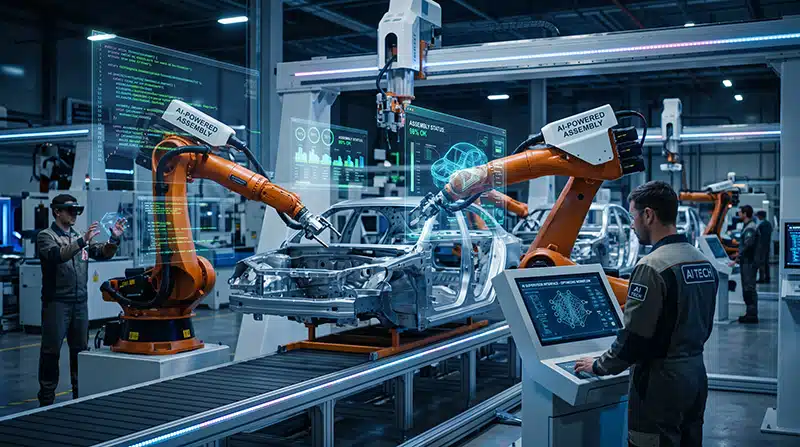
- AI use cases now include autonomous agents supervising workflows, orchestrating supply‑chain decisions, and directing quality control in real time
- By 2027, 75% of enterprise data will be created and processed at the edge, not in the cloud
This marks a shift from decision-support AI to physical AI systems that interact directly with machines, robots, and production lines.
The Problem: Networks Are Not Ready for Autonomous AI
Despite aggressive AI adoption, nearly every manufacturer reports a critical infrastructure gap:
- 97% say their network is not ready for AI’s low‑latency, high‑bandwidth demands
- Physical AI applications AMRs, real-time digital twins, machine-vision inspection require sub‑10ms latency
- Split‑second decisions cannot wait for round trips to distant data centers
AI ambition is high. Network readiness is not.
Why Edge Infrastructure Is Becoming the New Center of Gravity
Manufacturing AI is shifting from cloud‑centric to edge‑centric architectures:
- Real-Time Robotics
Autonomous mobile robots (AMRs) and robotic workcells require instantaneous decision-making.
- Digital Twins
High-frequency sensor data must be processed locally to simulate equipment behavior in real time.
- Predictive Maintenance
Edge-enabled analytics reduce unplanned downtime and maintenance costs but only if networks can support continuous data flow.
- Quality Control
Computer vision systems need high-throughput connectivity to inspect parts at production speed.
Manufacturers delaying modernization are leaving efficiency, cost savings, and resilience on the table.
The Modernization Myth: You Don’t Need to Rip and Replace
Manufacturing Dive notes that most leaders fear modernization means tearing out legacy systems. It doesn’t.
Effective modernization is:
- Phased
- Incremental
- Focused on gaps, not wholesale replacement
Protect what works. Replace what doesn’t. Build a roadmap that integrates existing investments while closing critical infrastructure gaps.
Additional Barriers: Cybersecurity & IT/OT Misalignment
A related Cisco survey highlights three major obstacles slowing AI scale-up:
- 40% cite cybersecurity concerns as the top barrier
- 43% report little to no collaboration between IT and OT teams
- Unreliable networks frequently disrupt AI once deployed
- Only 13% of companies are fully prepared for scaled AI adoption
AI is ready. Most organizations are not.
What This Means for U.S. Manufacturers
- AI Growth Will Outpace Infrastructure
AI deployments are accelerating faster than network modernization.
- Cybersecurity Must Be Reinforced
AI-ready networks require hardened security and segmentation.
- IT/OT Convergence Is Now a Core Requirement
AI cannot scale without unified governance across both domains.
- Modernization Is a Competitive Advantage
Early movers will gain productivity, quality, and resilience benefits.
Key Takeaways
- 61% of manufacturers are actively deploying AI, not piloting.
- 97% say their networks are not ready for autonomous AI workloads.
- Cybersecurity and IT/OT misalignment remain major barriers.
- Modernization is phased, not rip-and-replace, and is now essential for competitiveness.
FAQ
Why aren’t networks ready for AI?
Because autonomous AI requires high throughput, low latency, and edge compute — capabilities most legacy networks lack.
What AI applications are driving modernization?
AMRs, digital twins, predictive maintenance, and real-time quality inspection.
Is modernization expensive?
Not necessarily; phased upgrades allow manufacturers to protect existing investments.
What’s the biggest barrier besides networking?
Cybersecurity and lack of IT/OT collaboration.
 Spotify
 Apple Podcasts
 Podbean
 YouTube
 Spotify
 Apple Podcasts
 Podbean
 YouTube