
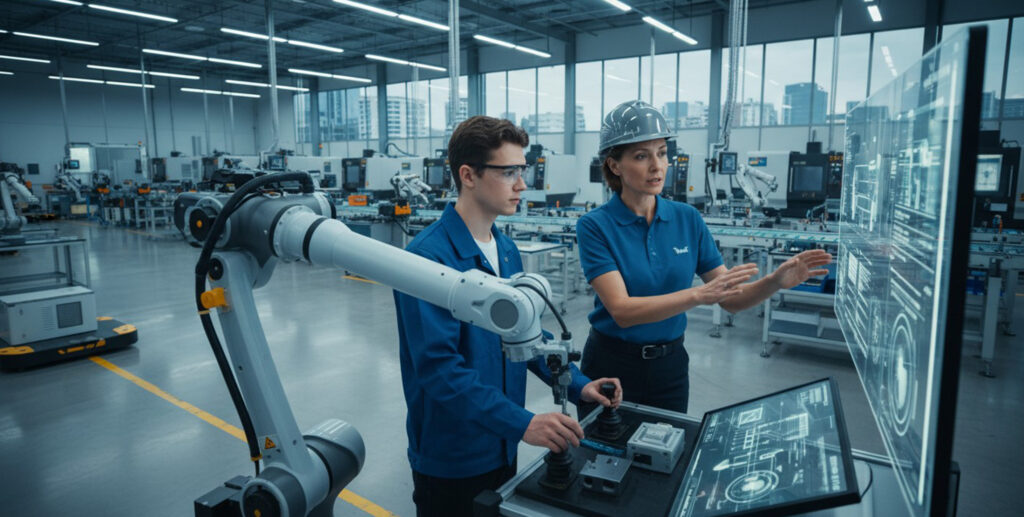
Walk into any growing factory in early 2026 and you will hear the same thing from plant managers. They are not struggling to find workers. They are struggling to find workers with the right skills. The National Association of Manufacturers reports that 48 percent of executives cite the skilled worker shortage as their top concern heading into 2026, according to NAM’s 2025 Outlook. This is not a temporary issue. It is the result of decades of prioritizing four-year degrees over apprenticeships, trade schools, and hands-on technical training.
The irony is that manufacturing jobs today are more advanced, more stable, and better paying than many white-collar roles. The Bureau of Labor Statistics reports that industrial machinery mechanics, automation technicians, and mechatronics specialists earn median wages between $60,000 and $75,000, with the top quartile earning more than $90,000 annually. When overtime and shift differentials are included, total compensation often exceeds $100,000, according to BLS Occupational Employment data. These roles do not require a four-year degree. They require skill, certification, and the ability to work with advanced equipment.
The skills gap is widening because manufacturing has changed faster than the education system. Factories now rely on robotics, AI-assisted diagnostics, digital twins, and predictive maintenance systems. Deloitte’s 2026 Manufacturing Outlook notes that more than 60 percent of manufacturers are increasing investment in automation and AI, which shifts the workforce toward higher skill roles. Instead of eliminating jobs, automation is creating new ones that require technical expertise. The challenge is that the pipeline of trained workers is not keeping up.
Companies are responding by building their own training ecosystems. Caterpillar has committed more than $100 million to workforce development programs that train welders, machinists, and equipment specialists, according to company announcements. Toyota’s Advanced Manufacturing Technician program combines classroom instruction with paid on-the-job training and has expanded to more than a dozen states. Siemens partners with community colleges to offer mechatronics certifications that can be completed in six to twelve months, giving students immediate access to high-demand roles.
Community colleges are becoming central to the solution. The American Association of Community Colleges reports that enrollment in manufacturing-related programs increased 14 percent between 2022 and 2025 as students seek faster, lower-cost pathways into high-paying careers. Many programs now include paid apprenticeships, industry-recognized certifications, and direct hiring pipelines. These models are proving far more effective than broad government retraining initiatives because they are built around real equipment, real processes, and real job requirements.
The shift toward high mix manufacturing is also reshaping the workforce. Instead of producing millions of identical units, factories are increasingly producing smaller batches of customized products. This requires flexibility, problem-solving, and collaboration between humans and AI systems. McKinsey’s 2025 Industrial Productivity Report notes that high mix manufacturing environments see productivity gains of 20 to 30 percent when technicians are trained to work alongside AI-driven tools. These roles require skill, not a four-year degree.
The economic incentives are strong. Students who pursue vocational training avoid tens of thousands of dollars in student debt. The average cost of a four-year degree now exceeds $104,000, according to the Education Data Initiative. By contrast, many technical programs cost $5,000 to $15,000, and apprenticeships often pay students while they learn. The return on investment is immediate. Graduates enter the workforce faster, earn higher wages, and have clearer career advancement pathways.
The positive outcome is that vocational training is becoming a powerful alternative to traditional college pathways. As companies invest directly in talent pipelines and community colleges expand technical programs, manufacturing is becoming a career of choice again. By 2030, the highest earning roles in the sector may not require a four-year degree at all. They will require skill, certification, and the ability to work alongside intelligent machines. This shift is not only solving the skills crisis. It is creating a more inclusive, more accessible, and more financially rewarding workforce for the next generation.
 Spotify
 Apple Podcasts
 Podbean
 YouTube