
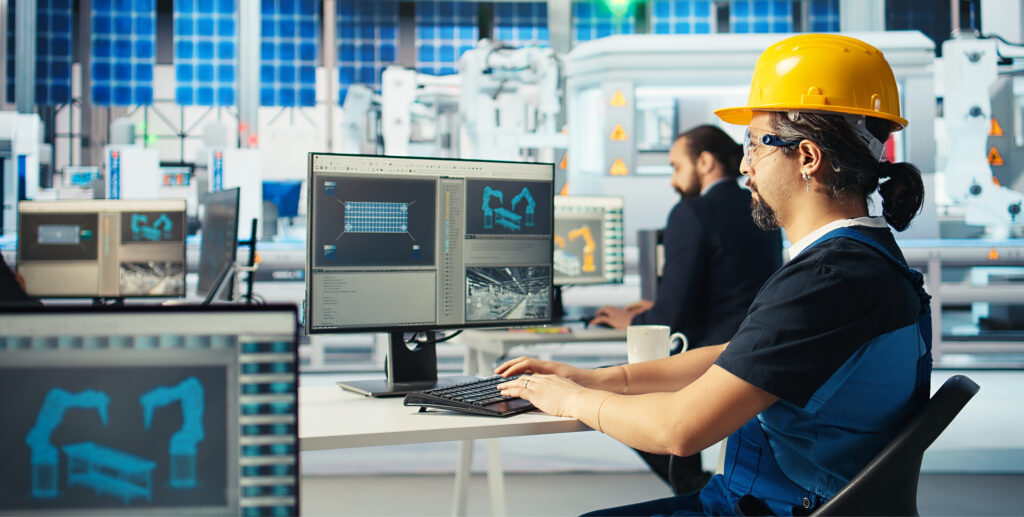
For much of the industrial age, manufacturing success depended primarily on physical assets such as machinery, assembly lines, and factory facilities. While these elements remain critical, software has emerged as an equally important component of modern manufacturing operations.
Today, sophisticated software platforms manage nearly every aspect of the manufacturing lifecycle, from product design and engineering to production planning, logistics coordination, and customer delivery.
Enterprise resource planning systems serve as the central nervous system of many manufacturing organizations. These platforms integrate information across departments, including finance, supply chain management, inventory tracking, and production scheduling.
By consolidating operational data into a single system, ERP software allows manufacturers to coordinate complex activities across multiple facilities and supply chain partners.
Another critical category of manufacturing software is product lifecycle management. PLM systems enable engineers to design products digitally, manage engineering changes, and maintain detailed records throughout the development process.
These systems are particularly valuable in industries where product complexity is high. Aerospace manufacturers, for example, rely heavily on PLM systems to manage thousands of design components and engineering revisions.
Manufacturing execution systems represent another important layer of software infrastructure. MES platforms connect directly to production equipment and provide real-time visibility into factory operations.
Managers can monitor machine performance, track production progress, and identify potential issues as they occur. This real-time insight allows manufacturers to respond quickly to problems and maintain efficient production flows.
Simulation software is also becoming increasingly important. Engineers can use digital simulation tools to test manufacturing processes before launching new products or modifying production lines.
This capability reduces the need for expensive physical prototypes and allows companies to optimize production methods before committing to large-scale manufacturing.
Software is also enabling new manufacturing models such as mass customization. Smart production systems allow manufacturers to produce customized products efficiently without sacrificing the economies of scale associated with traditional manufacturing.
Customers can configure products to meet specific preferences while factories automatically adjust production processes to accommodate these variations.
Industry analysts estimate the global industrial software market could exceed $250 billion by 2030, reflecting the growing importance of digital technologies in manufacturing.
Despite the benefits, implementing manufacturing software systems can be complex. Integrating new platforms with existing equipment and legacy systems often requires careful planning and significant investment.
Cybersecurity concerns also play a role, as digital systems become central to manufacturing operations.
Nevertheless, the trend toward software-driven manufacturing continues to accelerate. As factories become more connected and production systems more complex, software will play an increasingly critical role in coordinating industrial activity.
In many ways, the factories of the future may be defined as much by their software infrastructure as by their physical machinery.
 Spotify
 Apple Podcasts
 Podbean
 YouTube
 Spotify
 Apple Podcasts
 Podbean
 YouTube