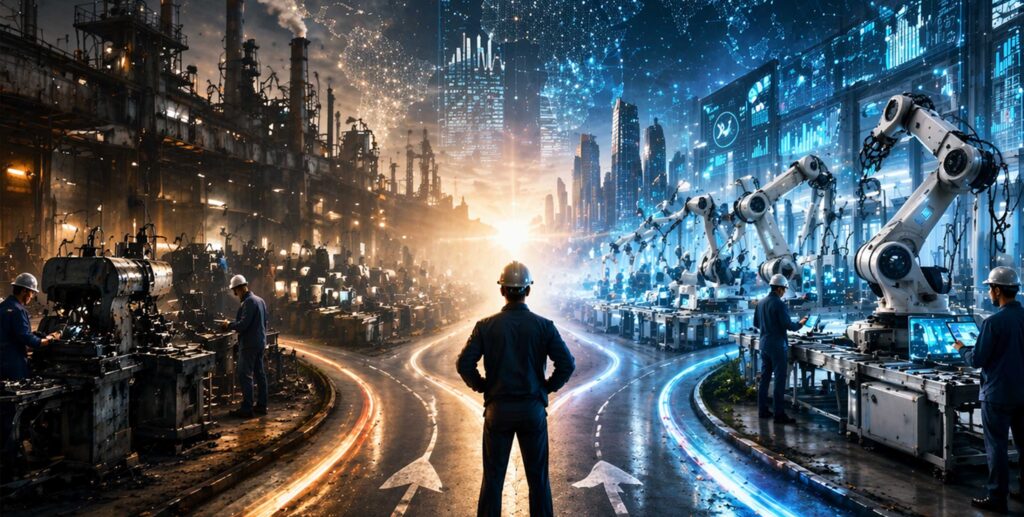
Manufacturers are starting down a year that might define the next decade of global competition, investment, and innovation. After a roller-coaster 2025, industry leaders say 2026 will be a make-or-break year, and the choices companies make now could determine who thrives and who falls behind.
At its core, the message from industry insiders is clear: this isn’t just another year. It’s a turning point. U.S. manufacturers are ramping up domestic production, pouring money into automation and artificial intelligence (AI), and navigating a maze of trade policy and regulation that’s changing by the month.
Investments Are Climbing, But So Are Risks
Companies are funneling record dollars into new plants, mergers and acquisitions, and next-generation technologies. Major facility builds from giants like TSMC, Samsung, and Micron are already scheduled for 2026, a sign that global supply chains are being reshaped in real time.
But even as investment climbs, so do the headwinds. Tariff uncertainty remains a top concern, and many manufacturers tell economists they expect input costs for things like steel, semiconductors, and energy to rise this year. In fact, a recent survey showed that 78% of manufacturers say trade policy unpredictability is holding back growth.
Across the Atlantic, the situation is even tougher. Investment in Europe’s chemicals sector plunged by more than 80% last year amid soaring energy costs and regulatory pressures, with thousands of jobs lost and capacity shuttered. Industry leaders warn Europe that it could become dependent on imports for key industrial materials if the trend continues.
On the global stage, U.S.-China manufacturing tensions are escalating. U.S. officials have warned that China’s rising export dominance could threaten American industrial jobs, a geopolitical squeeze that could have ripple effects throughout supply chains worldwide.
Automation and AI: No Longer Optional
If 2025 was about testing new tools, then 2026 is about deploying them at scale. Manufacturers are no longer dabbling in digital transformation; they’re overhauling entire operations to run smarter and faster.
Analysts note that smart factories are moving from buzzword to baseline expectation. Connected sensors, machine learning tools, and real-time data systems are becoming table stakes for companies trying to cut costs and boost efficiency.
AI is another major force: it’s not only optimizing production but also helping solve persistent labor gaps. In many facilities, AI-linked robotics are now working alongside humans, handling repetitive tasks while staff focus on higher-value work. And while this raises tough questions about jobs and retraining, executives see it as essential to staying competitive.
Workforce Challenges Remain a Wild Card
Despite all the high-tech promises, manufacturers still face a human problem: finding and keeping skilled workers. With automation changing job requirements, companies say they need new strategies to train and retain employees.
Many manufacturers plan to invest heavily in upskilling programs this year, teaching workers how to operate advanced machines, interpret complex data, and maintain automated systems. Those who don’t could find themselves behind fast.
Supply Chains: Reshoring Isn’t a Straight Line
For years, policymakers and executives have talked about bringing supply chains home. In 2026, that talk becomes action, but with caveats.
Some firms are nearshoring or relocalizing critical components to avoid global disruptions. Others are hesitant, waiting for clarity on trade deals like the future of the North American trade pact, before making huge commitments.
Meanwhile, global shipping costs, especially between Asia and the U.S., have spiked, adding pressure on manufacturers and pushing up the prices of everyday goods. Procurement experts now say volatility is the “new normal,” with transport, energy and raw materials all driving unpredictability.
Big Picture: Growth With a Side of Uncertainty
According to international economic forecasts, the world economy is still expected to grow modestly this year, providing a backdrop of opportunity if manufacturers can adapt. But that growth isn’t guaranteed, and the difference between success and stagnation could come down to how companies handle technology, workforce shifts, and geopolitical tensions.
Industry consultants now warn that manufacturers who wait risk being left behind. “2026 isn’t just another digital year, it’s a cultural inflection point,” one manufacturing strategist told leaders late last year, emphasizing that data unification, cloud systems, and AI adoption are critical now, not tomorrow.
Bottom Line: Adapt or Fall Behind
Let’s be blunt: 2026 will separate the leaders from the laggards. The companies that harness automation without losing sight of people, that manage complex trade pressures without paralysis, and that invest boldly instead of cautiously are the ones likely to thrive. For everyone else, the next 12 months could be a scramble.
If you’re in manufacturing on the shop floor or in the C-suite, what you do now might well decide your place in the industry for years to come.
 Spotify
 Apple Podcasts
 Podbean
 YouTube
 Spotify
 Apple Podcasts
 Podbean
 YouTube