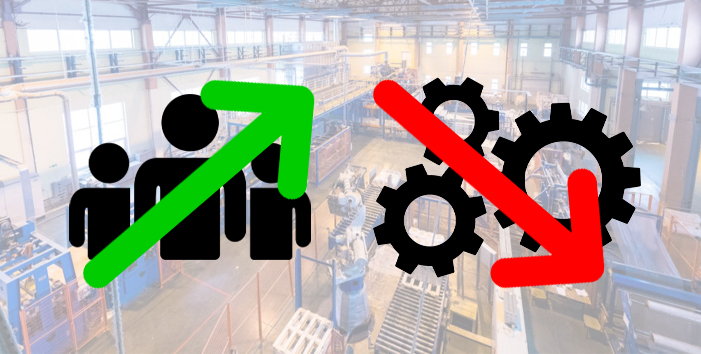
On the surface, the latest jobs report looks like a win. The U.S. economy added 178,000 jobs in March 2026, beating expectations and signaling continued resilience across several sectors. For many industries, that number reinforces the sense that the labor market remains strong despite ongoing economic uncertainty. But when you dig a little deeper, a very different story starts to emerge, especially in manufacturing.
While healthcare, professional services, and hospitality helped push overall job growth higher, manufacturing moved in the opposite direction. According to the latest data, the sector lost 11,000 jobs in March, a clear signal that something isn’t quite right beneath the surface. This isn’t just a one-month anomaly either; it’s part of a broader pattern that has been quietly developing.
A key indicator to watch here is the ISM Manufacturing PMI Employment Index, which came in at 48.7%. That number matters because anything below 50% signals contraction. In other words, more manufacturers are cutting jobs than adding them. And while a dip below 50 doesn’t mean a collapse, it does suggest that companies are pulling back, reassessing, and in many cases, bracing for what’s next.
So what’s driving this disconnect between overall job growth and manufacturing losses?
Part of the answer lies in demand. Manufacturing is highly sensitive to shifts in orders, and recent reports have shown softening demand both domestically and globally. New orders have been inconsistent, and export activity has been impacted by geopolitical tensions, supply chain disruptions, and fluctuating trade dynamics. When orders slow down, production follows—and hiring is often the first lever companies adjust.
There’s also the ongoing impact of automation and technology. While Industry 4.0 continues to promise long-term efficiency and growth, it’s also reshaping the workforce in real time. Advanced robotics, AI-driven systems, and smart factory technologies are enabling manufacturers to do more with fewer people. It’s not necessarily about eliminating jobs, but rather changing the type of roles needed, and that transition isn’t always smooth.
Then there’s cost pressure. Manufacturers continue to deal with elevated input costs, from raw materials to energy. Even with some stabilization compared to previous years, margins are still tight. Labor, as one of the more controllable expenses, often becomes an area where companies look to optimize. Add higher interest rates and cautious capital spending, and it creates an environment where hiring slows or reverses.
What makes this moment particularly interesting is the contrast. You have a broader economy that’s still adding jobs at a healthy pace, yet a foundational sector like manufacturing is signaling caution. Historically, manufacturing has often been a leading indicator. When it starts to contract, it can foreshadow broader economic shifts.
And yet, it’s not all negative.
There are still pockets of strength within manufacturing. Areas tied to infrastructure, defense, semiconductors, and energy transition continue to see investment. Government initiatives and reshoring efforts are also expected to create long-term opportunities. In fact, some estimates suggest that U.S. manufacturing could need to fill millions of roles over the next decade, particularly as older workers retire and new facilities come online.
But that’s the long game. Right now, manufacturers are navigating a complex mix of uncertainty, transformation, and pressure.
The takeaway? The headline number, 178,000 jobs added, tells one story. Manufacturing tells another.
And if you’re paying attention, that divergence is where real insight lives.
 Spotify
 Apple Podcasts
 Podbean
 YouTube