
Manufacturers are stepping into 2026 with a sense of urgency and opportunity. After years of global shocks, supply chain turbulence, rapid technological change, and shifting workforce expectations, the industry is no longer talking about transformation as a future goal. It is happening now, and the companies that adapt quickly are already pulling ahead. The latest insights from the National Association of Manufacturers and its research divisions show a sector that is becoming more intelligent, more connected, more sustainable, and more resilient. The message is clear. The next era of manufacturing will belong to the organizations that build agility into every part of their operations.
One of the biggest shifts is the rise of autonomous and adaptive operations. Factories are moving beyond basic automation and into systems that can sense, learn, and adjust on their own. Machine learning models are now controlling production schedules, tuning equipment settings, and identifying anomalies before they become failures. Plants are forming ecosystems of sensors, analytics engines, and automated controls that work together in real time. This shift is improving uptime, reducing scrap, and shortening throughput times. It is also changing the nature of work. Operators are spending more time validating system decisions and less time performing manual interventions, while engineers are focused on refining algorithms and ensuring data quality. Companies that invest early in workforce readiness are seeing the fastest returns.
Sustainability is also becoming a core part of the financial model rather than a side initiative. Manufacturers are embedding emissions tracking, waste reduction, and circular design into product development and capital planning. Regulators are demanding clearer reporting, customers want real data rather than broad claims, and companies are discovering that sustainability-driven improvements often reduce material use and energy consumption. Digital tools such as lifecycle analytics and predictive forecasting help teams understand the environmental and financial impact of design decisions long before production begins.
Cybersecurity has become another defining priority. As factories connect equipment, enterprise systems, and cloud platforms, the risk of cyber incidents continues to rise. Manufacturers are adopting zero-trust models, modernizing infrastructure, and using artificial intelligence to detect threats in real time. Yet technology alone is not enough. Human error remains the leading cause of breaches, so companies are shifting toward continuous micro training and scenario-based exercises to build cyber awareness into daily routines. Supply chain security is also becoming essential as manufacturers demand stronger documentation and controls from vendors.
Supply networks themselves are undergoing structural change. After years of disruption, companies are moving from reactive recovery to proactive resilience. They are regionalizing parts of their supply chains, expanding multisource strategies, and using real-time data to anticipate issues before they affect production. Digital traceability tools help manufacturers track materials, verify compliance, and improve recall readiness. Forecasting models that incorporate logistics indicators, weather patterns, and market data are guiding decisions about inventory buffers and supplier risk. The most resilient organizations treat suppliers as partners and share more data to strengthen the entire ecosystem.
Innovation is accelerating as teams learn to combine human creativity with artificial intelligence. Engineers are using generative design tools to explore new concepts, simulation models to test ideas quickly, and robotics to improve safety and repeatability. The cultural shift is just as important as technology. When teams understand how to use AI rather than simply what it does, they gain confidence to experiment and adapt. Companies that embed AI into daily workflows rather than isolating it in pilot projects are seeing faster learning cycles and stronger results.
Data has become a form of industrial capital. Manufacturers are building unified data architectures that connect plant systems, supply networks, and customer insights into consistent models. The goal is to move away from fragmented, plant-specific data and toward interoperable platforms that support high-quality analysis. Data stewardship teams are emerging to ensure accuracy and traceability. When data flows improve, companies can scale AI deployments more quickly, make more evidence-based decisions, and collaborate more effectively across sites.
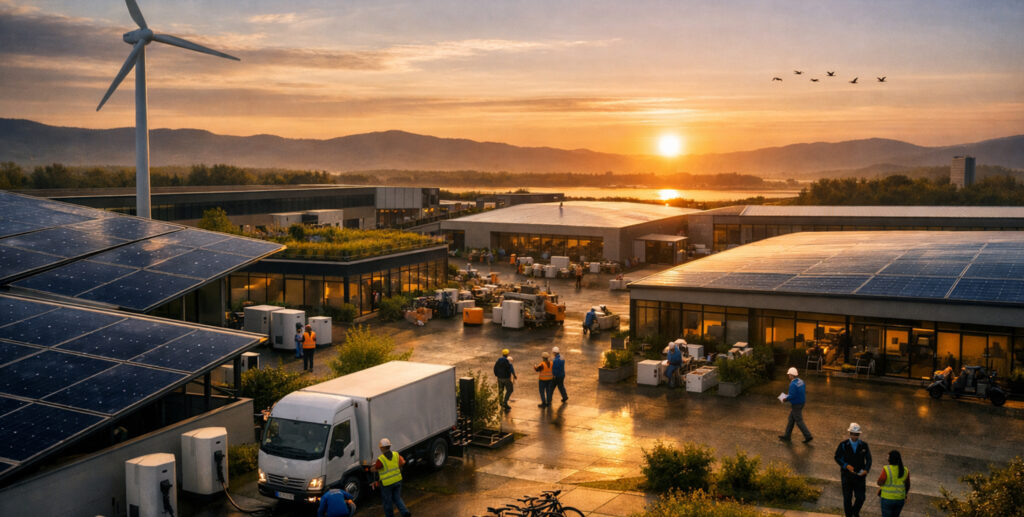
Energy strategy is becoming a financial and operational priority. Manufacturers are facing rising digital energy demands, volatile pricing, and pressure to meet carbon targets. Energy procurement is no longer handled by facilities teams alone. Finance, operations, and sustainability leaders are working together to blend long-term contracts with flexible pricing mechanisms. Companies are integrating renewable energy, exploring microgrids, and using analytics to forecast consumption and reduce waste. Grid instability is prompting manufacturers to think more strategically about resilience and backup power.
Finally, organizational structures are being redesigned for a digital future. Automation and AI are reshaping job roles and requiring new skills across every level of the company. Manufacturers are forming cross-functional teams that bring together engineering, operations, IT, and data expertise. Upskilling programs, microlearning paths, and internal talent pipelines are becoming essential. Leadership models are evolving as managers learn to guide teams through continuous change and encourage experimentation. Companies that offer growth opportunities and modernized work environments are seeing stronger engagement and lower turnover.
Taking together, these eight trends show a manufacturing sector that is not just adapting but reinventing itself. The companies that act now will be better prepared for the demands of 2026 and beyond. They will build smarter production systems, stronger supply networks, more secure digital environments, and a workforce ready to thrive in a world where technology and human capability advance together. With the right strategies and partnerships, manufacturers can turn these trends into a lasting competitive advantage.
 Spotify
 Apple Podcasts
 Podbean
 YouTube
 Spotify
 Apple Podcasts
 Podbean
 YouTube