
Summary
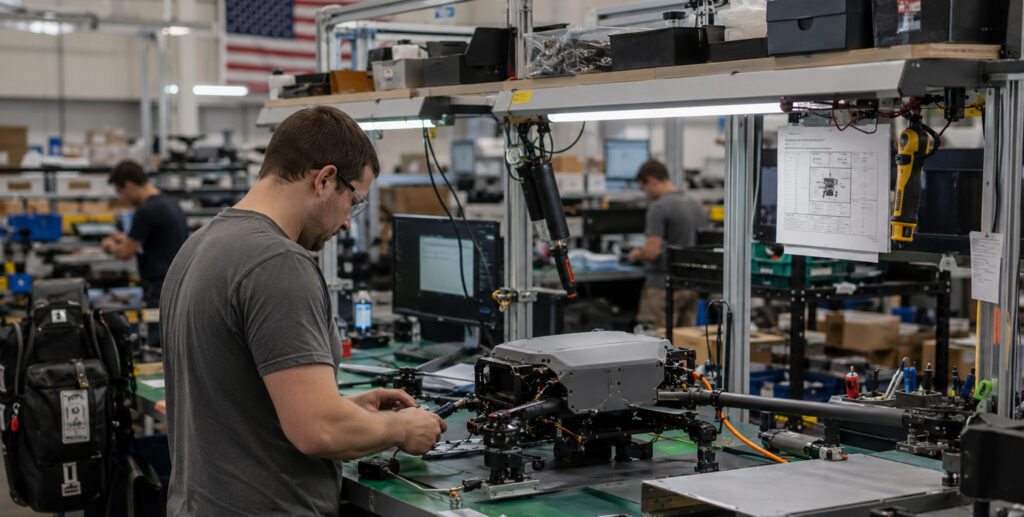
The U.S. Army is investing in advanced assembly technologies, including automated manufacturing systems, digital production tools, and high-rate assembly lines, to dramatically increase drone output. The initiative aims to strengthen battlefield readiness, accelerate replenishment cycles, and support the rapid deployment of unmanned aircraft systems (UAS) across multiple mission profiles.
Why the Army Is Accelerating Drone Production Now
The Army’s investment reflects a major shift in modern warfare. Drones are no longer niche assets; they are essential tools for:
- Reconnaissance
- Targeting
- Logistics
- Electronic warfare
- Precision strikes
Conflicts in Europe and the Middle East have shown how quickly drones are being used in high-intensity operations. The Army needs faster production, higher volume, and more resilient supply chains to keep pace.
Key Drivers Behind the Investment
- Rising demand for small tactical drones
- Increased use of autonomous systems
- Need for rapid replenishment in contested environments
- Pressure to modernize legacy production lines
- Growing threats from peer adversaries with advanced UAS capabilities
What Assembly Technologies the Army Is Deploying
- Automated Assembly Systems
The Army is adopting automation to reduce manual bottlenecks and increase throughput. These systems support:
- High-precision component placement
- Faster electronics assembly
- Repeatable quality control
- Reduced labor burden
Automation is especially critical for small drones with complex electronics and sensors.
- Digital Manufacturing Tools
Digital engineering and model-based design allow the Army to:
- Validate drone designs virtually
- Reduce physical prototyping
- Accelerate testing cycles
- Improve integration across suppliers
Digital twins and real-time production data help optimize assembly lines.
- High-Rate Production Lines
Borrowing from commercial aerospace and automotive manufacturing, the Army is building high-rate lines capable of:
- Rapid configuration changes
- Modular assembly
- Parallel production of multiple drone variants
- Shorter cycle times
This approach supports both small tactical drones and larger unmanned aircraft.
- Advanced Materials and Additive Manufacturing
The Army is incorporating:
- Lightweight composite structures
- Additive-manufactured components
- Rapid-fabrication techniques for replacement parts
These technologies reduce weight, improve durability, and speed up production.
How This Investment Strengthens U.S. Defense Capabilities
- Faster Deployment of Tactical Drones
High-rate assembly ensures units receive drones quickly, even during surge operations.
- Improved Battlefield Readiness
Rapid replenishment reduces downtime and ensures continuous ISR (intelligence, surveillance, reconnaissance) coverage.
- Greater Resilience Against Attrition
Modern conflicts show drones are frequently lost to jamming, kinetic strikes, and environmental hazards. Faster production offsets attrition.
- Enhanced Innovation Cycles
Digital engineering and modular assembly allow the Army to iterate drone designs faster critical as threats evolve.
- Stronger Domestic Industrial Base
Investments support U.S. suppliers, defense manufacturers, and advanced-technology partners.
Industry Context: The Drone Race Is Accelerating
The Army’s move aligns with broader trends across defense and commercial sectors:
- NATO allies are expanding drone fleets
- Commercial drone manufacturers are scaling production
- Autonomous systems are becoming central to logistics and surveillance
- Defense contractors are investing heavily in UAS innovation
The U.S. is positioning itself to maintain leadership in unmanned systems as global competition intensifies.
What This Means for Defense Contractors and Manufacturers
For Defense Contractors:
- Increased demand for drone components
- More opportunities for automation and digital-engineering partnerships
- Higher production volume requirements
For the Defense Industrial Base:
- Growth in electronics manufacturing
- Expansion of composite materials production
- Increased need for additive-manufacturing capacity
For the Army and Warfighters:
- Faster access to mission-critical drones
- Improved reliability and performance
- Greater operational flexibility
Key Takeaways
- The U.S. Army is investing in advanced assembly technology to boost drone production.
- Automation, digital engineering, and high-rate lines are central to the strategy.
- The initiative strengthens battlefield readiness and accelerates replenishment cycles.
- Modern conflicts have made rapid drone production a national-security priority.
- The investment supports the broader U.S. defense industrial base and unmanned-systems innovation.
FAQ
Why is the Army increasing drone production?
To meet rising demand, offset battlefield attrition, and support rapid deployment of unmanned systems.
What technologies are being used?
Automation, digital engineering, high-rate assembly lines, advanced materials, and additive manufacturing.
How does this benefit warfighters?
They receive drones faster, with improved reliability and more mission-ready capabilities.
Does this strengthen the U.S. industrial base?
Yes, it expands manufacturing capacity, supports suppliers, and accelerates innovation.
 Spotify
 Apple Podcasts
 Podbean
 YouTube
 Spotify
 Apple Podcasts
 Podbean
 YouTube