
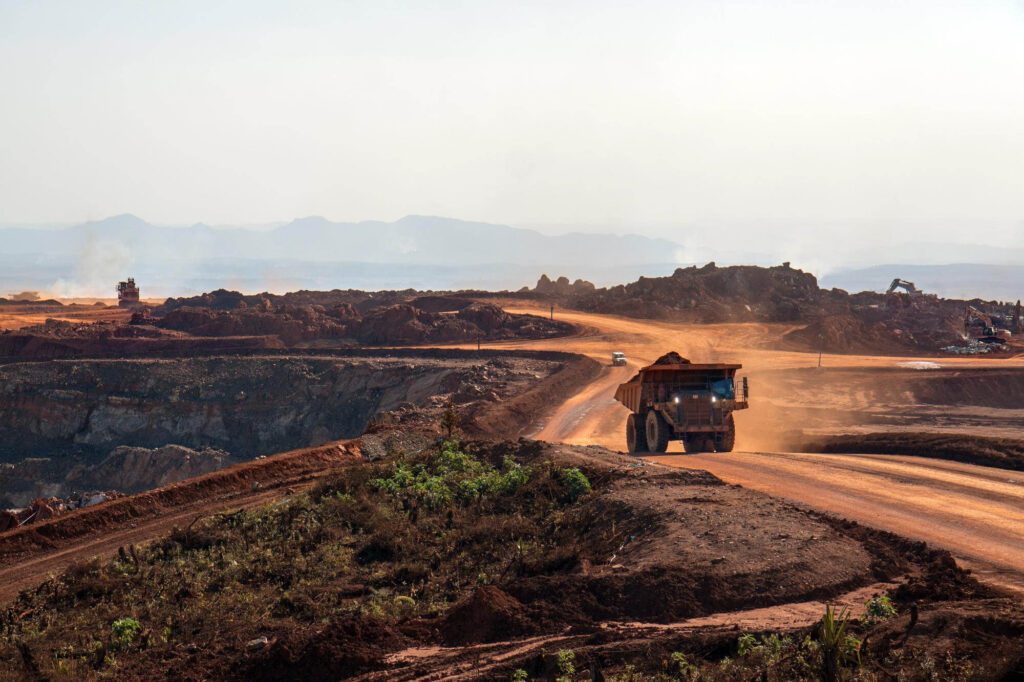
Across the American West, two very different mining efforts are underway, but they share a common goal. In Wyoming, new attention is being paid to rare-earth elements hidden in the state’s geological layers. In Nevada, gold mines are going high-tech, deploying massive autonomous trucks to haul ore without the need for drivers. On the surface, these efforts may seem unrelated. But look closer, and they tell a larger story, one about how the U.S. is rethinking not just what it mines, but how it competes.
This shift is not just about domestic opportunities; it’s also about global positioning, especially concerning China, which dominates both rare-earth supply chains and the manufacturing of mining technology. For years, China has controlled more than 80% of the global rare earths market and is a major supplier of mining equipment. The U.S. is now taking steps to loosen that grip.
Wyoming: Digging for Strategic Leverage
In Wyoming, rare-earth exploration is heating up thanks to new mapping tools released by the Wyoming Geological Survey. These maps, based on recent aerial surveys, show areas especially around Halleck Creek, where rare earth deposits are concentrated. Companies like American Rare Earths see the potential for Wyoming to become a domestic alternative to Chinese-controlled supply chains.
Currently, China processes and refines the vast majority of the world’s rare earths, even when the raw materials come from other countries. That means any serious attempt at U.S. production has to be more than just extraction—it has to be vertically integrated. Wyoming is still early in this process. While American Rare Earths and Ramaco Resources are actively exploring and testing the economic feasibility of local mining, there’s a long road ahead. Permits, environmental reviews, and uncertain investor confidence are all hurdles.
Still, the motivation is strong: reduce reliance on China, develop secure domestic supplies of critical minerals, and feed the growing demand from electric vehicle batteries, wind turbines, and defense applications. It’s about mineral independence, and Wyoming may be a key player in that story, if the economics line up.
Nevada: Automation as an Answer to Efficiency—and Dependence
Meanwhile, in Nevada, the mining story is less about discovery and more about transformation. Nevada Gold Mines, a joint venture between industry giants Barrick and Newmont, is rolling out one of the largest fleets of autonomous mining trucks in the U.S., partnering with Komatsu to equip its operations with cutting-edge automation.
The Komatsu FrontRunner system uses GPS, sensors, and an advanced 5G network to operate 230-ton and 300-ton trucks with no drivers. These systems improve safety, reduce fuel consumption, and allow for round-the-clock operations. Importantly, they also begin to shift the industry away from dependency on foreign-made machinery, something that’s long been dominated by Asian and European manufacturers.
Though Komatsu is a Japanese company, Nevada’s move to develop large-scale support infrastructure for autonomous operations, like service hubs and training facilities, is a step toward domestic self-sufficiency in operational control, even if not in the hardware itself.
The shift to automation isn’t just about productivity; it’s about control. In a world where labor costs, safety concerns, and geopolitical tensions can disrupt operations, having a predictable, data-driven haulage system makes economic and strategic sense.
What Connects These Two Stories? China.
Though they differ in scope and timeline, the Wyoming and Nevada stories are both rooted in a larger, shared motivation: reducing dependence on China’s grip over key parts of the mining supply chain.
- In Wyoming, the focus is upstream: mining and processing materials that the U.S. currently imports almost entirely from China.
- In Nevada, the focus is downstream: making operations smarter, leaner, and less exposed to foreign equipment vulnerabilities or labor instability.
Together, these efforts reflect a turning point. The U.S. isn’t just digging for resources—it’s rebuilding its mining strategy from the ground up. That means prioritizing not just what we mine, but how we mine, who controls the tech, and how secure the supply chains are from pit to product.
Two States, One Strategy
It’s easy to overlook mining as an industry of the past. But the truth is, it’s becoming a front line in the race for future industrial resilience. The technologies of tomorrow, batteries, AI hardware, and renewable energy systems, all depend on minerals pulled from the earth. And those supply chains are now global battlegrounds.
Wyoming’s effort to tap into rare-earth reserves is a national security play as much as an economic one. Nevada’s autonomous trucks are more than efficiency upgrades; they’re part of a broader trend toward operational independence.
If there’s a unifying message in these two stories, it’s this: The U.S. mining industry is not retreating. It’s repositioning strategically, methodically, and with a sharp eye on the long-term game. That means countering China’s dominance not just with rhetoric, but with results.
 Spotify
 Apple Podcasts
 Podbean
 YouTube