
The American manufacturing sector is at a pivotal moment. While companies continue to invest in advanced automation, robotics, AI-driven monitoring systems, and smart factory technology, these innovations cannot fully deliver value without the right people in place to operate them. That reality is being recognized across the industry. A recent Industrial Equipment News survey revealed that nearly 46% of manufacturers say closing the skills gap is now the most important factor for the long-term survival of U.S. manufacturing. This isn’t just a concern for the future; it’s a challenge manufacturers are already experiencing on the shop floor, where essential roles remain unfilled and retirement is steadily removing decades of skilled experience from the workforce.
The skills gap has roots in several long-term trends. For one, many manufacturing workers come from the Baby Boomer generation. As they retire, companies lose not only staffing capacity but also institutional knowledge, the kind of problem-solving expertise that isn’t easily replaced by training manuals. Meanwhile, younger workers are entering the field at a far slower rate. According to a 2021 study by Deloitte and The Manufacturing Institute, the manufacturing industry could face 2.1 million unfilled jobs by 2030, simply because the supply of new skilled workers is not keeping pace with demand. This shortfall could result in an estimated $1 trillion in lost economic output over the next decade. These are not just numbers; they represent stalled production lines, delayed shipments, unrealized expansion plans, and companies forced to turn down contracts because they don’t have the workers to deliver.
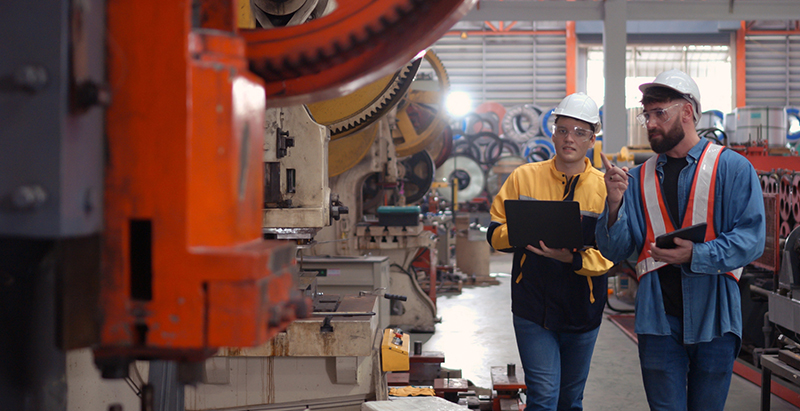
At the same time, the nature of manufacturing work has changed drastically. The rise of Industry 4.0, where machines communicate digitally, data drives decision-making, and production systems rely on automation, demands a workforce that blends mechanical understanding with digital literacy. Research from the World Economic Forum shows that more than half of all manufacturing workers will need some level of reskilling by 2027 to keep up with new technology-driven workflows. And yet, manufacturing still battles an outdated reputation. Many students and job seekers still imagine dark, loud factories filled with repetitive manual labor. Today’s advanced manufacturing facilities look more like high-tech labs, where workers use tablets, digital dashboards, and robotic programming interfaces as part of daily tasks. But the perception gap remains, and it keeps younger talent from considering manufacturing as a rewarding and future-focused career path.
Some manufacturers have turned to automation to compensate for worker shortages, and while automation can boost efficiency, it has not eliminated the need for skilled human labor. Rather, it has shifted the type of labor needed. A robot can weld parts or move pallets, but a trained technician must install the robot, program it, synchronize it with other automated systems, perform diagnostics, and carry out preventative maintenance. The National Association of Manufacturers has emphasized that machines increase productivity, but humans remain critical in managing complexity, safety-sensitive environments, decision-making, and system optimization. Technology and people must advance together. Without skilled employees, even state-of-the-art facilities can underperform.
The good news is that momentum is being built to address the skills gap. Many manufacturers are partnering directly with community colleges, vocational schools, and high schools to introduce earlier pathways into manufacturing careers. States like Indiana, Ohio, and South Carolina have become models for workforce development by linking local manufacturing employers with training programs that teach real-world, in-demand industrial skills. Apprenticeship programs are also resurging. In 2023, the U.S. Department of Labor reported a significant increase in Registered Apprenticeships in manufacturing, signaling a return to hands-on training models that allow workers to earn while they learn.
Companies are also investing in reskilling and upskilling their existing workforce. Training programs now commonly include robotics programming, data analytics for production monitoring, industrial cybersecurity, CNC programming, Six Sigma, and digital lean manufacturing systems. These internal investments also improve retention. Employees who feel supported in developing their careers are significantly more likely to stay, reducing turnover-related costs.
However, solving the skills gap requires more than training and outreach. It also requires reshaping the cultural narrative around manufacturing. Industry leaders, workforce organizations, and even marketing teams have a part to play in telling a new story: one where manufacturing is portrayed as innovative, stable, technology-driven, and full of opportunities to build meaningful careers. Manufacturing isn’t fading, it’s transforming. And the companies that thrive in this transformation will be those that recognize that technology is only as powerful as the people who are trained to use it.
The path forward is clear. Manufacturers must continue to build training partnerships, invest in education pipelines, expand apprenticeship and reskilling programs, and elevate the image of manufacturing as a modern, dynamic, and high-value career choice. The success of U.S. manufacturing, its global competitiveness, its growth potential, its role in national security, and its economic impact depend on it. The future of industry will be shaped not just by innovation in machinery, but by innovation in how we develop and support the people who power those machines.
 Spotify
 Apple Podcasts
 Podbean
 YouTube