
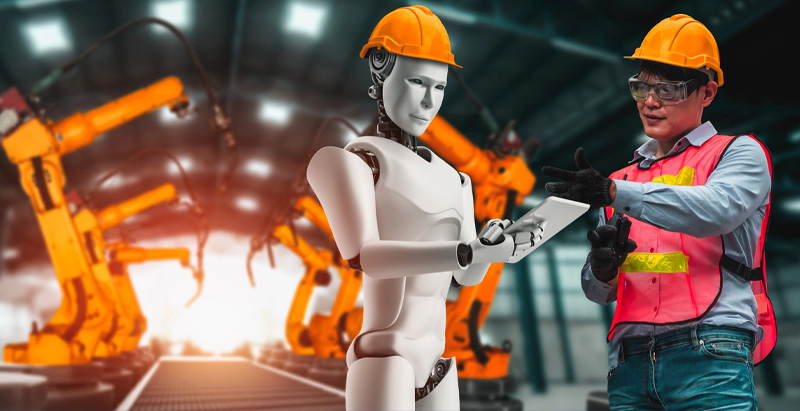
Manufacturing is entering a bold new era, driven not just by robots and automation but also by artificial intelligence. According to Forbes, thanks to years of digital transformation, factories already have a strong infrastructure to scale AI fast. As Assembly Magazine notes, the National Association of Manufacturers (NAM) is spotlighting AI’s vast potential for manufacturers to boost assets across efficiency, safety, and innovation.
This isn’t hype. NAM surveys show real impact:
- 75% of manufacturers report reduced costs and improved efficiency after deploying AI.
- Roughly 50% cite better operational visibility and responsiveness.
- And 41% say process optimization has improved thanks to AI.
These gains translate directly, AI-powered scheduling and predictive maintenance reduce downtime. Quality control vision systems detect defects invisible to the naked eye. And intelligent logistics systems align inventory to demand.
Despite the promise, scaling AI isn’t plug-and-play. According to Forbes, manufacturers still wrestle with fragmented legacy data and disconnected IT systems—struggles that mirror the early Industry 4.0 rollout. A Deloitte survey reinforces this: 70% of manufacturers say poor data quality, contextualization, and validation are top barriers.
To overcome that, 78% of manufacturers are embedding AI within broader digital transformation plans. Three-quarters have upped investment in data lifecycle management to support those AI ambitions.
AI doesn’t run itself. Assembly Magazine emphasizes that AI tools often feel like “a black box”, making operators, security experts, and data scientists critical for unpacking IQ behind the inputs and outputs. Without skilled staff, AI remains locked in pilot mode.
NAM champions this human-AI story, too. Companies like Johnson & Johnson, Schneider Electric, and Hitachi are already experimenting, and NAM calls on policymakers to support their efforts with solid data privacy laws, investments in workforce education, and reasoned regulation. “All possible futures for modern manufacturing in the U.S. involve AI,” says Kathy Wengel from Johnson & Johnson.
Forbes highlights generative AI and digital twins as the next frontier. Virtual replicas of machinery simulate design changes or performance tweaks before committing to real-world builds. Engineers are also deploying large language models for design prompts and rapid prototyping—a leap beyond traditional CAD tools.
Market data backs this momentum: the global AI-in-manufacturing market is projected to surge from $7.09 billion in 2025 to $47.9 billion by 2032.
Deloitte adds that 55% of industrial manufacturers are already using generative AI, and over 40% plan more AI investment in the coming three years. Still, only 51.6% actually have a formal corporate AI strategy, leaving room for structured planning and governance.
Concrete Use Cases
- Predictive maintenance: AI models forecast machine wear and schedule repairs before breakdowns.
- Quality inspection: Computer vision catches faults faster and more reliably than humans.
- Supply chain forecasting: Algorithms predict demand and optimize delivery to reduce waste.
- Employee training & experience: AI-powered simulations and talent planning tools reallocate workers to match production needs.
- Generative design & digital twins: Engineers run virtual tests, catch flaws early, and test scenarios without spending on physical prototypes.
NAM suggests that generational success relies on four pillars:
- Workforce development – train operators to support AI systems.
- Data privacy & clarity – federal guidelines to protect individuals and businesses.
- Risk-based regulations – tailor legal frameworks to real-world AI use cases.
- Global alignment – consistent standards to reduce compliance friction.
Forbes highlights similar themes: data infrastructure, human-machine collaboration, and moving beyond “experimental” AI to full integration across operations.
If manufacturers crack the code on data, strategy, and workforce integration, the future is clear: AI-infused shop floors where humans and machines collaborate in real time.
- Efficiency will rise.
- Quality will improve.
- Safety will become smarter.
- Promotion paths in manufacturing roles will expand.
- Businesses will be more agile, especially when navigating global market disruptions.
NAM and Forbes agree: AI in manufacturing isn’t a flash-in-the-pan trend. It’s a fundamental shift, with measurable ROI and transformative potential across the value chain. Those who integrate AI responsibly, grounded in strategy, training, and infrastructure, will build faster, smarter, safer, and more resilient factories.
AI is not the future of manufacturing, it’s the now. With three-quarters of manufacturers already seeing benefits, nearly 80% weaving AI into broader digital plans, and generative and predictive AI mounting fast, the time to act is now. Those who master the data, people, and policy essentials today will shape the smart factories of tomorrow.
 Spotify
 Apple Podcasts
 Podbean
 YouTube