TRANSCRIPT
Amy Nicklaus (00:01.87)
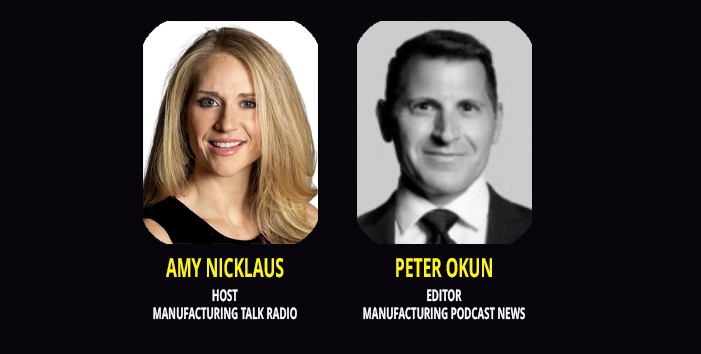
Hi, I’m Amy Nicklaus and this is Manufacturing Talk Radio News. And today we are gonna go over our Manufacturing Talk Radio News 2026 Pulse with our editor, giving insights into the trends, stories and what’s ahead. So Peter, can you start by telling us a little bit about your role as editor of Manufacturing Podcast News and what drew you to this industry?
Peter (00:25.508)
Sure, hi Amy. Again, my name is Peter, Peter Oken and…
As editor of manufacturing podcast news, my role is really about listening at scale. I’ve spent a significant amount of time each week listening to manufacturing podcasts, paying attention to episode themes, guest backgrounds, and especially the recurring questions that arise across different conversations. When leaders from various sectors start asking the same questions, that’s usually a sign the industry is shifting in a meaningful way.
me to manufacturing is how grounded and honest the industry is. This isn’t a space driven by hype. Its ideas don’t live on slides or strategy decks for very long. They eventually have to work on the shop floor with real people, machines, and constraints.
Early on, I remember listening to a plant manager describe how a simple scheduling change freed up several hours of capacity every week. It wasn’t flashy, but it worked. And that kind of practicality really hooked me. Manufacturing also sits at the intersection of technology, labor supplies, and policy. So when you cover manufacturing, you’re really covering how the economy functions in the real world. Decisions made in offices or boardrooms eventually show up
on the plant floor and that connection makes this industry especially important and relevant to cover thoroughly.
Amy Nicklaus (01:56.488)
wow, okay great. So did you originally come from a manufacturing background?
Peter (02:01.782)
Not directly, and I actually see that as a strength. So I approach the industry as a listener and translator. I tend to ask the questions that busy manufacturing leaders don’t always have time to set back and ask themselves. So several years ago, I worked at a state manufacturing extension program, an MEP, and this afforded me the ability to conceptualize and learn and speak with manufacturers. And I wrote the initial MEPs quarterly industry report
Amy Nicklaus (02:05.367)
Ugh.
Amy Nicklaus (02:16.268)
Yeah.
Peter (02:31.706)
and Manufacturing Matters magazine and I worked with manufacturers to get this information and listen to them and relay important information that needed to be in these reports and magazines.
Amy Nicklaus (02:44.962)
Amazing, well that’s quite the resume. And now we’re very happy that you’re with Manufacturing Talk Radio Podcast News. So what have been some of the key stories? I mean, you’ve written so many great articles. I read them all the time, obviously. But what do you feel like some of the key stories or articles are that you’ve written about over the months that we’re leading into 2026?
Peter (02:48.322)
Yes.
Peter (03:08.228)
Sure. So over the past several months, a few storylines to me have really stood out. And one of the biggest has been the shift in how manufacturers are approaching AI. AI sounds scary. In some cases it is. We’ve covered many conversations where leaders… We’ve covered many conversations where…
Amy Nicklaus (03:22.126)
Say it like that.
Peter (03:29.048)
leaders were very candid about early AI pilots not delivering much value. But instead of abandoning AI, most refined their approach, which is what everyone needs to do nowadays. So what we found is roughly 60 % of manufacturing using AI in 25 said they plan to expand it in 26, but only in areas with a clear measurable ROI, like predictive maintenance, quality inspection, production scheduling, and quoting.
Amy Nicklaus (03:34.594)
Yeah.
Amy Nicklaus (03:49.986)
Wow.
Peter (03:58.934)
Another major theme that we’ve seen coming up more and more again has been reshoring. So while reshoring is still part of a long-term planning, manufacturers are being so much more selective. And one survey that we referenced in one of the articles showed that over 70 % of manufacturers are now qualifying secondary suppliers. So up from under 50 % just two years ago, that reflects maturity and not fear.
Amy Nicklaus (04:27.822)
Yeah.
Peter (04:28.838)
exclusively about workforce retention. Replacing a skilled manufacturing worker can cost 100 to 150 % more of their annual salary when you account for recruiting, training, and unfortunately lost productivity. So that statistic has helped many leaders reframe training and leadership development as strategic investments rather than overhead.
Amy Nicklaus (04:52.812)
Yeah, I know we’re going to get into the skills gap and retention again later on, but because I do have a lot more questions about that. But out of the topics that we just that you just mentioned, what topics do you think generated the strongest response from our readers?
Peter (04:56.516)
Thank
Peter (05:00.228)
Sure.
Peter (05:08.994)
So I would say workforce issues by far. Everyone is feeling it and leaders are hungry for solutions that work in the real world.
Amy Nicklaus (05:13.304)
Okay.
Amy Nicklaus (05:19.308)
Okay, so you, I mean, you’ve got your pulse on everything as you’re writing about all this stuff all the time. But from your perspective, what’s like the overall pulse in the right now in early 2026? Obviously, you know, that was 2025, which is the leader into this, right? But now as we’re looking forward, what are people feeling? What are they seeing? What are you thinking with the pulses looking like?
Peter (05:24.27)
Mm-hmm.
Peter (05:43.938)
So the pulse right now feels like cautious confidence.
Amy Nicklaus (05:48.334)
Okay.
Peter (05:48.632)
So manufacturers have largely accepted that volatility is the norm. They’re no longer waiting for things to settle down. What’s changed compared to last year is preparedness. Nearly two thirds of manufacturers say they feel more prepared for disruption than they did a year ago. And even though economic and geopolitical pressures are still there, I’ve noticed a shift in leadership language. Instead of asking when things will return to normal, leaders are asking
how quickly their organizations can adapt. That shift moves companies away from reactive decision making and toward building long-term capability.
Amy Nicklaus (06:30.446)
So is that optimism or realism?
Peter (06:33.028)
I’d say it’s realism. Manufacturers aren’t expecting good news, unfortunately. They’re building the ability to respond quickly when conditions change.
Amy Nicklaus (06:39.671)
Amy Nicklaus (06:43.692)
Yeah, that’s, fortunately, I think that’s very true. So we’ve seen a ton of ongoing discussions around supply chain resilience. How are manufacturers adapting to that this year?
Peter (06:59.244)
So supply chain conversations are still happening daily, but the definition of resilience has changed. Early on.
Resilience meant redundancy, which is expensive and hard to sustain. Today, resilience is more about visibility and responsiveness. We’ve covered manufacturers who improve supplier visibility and reduce disruption response times by nearly 30%. And that doesn’t prevent problems, but it gives teams time to react intelligently.
Another shift is toward relationship-based supply chains. Manufacturers who treat suppliers as partners rather than interchangeable vendors tend to recover faster because communication and trust already exists when something goes wrong.
Amy Nicklaus (07:49.113)
So is that affordable for a smaller manufacturer? Like is that something that kind of goes across the board or can you speak a little bit more to that?
Peter (07:59.822)
Sure, so yes, and only if it’s targeted. You don’t need perfection everywhere. You need clarity where failure would hurt the most.
Amy Nicklaus (08:10.072)
Okay. So we mentioned AI before. So technology, which is a hot button for everybody right now. Technology like AI and automation, it’s evolved so much, it’s obviously continuing to evolve. What role is AI playing in 2026 within the manufacturing industry?
Peter (08:16.856)
Yes.
Peter (08:24.548)
you
Peter (08:34.2)
The conversation around AI and automation in 26 is, I feel, much more grounded. We’ve covered real world examples where AI-driven predictive maintenance reduced unplanned downtime by 15 to 20%. That matters because downtime directly affects throughput, delivery, and profitability. Automation is also being reframed. Instead of replacing people, manufacturers are using it to stabilize
operations and reduce burnout. One plant leader that I had spoken with shared that automation gave experienced workers time to mentor new hires instead of constantly firefighting and that human benefit is often overlooked.
Amy Nicklaus (09:19.666)
Are workers though still concerned about automation because I feel like there’s still that underlying concern. Are you seeing that workers are still concerned about that?
Peter (09:28.682)
I am and they are when communication is poor. When automation is positioned as support rather than replacement, acceptance goes up dramatically.
Amy Nicklaus (09:39.893)
Well, I mean, that makes sense. makes sense. Communication is key. That’s what they say. So, okay, so next question. So labor and workforce issues are obviously hot topics. How do you feel that those might be unfolding in 2026?
Peter (09:41.486)
Yeah. Absolutely. Community Commission is key.
Peter (09:51.31)
Mm-hmm.
Peter (09:59.084)
So this is one of those that are still one of the most emotional and complex challenges in manufacturing.
The skill gap hasn’t disappeared and it’s not going to disappear for quite a while, if ever, to some degree. But responses have matured. Many manufacturers have stopped waiting for perfect candidates and started building talent internally. Structured training programs are delivering results with 20 to 30 % improvements in retention. And beyond training, culture has become a bigger focus. Respect, predictability, and clear growth paths matter just as much
Amy Nicklaus (10:29.601)
Okay, that’s good.
Peter (10:37.804)
as compensation. Manufacturers who generally listen to their workforce tend to adapt faster and retain people longer.
Amy Nicklaus (10:47.95)
So is remote work a viable option? Is that something that’s realistic in manufacturing?
Peter (10:55.936)
not on the shop floor, but flexibility in scheduling, training, and leadership roles still makes a meaningful difference. You got the shop floor, you still need to be there.
Amy Nicklaus (11:08.162)
Yeah, mean, that seems to make the most sense to me, but you know, okay, great. I mean, I’m a big believer in you gotta show up. So you gotta show up. I mean, I feel like that’s gonna be a big shift and you know, skills gap to learn the skill, you kind of have to follow.
Peter (11:11.906)
Yes, absolutely.
You gotta show up in manufacturing.
Peter (11:27.844)
You gotta be there. You gotta do it. It’s all about being hands on.
Amy Nicklaus (11:31.82)
Yeah. So a big word that we’re hearing a lot of is sustainability. So sustainability, green manufacturing, it seems to be gaining a tremendous amount of momentum. What are you seeing in that space?
Peter (11:39.652)
Mm-hmm.
Peter (11:51.268)
So sustainability has become a practical business conversation. In recent coverage, sustainability is tied to cost control, compliance, and customer expectations. We highlighted a manufacturer that reduced energy consumption by 18 % in under a year through process optimization alone.
when sustainability efforts lower costs and improve efficiency, they stop being ideological and become part of an operational excellence.
Amy Nicklaus (12:24.078)
Okay, is this driven, do you think more by regulation or by the actual end customer?
Peter (12:30.724)
Good question. So I would say both and it’s energy costs. So when savings show up on the balance sheet, alignment will follow quickly.
Amy Nicklaus (12:41.998)
All right, so let’s talk about some of the upcoming topics that we can, advice maybe you have for us. Looking ahead, what emerging topics would you be covering next?
Peter (12:55.822)
So we’re focusing, we’re still gonna continue to focus on small and mid-size manufacturers adopting digital tools without over complicating operations. So companies under 500 million in revenue often move faster because they’re closer to the work. We’re also paying more attention to cybersecurity on the shop floor. Cybersecurity has been a hot topic for a long time and
with all the cyber attacks that have been happening. And as equipment becomes more connected, exposure increases, many manufacturers are only beginning to address that risk. You have some manufacturers that are deep into it, but a lot of them, some of them don’t know where to start. Some of them are in the middle of it. So there’s a lot to do there and a lot to discuss and research.
Amy Nicklaus (13:51.182)
like it. So why focus just out of curiosity so much on mid-size manufacturers?
Peter (13:56.482)
So they’re often overlooked, they still are agile and practical. Innovation tends to be faster and more grounded with mid-size manufacturers. So there’s still a lot to gather on that side.
Amy Nicklaus (14:12.302)
Okay, that makes a lot of sense. So this is a question that I think everybody has as we all watch the news and we see what’s happening in the world. How is that gonna affect us as the, within manufacturing, how is it gonna affect the consumer? So how do you think global events?
This is a very, I’m going to make this a general question so we don’t have to get too specific, but how might global events you think influence manufacturing for the rest of this year in 2026?
Peter (14:35.437)
Sure.
Peter (14:44.834)
I think global uncertainty is going to continue to shape strategy. It’s going to play a big piece.
of what’s happening with manufacturers. So one survey that we referenced showed 65 % of manufacturers are building contingency plans tied to trade policy and economic shifts. So instead of reacting to headlines, companies are planning for volatility as the baseline. That’s the world that we live in, and that’s what manufacturers need to do.
Amy Nicklaus (15:23.95)
And so how would you, I mean, if you’re a manufacturer, how do you think it would be best to plan without really knowing what’s coming? It’s hard to make plans and you don’t know what’s gonna turn on tomorrow.
Peter (15:35.8)
Sure, no, I totally understand that. I think by building flexible strategies instead of betting everything on a single outcome, that’s going to be the way that manufacturers need to go. They’re going to need to be flexible, just like all companies in business today need to be flexible with their strategies because all these changes are going to be coming up fast, quickly, and you need to be able to adapt to it in order to stay in business.
So it’s all about flexibility.
Amy Nicklaus (16:08.75)
Yeah, absolutely. All right, so based on all of your conversations with industry leaders, which you have on a regular basis, we talk about it, you always have something interesting that you bring back that you’ve had a great conversation. So, but based on those, what advice do you think you would give manufacturers today for this year? What would you be like, hey, here’s some advice for you guys for this year?
Peter (16:13.496)
Mm-hmm.
Peter (16:30.434)
So my advice would be focus on what you can control.
So process, discipline, communication, and talent development consistently separate strong performers from struggling ones. So one executive summed it up very well when they said, we stopped chasing certainty and started building resilience. So if you focus on what you can control and put
what you need to into those different areas, you’re going to become more successful. That would be my advice.
Amy Nicklaus (17:09.326)
I feel like that’s good advice for life. right, so I mean, that sounds like a great idea. So what are one of the biggest mistakes you’ve seen a lot of these companies make?
Peter (17:12.342)
Yeah, it actually is.
Peter (17:24.868)
I would say chasing every trend instead of executing a few priorities really well. So trends are just like the word trends. They come and go. It doesn’t necessarily mean that the trend is good and that you need to follow it. It could be a trend that’s happening because of another reason. You need to execute.
a few priorities really well. Don’t focus on every trend because they might not be pertinent to you, but you should know about them. But if you execute a few priorities really well, that’s going to help set you apart and it’s going to prevent you from making mistakes.
Amy Nicklaus (18:13.23)
Yeah, mean, that makes a amount of sense. But are there any specific under-the-radar stories you can tell us about that maybe deserve a little bit more attention from our readers?
Peter (18:25.294)
short.
To stand out, first is knowledge capture. Studies suggest that nearly 40 % of manufacturing expertise could be lost within five years if companies don’t act intentionally. And yeah, that’s a large percentage. And documenting processes and mentoring matter more than ever. document everything, document the processes, and just stay on
top of thing. Always increase your knowledge of what’s out there. If you have a process that’s working, document it. If you have a process that’s not working, document it so you know that you’ve tried it and you know where you need to go from there. Second is frontline leadership development.
Manufacturing or manufacturers specifically investing in supervisors are seeing improvements in safety, morale and productivity. It’s not flashy work by any means, but it creates a strong foundation. And that’s extremely important. The supervisors play a very big role. And as any business owner,
Amy Nicklaus (19:24.174)
Okay.
Peter (19:40.036)
president or CEO of a company would say safety, morale and productivity are three of the biggest things that are going to make a company successful. And it’s something that we’re going to focus more on too.
Amy Nicklaus (19:55.309)
I I think that those are all great. know how wonderful your articles are that you’re writing. They’re so informative. We get such wonderful feedback from everybody. So yeah, absolutely. So I think we’re going to continue. I’d love to have you back on a monthly basis. Maybe you can give us the inside scoop as to what you’re seeing, because you, again, really have your pulse on everything.
Peter (20:04.014)
Thank you. That’s great to hear.
Peter (20:17.529)
Mm-hmm.
Amy Nicklaus (20:19.554)
You just get to talk to so many industry leaders. So this is great for us and for our readers. And if you’d like to read more about all of these amazing articles, the insights that Peter is writing about, you can go to manufacturingtalkradio.com or you can listen to the podcast, obviously. But lots of great news on the website. Peter, we really appreciate all that you do.
Peter (20:43.868)
I thank you for having me on here, Amy. It’s always great working with you and with Lew and all the guests. you know, there’s a lot, as Amy said, there’s going to be a lot more news coming as the industry continues to grow and change. So again, visit Manufacturing Talk Radio’s website.
click on the news tab and read up. There’s a lot of great past episodes. We’re gonna have many more great episodes coming up that are gonna touch on many of these topics that we talked about and stay tuned. It’s only going up from here.
Amy Nicklaus (21:18.946)
us.
Amy Nicklaus (21:28.206)
That’s right, that’s right. All right, Peter, we’ll talk to you soon. We’ll see you on next month in February to get more of what’s happening. And thanks so much for listening. Okay, bye-bye.
Peter (21:38.916)
It’s my pleasure, thanks again, Amy. Bye.
 Spotify
 Apple Podcasts
 Podbean
 YouTube