TRANSCRIPT
Speaker 1 (00:00):
Welcome to Manufacturing Talk Radio, your Everything manufacturing podcast with host and veteran manufacturing industry expert Lewis Weiss and co-host Amy Nicklaus. Make sure to check out our catalog of 800 previous shows on YouTube, Spotify, or wherever you’re listening. Now, let’s get into the episode.
Speaker 2 (00:28):
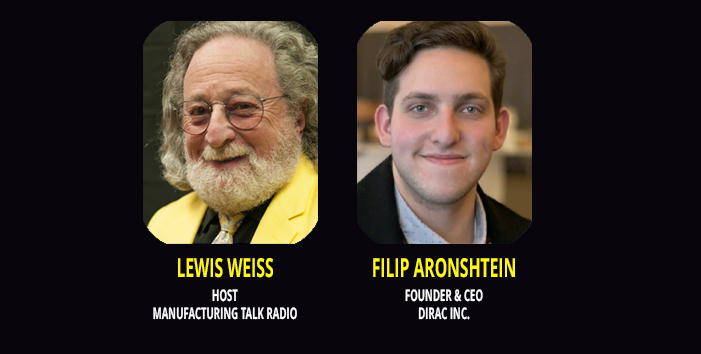
Good afternoon everyone. This is Lew Weiss from Manufacturing Talk Radio and I welcome all of you to our show. This is now our 1020 first show. We’ll have a great conversation with Phil Aine, who’s the founder and CEO of Iraq. They’re located in the Empire State Building. We’re here to tell the story and Phil is going to tell us a story about his company.
Speaker 3 (01:00):
Thank you for having me. Really excited to be here. Would love to tell you a little bit more about myself, about the company, how we kind of got here. A little bit about myself. My background’s originally in electrical engineering and robotics. I spent a little bit of time over North Grumman, got TS clearance, worked on some pretty cool radar stuff over there. When they ran out of electrical engineering work to give me me, they gave me some mechanical engineering work to do and when they ran out of mechanical engineer to give me, they gave me some technician work. So I did a little bit of assembly work, a little bit of tests, and just got to see how unfortunately archaic a lot of the infrastructure was on the manufacturing side of things. To me, it seemed like a pretty advanced company on the engineering side and want to do something about that. I was more broadly getting the feeling that the west was forgetting how to build great things and I want to make sure that didn’t happen. So I got my best friend and co-founder, Peter, and we set out to go build direct.
Speaker 2 (01:48):
Okay,
Speaker 3 (01:48):
So
Speaker 2 (01:49):
Bottom line is that you’re a software company, makes workflow instructions easier, quicker, and more efficient.
Speaker 3 (02:01):
That’s right. We built out what we call the first automated work instruction platform. So our software will take a CAD file as an input, it’ll run an assembly physics simulation that will pull it apart, figure out what order to do all the assembly in automatically and then generate 80 to 90% of your assembly work instruction for a manufacturing engineer at a facility. Normally this takes weeks or months super manual. Oftentimes you might not even end up doing a work instruction just because it’s so tedious and awful to do. And so the process of that today is a manufacturing engineer getting a CAD file over email manually figuring out how to do all the assembly, what order to do all the assembly in, taking hundreds of screenshots, and then throwing all those screenshots into a several hundred page PowerPoint or Word doc over the course of weeks or months. And so with our software, instead of it taking weeks or months, it takes you a couple minutes, couple hours, couple days tops, and it’s radical quality of life improvement for folks on the shop floor.
Speaker 2 (02:56):
So is there much training involved required for particularly the operator on the manufacturing floor?
Speaker 3 (03:05):
So to use our software, no. But today, I mean the amount of effort that it normally takes to trade operators is usually pretty high and there’s generally pretty high turnover rates at manufacturing facilities. It’s very hard to hire increasingly getting harder to hire a skilled labor. And so what we found with the folks that we work with is because we have this animated automated work construction, it actually really reduces the training requirements for new operators to get trained up on a line. And so we actually help companies unlock the ability to hire less skilled labor too. It makes it a lot easier for ’em to hire and also super, super easy and fast to trade up folks on a new production line. And then to use our software, it’s super, super easy. I mean it’s a couple of buttons. Everybody on our team comes from hardware backgrounds and just pivot their careers in software. And so we don’t have a single computer science degree on our team. It’s all folks with mechanical engineering degrees or electrical engineering degrees who have been in production environments, who know what it’s like to work with operators who understand the production environment. And that’s how we built our software, just deeply, deeply aware of what it’s like to work as a manufacturer. So we built something to specifically improve their quality of life. So training’s pretty easy
Speaker 2 (04:16):
To create a automated workflow instruction for a particular task compared to doing it the old fashioned way.
Speaker 3 (04:27):
What’s
Speaker 2 (04:28):
The time saving factor?
Speaker 3 (04:30):
Oh, funny enough, we see typically at least 95% time reduction. So a couple of anecdotes, a work instruction that would’ve taken somebody four days prior. We’ve had customers say that it took them an hour. Today we’ve seen a work instruction that would take somebody a month come down to two or three days for sufficiently large work constructions. We’re pretty vertical agnostic. We work with folks in aerospace, defense, automotive, ag and construction, machinery, maritime, any sort of complex industrial machinery. We’ve actually had folks with sufficiently a large enough complex enough assembly where they’ve never been able to make a work construction for a top level piece of ag equipment equip. We have enabled them to actually make a work structure for the first time for the thing. And so that’s been pretty game changing folks. It’s a whole new unlock for them. It’s been pretty cool to see. For
Speaker 2 (05:19):
The benefit of our listeners, what is a likely era to occur? At what rate?
Speaker 3 (05:28):
Ooh, well an interesting one is oftentimes you’re thinking about hardware, you’re thinking about literally nuts and bolts, right? Think about fasteners, hundreds of fasteners on a system, potentially thousands of fasteners on a system and to just forget one or two fasteners is a potentially catastrophic issue for a build. And that happens pretty frequently. I would say scrap rates for some of the companies that we are working with around like 20, 30% where we drove them down significantly lower. Mainly because if you’re working on a really large build, you might forget to add a couple of bolts here and there, especially if your work instructions are not very detailed, especially if you’re not tracking anything. And so it’s forgetting parts, it’s forgetting how to assemble a part correctly if you don’t have a work instruction. It’s inconsistent application of best practices across different builds and so lot it’s really just an enormous amount of tribal knowledge.
(06:19):
It’s powering a lot of American manufacturing facilities and a lot of what we’re trying to do is get that on paper, get that codified, get that structured so that you can actually distribute it across your whole manufacturing team and keep it consistent. And because we have a lot of auto associative framework stuff, if you recognize a bolt, whenever we see that bolt, let’s say you add a torque spec to it, we automatically associate the two. And whenever you see that bolt again in any other upload of any other assembly and in the same assembly that you’re working with, we’ll automatically pull in that torque spec. So that’s why we very much call it an 80 20 tool. It’s not 100% fully automated. We figure out the sequence for you generate all the animations in this 3D environment automatically too. But then tribal knowledge type of stuff that you can’t get from a CAD file like grease this or lock type that or to this bolt of this specific spec, we allow manufacturing engineer to add it and then end up serving as this tribal knowledge retention and distribution mechanism for manufacturing team. So that’s been another pretty big game changer
Speaker 2 (07:16):
In the scenario where you have multiple location manufacturing company, a plant in Chicago and Minneapolis and Los Angeles, and they all make the same parts. Is there any problem with that?
Speaker 3 (07:33):
Not really. Funny enough, this happens to us all the time. This is a pretty common occurrence for us. For the most part. You still want to maintain the same top level standards, but you might have a different tool that you use for a different step or different part. But if you’re trying to keep consistent production, the same bolt here versus the same bolt there, you’re still going to want to have the same torque spec. You might have a different tool, you might have built a different fixture, but because we have allowed the ability to hide and do local versus global requirements and flip those on and off, we found that you can actually with our revision infrastructure, create a rev of an instruction and have it sort of branch out and diverge for different manufacturing facilities. You can have slight variance of it. So no, it’s been pretty straightforward for folks that have multiple facilities that make the same.
Speaker 2 (08:17):
So many listeners might be curious as to how the software is sold, leased or purchased. What’s
Speaker 3 (08:30):
Your model? So we like to think of ourselves as what CAD software did for mechanical engineers. On the design side, we have done for manufacturing engineers, right? It’s the first tool, the first automated work construction. Really the first thing to actually care about manufacturing engineers, which we very deeply do. And so that being said, cats off was something that people pretty well understand how to buy. You buy it per seat per year. Historically it’s been like a license plus maintenance fee structure, but for us, because our software is, we actually charge per seat per year. So just an annual subscription, really simple, really straightforward. We have two different types of seats. We have a drafting seat for engineers to make the work instructions and then we have a operator viewer seat. We’ve just recently actually released Operator Plus. That’s a seat that allows an operator to instance a run of an assembly.
(09:20):
It automatically tracks a time study in the background and then allows an operator to give feedback back to the manufacturing engineer who drafted that work construction. They can record error error codes, they can record improvements and suggestions for the work instruction because oftentimes there’s an enormous amount of context that operators have about how to do a build better and they never get that back to manufacturing engineers to codify that or turn that into a work instruction. And that is what we want to enable. We want to enable a really tight feedback loop between manufacturing engineers and operators so they can actually improve upon and drive context earlier into the design process as well.
Speaker 2 (09:55):
I would imagine that the operators are pleased with the unlined as to what your software will generate in terms of efficiencies and errors, so on.
Speaker 3 (10:09):
I would definitely say so. It’s one of those funny pieces of software where the majority for the past 20 years of software getting into manufacturing has been some Stanford kid comes out of school and it does a company and then tries to convince C-Suite to buy some piece of software. And it’s very much like it takes a manual pen and paperwork flow. And now with that software, it’s manual, but it syncs with the cloud. Cool. And so historically software that’s sold to manufacturing teams has not ever really actually improved quality life for the guys actually doing the work like operators and manufacturing engineers. And what we found is we are sort of like that 1% a case where what we’re actually trying to go for is actually radically improving quality of life for the guys doing the work for operators and for manufacturing engineers. And so we found that oftentimes some of our biggest champions for expanding inside of facility are the operators, right?
(11:05):
Not only it’s easier instructions to follow, everybody’s using 2D printed out pieces of paper or photos that don’t really have a ton of context. And so what we’ve been able to basically be is we like to say a picture’s worth a thousand words, but an animation’s worth a million, right? So an operator giving the operator the ability to have the same level of CAD file that the folks on the design team have, the mechanical engineers to be able to rotate the model around and see the parts coming in in real time in front of them radically makes it easier to do their job and really improves the quad. So there’s fewer questions, fewer abilities or less of a chance that they’ll end up misunderstanding instructions. And so it’s been really great. Operators really, really love the software.
Speaker 2 (11:46):
Again, going back to the case of multiple locations or multiple shifts within the same manufacturing footprint, is there any slips between morning shift and night shift?
Speaker 3 (12:00):
Not that we’ve seen. Not that we’ve heard. What’s pretty cool about the software, especially on the operator plus side, is we can actually let an operator semi complete they run, they can put it down and then another operator can actually pick up where they left off. And we track both of that. So you can actually see maybe Joe did steps one through five and then Paul picks it up and does steps six through 12 on his shift. So you can have these semi completed work in progress builds be picked up by different operators, but because they’re all standardizing how they build on a single source of truth, you end up having that context be preserved too.
Speaker 2 (12:36):
Taking into account that the operator really is your end use customer
Speaker 3 (12:42):
And the manufacturer engineer too or mostly. Yeah.
Speaker 2 (12:45):
So my point being, have you learned anything to enhance your softwares through the conversations and feedback that you got from operators?
Speaker 3 (12:56):
Oh, absolutely. I mean, we love spending time with operators and manufacturing engineers. I mean we spend a ton of time on site with folks. I find nothing more fun and more rewarding honestly going on site with folks and not only showing them the software but getting it tour their facility and talking to them about what is their quality of life like today, what are they doing today? There’s no better person to learn from than the guy actually using the software, doing the work, right? There has been a bunch of new features that we built because we just build really, really close relationships with the guys that we’re building for. I would say tons and tons of cool features have come out of working with operators. And then I mean throughout the entire process of building the software, I mean we’ve been working really, really closely with manufacturing engineers on we’ve hardened North Star metric is time to draft a work construction and number of clicks that you have to do to actually finish that work instruction. What is the best feature that we can build for you? And so it’s always an open dialogue. It’s always an open conversation. I mean that’s what makes us, I think special. That’s I think why we’re going to win. We spend so, so much time guys that we build. You
Speaker 2 (14:02):
Have a lot of clients, what have you gained from the client themselves in terms of they like your product, they don’t like the product, they want to see some change in your product. So dealing with the company itself, what is your experience in terms of satisfaction in ROI?
Speaker 3 (14:23):
In terms of ROI, A lot of what we like to do is just upfront when we start working with the company, we like to figure out what are the key ROI metrics that you care about? Is it that you don’t have work instructions? Is it that your work instructions take forever to draft? Is it that 50% of your manufacturing engineers days fed making work instructions and they hate it? And so time to draft work instructions we’ve reduced for folks. That’s a lot of the key metrics that we end up going for. Reduce scrap rate, reduce time to build. Crazy enough, we’ve actually helped folks get products to market faster and be more competitive in their builds. So another piece of this is pretty cool. We’ve actually in a bunch of different cases now, we’ve had a company say, Hey, we are bidding on this contract. Can we use your software and advertise your software as a reason for us to be a more competitive bid on this contract? So that’s happened a couple of times for us in aerospace defense and then for a couple of tier one suppliers included us in their proposals as a reason for why they are going to be a more competitive bid and we’ve actually helped them win contracts. So that’s been really, really cool as well.
Speaker 2 (15:25):
Got it, got it. So what is the long-term plans or goals and improvement to the software?
Speaker 3 (15:34):
So today the main person that we are building a tool for is a manufacturing engineer. Manufacturing engineer makes a work construction operator consumes and uses it. We think that every piece of information in a manufacturing facility is one node in a very, very deeply interconnected graph. There are a lot of different people that care about different pieces of context across a manufacturing facility. It’s not just manufacturing engineers, right? You’ve got folks caring about maintenance repair, you’ve got industrial engineers laying out lines. And so a lot of what we’ll end up extending out into, whether it’s products or modules, will be us basically going from being a point solution for automating work instructions to a what we call context aware production planning platform. And that’s us building out a tool set and suite for industrial engineers. That’s us giving an automated factory layout planner tool to them.
(16:24):
This is us getting earlier into DFM. A lot of the simulation under the hood allows us to check for assimil ability and do flash detection as we’ve already started developing features in that vein. So us getting into DFM to drive value from manufacturing earlier into the design process by dragging all that context earlier within the context of the CAD file and us getting into automated maintenance repair instructions, we think that if you can automatically assemble a system, it’s pretty easily to generate the assembly, the disassembly instructions as well. So that’s a lot of where the next couple of years are going to take us. It’s broadly expanding out to deeply interconnecting everybody in a manufacturing facility. I like to use the analog of three blind men and an elephant different piece of context that every blind man has, but really what they’re feeling around is an elephant and I think that the factory is the elephant, right? We want to build more lenses for all these folks. It’s kind of our perspective. That’s our plan.
Speaker 2 (17:19):
Give us an example, and I don’t have a problem with you naming names. Give me an example of some radically improvement in a certain manufacturing environment.
Speaker 3 (17:33):
I would love to give you the example. I can give you two really cool ones. We’ve done two case studies pretty recently. One of them is with a company that is called an IS awesome company. They’re a tier one supplier to a bunch of aerospace and defense companies. They make 60% of all of the cargo loading mechanisms on all the planes in So big deal, really, really cool company. And we help them generate their work constructions 95% faster actually. It’s pretty crazy stuff. Another example is Sputnik. We love these guys. Sputnik, they make potato harvest equipment over in Blackfoot, Idaho. Really, really great people and my God, they’re so smart and their operation is so ridiculously sophisticated. We helped them do a couple of different things. One of them was, we did a case study around this. There was an operator who has been at the facility for decades, super, super experienced and he was the only one who knew how to build this really, really complicated harvester and he’s planning in retire in a year and they said, oh boy, we’re going to have to write some of this down because he’s retiring and we’re not going to know how to build this thing.
(18:37):
So they said, okay, perfect use case for BUILD os. Let’s actually make a work construction for this thing. And then they actually had a bunch of newer hires, like 24, 25 year olds come in as operators and use our work instruction to actually assemble a thing and they were able to do it 33% faster. That was not even a thing we expected to happen. We just thought one set of instructions versus another. We helped them draft the instructions way faster and are able to make instructions for the thing. But they were actually able to do the build 33% faster than without it. It’s crazy. So that’s another really interesting statistic that wasn’t even in the cart, so we didn’t even think about that. But turns out with our software, because it’s 3D and animated and model based, it allows folks to actually not have to worry so much about, am I reading these instructions correctly? Am I interpreting this okay? And they’re able to do it 33% faster. That was pretty exciting.
Speaker 2 (19:30):
Before I forget, Phil, why don’t you give us the URL for your company and give us an email where absolutely for more information?
Speaker 3 (19:42):
Absolutely. The URL is dirac inc.com. It’s D-I-R-A-C-I-N c.com. So dirac inc.com. And my email is phil atrac inc.com, so F-I-L-D-I-R-A-C-I-N c.com. Shoot an email to me or shoot an email to contact at direct inc com. That’ll also get voted to me. It’s just an alias for my email.
Speaker 2 (20:07):
It brings us almost to the end. Do you have any further comments that you’d like to get in before we close the
Speaker 3 (20:14):
Gates? If you’re listening out there and you’re a manufacturer and you want to change the way that your team builds, if your work instructions are a massive hassle, you want to become more competitive. If you want to win, if you want to change the way America builds, please reach out. We’d love to work with you. We’re vertical agnostic. We work with folks that are OEMs, share with the police suppliers. We don’t care. We would love to work with you, so please reach out.
Speaker 2 (20:36):
Okay. It was very interesting and thank you for your time folks. Just remember that we are now broadcasting in manufacturing tele Radio 2.0. We’re relaunching. We’ve been quiet for a year due to life interrupting life, so we are now back. So keep this in mind. Awesome. Thanks Aton, to appreciate you having me. Thank you very much for being here.
Speaker 1 (21:10):
Thanks again for joining us on another episode of Manufacturing Talk Radio. This hosts Lewis Weiss and Amy Nicklaus. Before you head out, make sure to subscribe and leave us a review. For more information about the show and the manufacturing industry, head over to mfg talk radio.com. That’s M-F-G-T-A-L-K-R-A-D-I o.com.
 Spotify
 Apple Podcasts
 Podbean
 YouTube